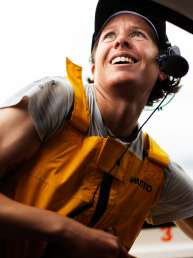
Thanks to Nike Vision, we explored the Venicemarathon, and running itself, through the eyes of Nicolò Petrin: a Venetian baker whose passion for long-distance running represents the culmination of a sporting journey pursued with extraordinary devotion
The Venicemarathon is a race unlike any other, its singular character distilled into the experience of running through the Queen of the Adriatic: a city suspended between sky and sea, within a lagoon that reveals as much as it conceals. An event as unconventional as it is evocative, epitomised by the temporary pontoon bridge along the Riva dei Sette Martiri, heralding the final stretch of its 42 kilometres. And, in its own way, by the sporting biography of Nicolò Petrin, a son of this corner of Italy and one of the most compelling figures in its running community.
Baker and runner. In that order. An amateur by definition, a professional in both dedication and achievement. Among Venice’s calli and canals, we traced the course of his running life, weaving his story into yet another chapter of an intensely personal pursuit of physical exertion. A passion rooted in family traditions and memories. In the instinctive desire to reconcile long nights at the bakery, governed by attentiveness and precision, with training sessions and races approached with the same meticulous care.
Together with Nike Vision, we gathered his visions, shaped by the Venicemarathon and his distinctly Venetian identity, allowing them to unfold into broader reflections on a discipline in which nothing is left to chance. A discipline whose underlying principles find a profound correspondence in the very philosophy of breadmaking. At the same time, we had the opportunity to explore another set of guiding principles, those shaping Nike Vision’s contemporary direction, as articulated by Head of Brand Comms Marco Frani.


Karate, football, cycling, running… Sport has been part of your life since childhood, taking you through a remarkably diverse range of disciplines. Looking back on that journey, what do you think first drew you towards physical activity and competition?
“Sport and physical activity have always been part of my life. They are my greatest passion. Fortunately, it’s a passion I now share with my partner. Every day, we make time for physical activity, without ever seeing it as a sacrifice or something we have to give up other things for. It’s simply something we love doing, something that makes us feel good. After training, we find ourselves approaching life with a greater sense of ease, with the energy we need to meet the demands of our working lives. I think I have an innate passion for physical exertion. It’s something I feel deep within me, almost like an instinctive calling. Of course, the effort is real, especially when you truly push yourself to the limit. But when it’s sustained by such a powerful passion, it somehow ceases to feel like a burden. Over time, competition has become another source of motivation. And it still is. It encourages you to improve, to stay focused, to always have something to strive towards. As a child, I looked up to athletes as though they were superheroes. On television, there were Batman and Superman, and then there were Schumacher and Del Piero. They were figures I identified with. Fortunately, my father was also always involved in sport and achieved some good results in running himself. I remember climbing onto podiums alongside him… I still have a photograph of myself when I was tiny, holding one of his trophies. Those memories of sport are incredibly precious to me, filled with emotions that have accompanied me since my earliest childhood and that I still carry with enormous affection.”
To what extent do you think your experience across so many different disciplines has contributed to the well-rounded athlete you are today? Do you notice any differences between yourself and runners whose sporting backgrounds have been less varied?
“I think it has helped me enormously, because every sport has something different to teach you. Karate, football, cycling… The three disciplines I practised most extensively before taking up running each taught me invaluable lessons, both technical and otherwise. When all those experiences come together, they also help shape a particular mindset, one that stays with you for the rest of your life, both in sport and in everyday life. I believe that this kind of cross-disciplinary experience can give you a broader perspective than you might develop by dedicating your entire life to a single sport. Cycling, for instance, gave me a thorough understanding of the nuances of endurance, and that education is probably what eventually drew me towards long-distance running. I discovered that I could be competitive over those distances. More generally, I obviously don’t have the flexibility of someone who comes from a gymnastics background, for example. But I still have the coordination I developed through karate and football, along with a whole range of less tangible qualities that have stayed with me over the years, particularly from cycling. Cycling and running are two entirely different sports, so making a direct comparison between them is difficult. Nevertheless, the physical conditioning I developed over years of cycling proved extremely valuable when I made the transition to running. And the same is true, perhaps to an even greater extent, of the mental side of things.”
As you mentioned, your introduction to running was rooted in a strong family tradition, particularly through the runs you shared with your father. What has this discipline meant to you throughout your life, and what does it continue to represent today?
“As I was saying, cycling was the last sport I practised, at a fairly competitive level, before dedicating myself entirely to running. That change was largely a matter of time. At a certain point, work and cycling simply became incompatible. To be genuinely competitive in cycling, you need to devote an enormous number of hours to training. With running, on the other hand, even an hour a day can provide a solid foundation. So, in part, the decision came out of necessity. At the same time, my father was a keen runner, and I often joined him. I’ve always regarded running as an extraordinary sport. And I had always run during the winter months as an alternative form of training for cycling. Had I not decided to leave cycling behind to become a baker, I would probably still be riding today. But starting work at the bakery led me to make what I considered the most sensible choice. As I mentioned, there was also a deep passion for running, undoubtedly inherited from my father. He always practised the sport, albeit at an amateur level. So there’s something very special about carrying on a family tradition. When I was little, I used to slip my feet into his running shoes, put on his long-sleeved cycling jerseys, wear his caps… My grandfather was also a great sports enthusiast. Everyone in my family has led a life connected to physical activity, whether competitively or otherwise. We all exercise, even if it’s simply going for a walk. My aunt, for example, was an Italian national high jump champion. My partner is now expecting a baby, and naturally, we hope the next generation will share that same passion.”


Your daily life is quite different from the conventional image of an athlete. Your days begin at three in the morning, at the bakery where you work, before continuing with rest and training. How have you managed to find a balance between these different aspects of your life?
“I think real sacrifices are something else entirely. Personally, I don’t feel I’ve made many sacrifices in my life. Naturally, work comes first, because I’m not a professional athlete: I’m an amateur. I don’t have any particular vices. In fact, I don’t really have any at all. My routine starts very early. After work, I get home around lunchtime, eat, sleep for a couple of hours, and then I’m ready to head out for training. Afterwards, I spend the evening with my family. That’s it. That’s my life. Of course, I also make time to enjoy myself, perhaps going out on a weekend evening… I had my share of wild moments when I was younger, but nowadays everything revolves around maintaining this balance. The only thing I regret is not being able to take part in more marathons abroad, precisely because of my work. Weekends are particularly demanding when you work in a bakery. In that respect, my commitments inevitably limit what I can do, but we’ll see what the future brings…”
Despite your dual identity as a baker and runner, what allows you to remain competitive against athletes who can devote considerably more time to running, often pursuing it as their sole profession, or something close to it?
“There’s certainly a small element of natural talent involved. Beyond that, I make sure I train properly at least six times a week… I give myself Saturdays off to rest and spend time with my partner, but the rest of the week still involves a genuine, consistent commitment. Looking back, I think losing taught me an enormous amount during my early years as a runner. I made plenty of mistakes, both tactically and technically. These days, I approach things much more thoughtfully. Pace is fundamental in running, of course, but in so many situations you also need to know how to manage your energy. I try to analyse every race from every possible angle. I enjoy identifying all those small details I can work on improving. I also listen carefully to my partner’s advice, as she’s a nutritionist. Together, we try to find the best solutions, always experimenting with something new. I also make an effort to keep up with technological developments, whether in footwear, clothing or accessories. Generally speaking, I try to leave nothing to chance.”
Working as a baker and competing as a runner both demand a particular relationship with time, the repetition of movements and discipline… Have you ever recognised any parallels between these two worlds?
“The main connection lies in leaving nothing to chance. If one plus one equals two, then that’s the result, and that’s the path you have to follow. I can’t simply decide to skip a training session one evening and then expect everything to go well on race day. Of course, in running, the outcome is less predictable, because sometimes your body has a mind of its own. But the fundamental similarity lies in daily dedication. You have to remain focused at all times. In the bakery, a momentary lapse in concentration, adding the wrong amount of yeast, for instance, can ruin everything. The same applies to the closing stages of a race, when you need to pay attention to every little detail. It’s a shared mindset. If I had to come up with the perfect recipe for a great performance? I’d say passion accounts for seventy per cent. Because if you lack the desire to go out, train and improve, all the talent in the world won’t be enough. Then comes talent itself. I see professional athletes who seemingly put in half the effort during training, yet perform in competition with an astonishing naturalness. The more effortless their movements appear, the more you realise you’re witnessing exceptional natural talent. And finally, I would obviously place training itself on an equal footing.”


Venice is a city the entire world comes to admire and explore. You, however, have come to know it in a rather unconventional way: through running. How has running transformed your perception of the city?
“You can return to Venice thousands of times and still discover something new every day. It’s such a fascinating city that every corner, every glimpse, has a story to tell. Experiencing it through running, whether during the Venicemarathon or the Venice Night Trail (which Nicolò has won multiple times, Ed.), is something truly magical. As a child, you first discover the city through school trips: museum visits, excursions to its most famous landmarks… As an adult, you begin to see it differently. And at night, you really come to appreciate its magic. The light changes, there are fewer tourists, and you can experience a unique sense of intimacy, even finding moments of complete silence. It’s deeply moving. Sometimes there’s a little fog, and then the whole experience becomes extraordinary. You cross Piazza San Marco, so monumental and beautifully illuminated… A few steps later, you find yourself in a completely deserted calle, one of Venice’s narrow streets. It’s spectacular. Running through Venice is undoubtedly a privilege, something you can’t experience every day, but something you can fully appreciate during events like the Venicemarathon. Of course, I’d love to be able to run through Venice on my own throughout the year, but with tourism and the sheer number of people visiting the city, it’s extremely difficult. Sometimes even walking becomes a challenge. Having the opportunity to run freely through Venice as part of a sporting event is a truly unique experience.”
When you run, particularly over long distances such as the Venicemarathon, what do your eyes seek out and observe? And when physical exertion begins to take its toll, how does your perception of your surroundings change?
“In the case of the Venicemarathon, the race starts practically on my doorstep. At the beginning, I mainly try to take my mind off the race, to stay relaxed and at ease. The opening kilometres are therefore relatively easy, partly because I let myself be carried along by the encouragement of the crowds. We pass through towns and villages where I have lots of friends, who come out to watch and support me. I try to enjoy myself, perhaps catching their eyes as I go. From the twenty-first kilometre onwards, though, you have to start taking stock of how things are going. You need to understand how you’re feeling, how much longer you can afford to stay relaxed, at least until the thirtieth kilometre, when your body generally starts making you pay for the effort. From that point on, you have to find ways to trick your mind. You tell yourself that the remaining kilometres are essentially the same distance as your usual run around home. You try to distract yourself as much as possible through little mental tricks. Having someone running alongside you makes things easier. It gives you the chance to lose yourself in your surroundings, take an energy gel, have a drink, switch off for a few moments without constantly feeling the pressure of the clock…”
In the very final kilometres, though, when exhaustion brings on a genuine sense of tunnel vision, are you still able to take in what’s happening around you?
“Of course. Although I have to say that afterwards, I struggle to remember everything. Sometimes friends or acquaintances ask me, ‘Did you see me in Piazza San Marco?’ I say yes, and perhaps I did, but it’s as though that information is no longer available to me. I’m so focused on the course that, in a sense, I see everything: the people, the road, everything around me… But afterwards, I’m left without a clear memory of each individual detail. Perhaps it’s the adrenaline, but I have the sensation of running through a strangely rarefied world. At the same time, I remain perfectly aware of what I need to do. I know, for instance, when a bridge is approaching, so I slow down slightly, increase my cadence, shorten my stride… After all, there are very precise strategies for negotiating these sections too.”


If you were to recount your experience today through a series of images or still frames, which moments would you choose?
“One of the images I’ll carry with me from today is undoubtedly the enormous crowds that accompanied the marathon. A record-breaking edition, with an extraordinary turnout and countless people lining the streets from the very start. Another image that will stay with me is that of the spectators all along the course, cheering us on and applauding as we passed. Then there’s the Ponte della Libertà, which always retains something magical about it. It’s a demanding stretch, coming around the thirtieth kilometre, when fatigue really begins to set in. Runners further back in the field are more likely to cross it alongside others, whereas those near the front are often spread quite far apart. You find yourself crossing it in almost complete solitude, just before entering Venice. Then, suddenly, the streets are lined with people once again, cheering you on, and you can feel a fresh surge of energy coursing through your legs. From that moment all the way to the finish line, it’s an extraordinary spectacle.”
Focusing on the technical and strategic aspects of running, what makes racing a marathon in Venice different from running one anywhere else in the world?
“In Venice, in a sense, the real race begins the moment you enter the city. Until then, it’s a beautiful course, but a fairly conventional one overall. Everything changes on the Ponte della Libertà, which many runners call ‘Calvary’, because they often reach it having already depleted much of their energy. And if you encounter a headwind, things can become particularly difficult. Once you’ve crossed it, you reach the other bridges, and you have to pay much closer attention. You need to understand when to push the pace, when to ease off, when to let yourself flow a little more freely downhill without tensing up. It’s important to visualise the entire course beforehand, imagine how you’re going to tackle it, choose every line…”
On the one hand, you’ve mentioned the attention you pay to your running apparel, including accessories such as eyewear. On the other, you’ve highlighted the unpredictable conditions that a course like Venice can present, particularly the wind… How much importance do you place on these two distinct yet closely interconnected aspects of your preparation?
“Coming from a cycling background, I’m used to considering eyewear an integral part of my equipment. It’s no coincidence that the vast majority of athletes in both cycling and running wear glasses… I also wear contact lenses, which makes me particularly sensitive to both wind and sunlight. Eyewear is therefore essential for every training session and race. On a course like Venice, it becomes, if anything, even more important. As I mentioned, you’re exposed to the wind in a way that’s quite different from many other races I’ve run. And the light and reflections are constantly changing as you move from one canal to the next. There’s also something I’ve been thinking about recently: wearing the right eyewear helps keep your face, and especially your eyes, more relaxed. It might seem like a minor detail, something many people overlook, but over long distances, it can contribute to your overall physical well-being. Having the opportunity to wear Nike Vision eyewear throughout the Venicemarathon meant I could run without experiencing any issues. The lenses performed perfectly, particularly considering that the sky was overcast for most of the race. They adapted extremely well to the conditions. In fact, at the finish line, several people came up to me asking about them. They’d seen the photos I’d posted and wanted to take a closer look, asking where they could find a pair themselves. It’s great to see that kind of genuine interest.”


For this edition of the Venicemarathon, you represented a local running team for the first time. What emotions does that bring, looking back on the experience? And how did you approach the race itself?
“In terms of performance, I approached the race with a real sense of ease, because I felt I had trained well. Over the years, I’ve already achieved the times I had set myself as targets. So I didn’t feel any pressure to chase a particular result. Especially because, ultimately, I’ve always been very aware that I’m an amateur athlete, and that’s what I intend to remain. I knew I’d done my homework, that I’d prepared properly, and that allowed me to arrive at the start line feeling relaxed and composed. My relationship with the Venicemarathon Running Team brought an entirely different dimension to the way I experience running. This year, I really had the opportunity to get to know the team, spend time with its members and discover an extraordinary group of people. More than a team, it’s a genuine family, a group of friends with whom I’ve developed a wonderful connection. When we meet at different races, they sometimes ask me for advice, and I’m always more than happy to share what I’ve learnt through my own experience. Running this Venicemarathon alongside them was a truly special experience.”
You mentioned that neither the result nor the clock was your primary objective. Having crossed the finish line and completed those 42 kilometres, what do you feel you achieved, and what did you take away from this Venicemarathon?
“From a competitive standpoint, the race went well until the twenty-fifth kilometre, when I experienced a muscular problem and was forced to slow down considerably. My legs had completely seized up. I don’t know whether it was a mistake, but I was wearing a new pair of running shoes that I’d only bought the previous Friday. Unfortunately, I had no other choice. I don’t want to attribute everything to that particular factor, but I do think it had a significant impact on my performance. My finishing time was therefore very different from what I had expected. After the thirtieth kilometre, I decided to put any thoughts of achieving a particular result aside and simply embrace every aspect of the marathon. Even the most profound physical exhaustion, when your legs no longer respond the way you want them to, but you somehow have to carry them all the way to the finish line. Giving up today was absolutely out of the question. I wanted to make it to the end for my team, for everyone who had come out to support me, for my family and for my partner. That became my main objective. Entering Venice and finding so many people still waiting for me, regardless of my time or result, hearing them cheer me on, was something deeply moving… Ultimately, I have nothing to reproach myself for. Even professional athletes have bad days, but I’m at peace with how things went, and I’m already looking ahead to new adventures.”

Marco Frani – Head of Brand Comms Nike Vision
Let’s begin with a concept inherent in your brand’s very identity: vision. What are the guiding principles behind Nike Vision today? How do you see the practical role of eyewear, and what aesthetic and design possibilities does it offer?
“Our starting point is sport: understanding what people need when they’re in motion and how eyewear can support them. Visual clarity, comfort and stability guide our approach to product development. Design gives those functional requirements form and identity. Eyewear occupies a unique position: it’s a tool through which we see the world, but also one of the defining elements through which others recognise us. That’s why we work across both dimensions, from performance to personal expression, including beyond the sporting arena.”
‘Greatness in Sight.’ What does this statement represent for Nike Vision? And how does the brand define greatness, both in sport and beyond?
“‘Greatness in Sight’ connects what we see with what we imagine ourselves capable of achieving. In sport, greatness can be measured by a result, but it can also take shape through the journey itself: finding consistency, overcoming adversity, pushing beyond a personal limit. It’s an ambition that everyone can pursue on their own terms. Our role is to support that ambition through our products and through stories that make those possibilities feel tangible and within reach.”
Staying within the sporting world, how does Nike Vision approach its direct relationships with athletes? What kind of partner does the brand aspire to be?
“We want to be a partner that begins by listening. Every athlete has specific needs dictated by their discipline, but also individual habits, sensibilities and a personal way of experiencing sport. Any meaningful relationship must grow from that understanding, both in the products we offer and in the way we tell their stories. Even in an editorial project like this one, what matters to us is giving the athlete’s own perspective the space it deserves. Our ambition is to bring forward what makes each athlete distinctive, both within and beyond competition.”
Finally, as Head of Comms, what objectives are you setting for Nike Vision in the short and long term? And, returning to the sporting dimension, what does Nike Vision ultimately aspire to become within the world of sport?
“In my role as Head of Brand Communications, my immediate priority is to communicate more clearly what Nike Vision offers and the role eyewear plays across the different contexts of an active, sporting life. This means building consistency across our products, athletes, communications and retail experiences. In the long term, our ambition is to become a natural choice for people who embrace sport, both for the functionality of our products and for what they express. From a communications perspective, I want every project to contribute to building a distinctive, recognisable identity that endures over time.”