


Exegesis of Surf | Leonardo Fioravanti & Tommaso Geraci
Thanks to K-Way, we had the opportunity to explore the creative symbiosis between Leonardo Fioravanti, a contemporary icon of Italian and international surfing, and Tommaso Geraci, the visual storyteller entrusted with capturing the verses Fioravanti composes upon his board. A relationship extending far beyond professional collaboration.
The board as a prism, through which everything becomes experience, enchantment, expression and, inevitably, narrative.
On one side, Leonardo Fioravanti, one of the discipline’s foremost interpreters. A self-taught artist who, from the shores of Lazio, has carved his way through ocean swells, attaining a status previously unimaginable in the Italian history of this sporting art form. On the other, Tommaso Geraci, the lens through which this pursuit of excellence has acquired, and continues to acquire, tangible form. A succession of aesthetic visions and narrative tableaux, captured barrel after barrel, across the latitudes of the globe.
Athlete and visual biographer. Artist and digital painter. Their synergy unfolds as a shared pursuit of surfing’s fullest stylistic and competitive potential, propelled by an ever-deepening human connection.
Amid the celebrated Atlantic scenery of Peniche, as guests of K-Way for the final and only European stop of the World Surf League, we had the opportunity to engage with both, approaching the board as a prism through which to refract personal histories, the poetics of surfing and an exacting attention to detail. What emerged was a dual stream of consciousness, an undulating compendium of two distinct yet kindred approaches to a shared passion.
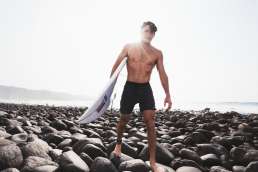




Leonardo Fioravanti
“I believe my personal style is deeply influenced by my Italian identity. Having a recognizable style, something aesthetically distinctive and beautiful, has always been important to me. There are surfers who surf incredibly well, but who aren’t necessarily beautiful to watch… I’ve always tried to develop a way of surfing that goes beyond the score, something that might inspire young boys and girls watching from the beach to want to surf like me. Having a distinctive style means, in a certain sense, being an artist.
There are surfers who have inspired me enormously, even though their competitive careers, strictly speaking, haven’t been particularly spectacular. The way they surf, the way they execute certain moves, remains extraordinary to me. I think, for example, of Andy Irons. The way he moved on a board was simply inimitable. Or Michael Rodrigues, a Brazilian surfer who performs incredible airs. They are sources of inspiration for me. I’ve always tried to draw small elements from different surfers, finding something in each of them that could contribute to shaping my own way of surfing. After all, that’s precisely what happens in art: artists gather impressions and fragments of inspiration, transforming them into something entirely their own.
Attention to detail is essential. Even the details you find in a photograph, something I often discuss with Tommaso, who follows me and documents my journey through images. I don’t think I’m ever one hundred per cent satisfied, because I’m always looking for something more. Experience has taught me that this constant pursuit can also have a negative side, but approached in the right way, it can become a source of strength. You can be happy with what you do, with what you have, and with the person and athlete you’ve become, while still striving for something more. That desire keeps pushing you towards a better version of yourself.
When you’re confronted with a canvas in perpetual motion, like the ocean, instinct becomes paramount. You have to be completely present, entirely focused on what you’re experiencing. To continue the parallel with art, an artist can create something, decide to discard it, and start all over again. Surfing is different. When the right wave comes, it might be your only opportunity. You can’t waste it, and you can’t count on a second chance. You have to put everything into that single instant, concentrating entirely on yourself and what’s happening around you.


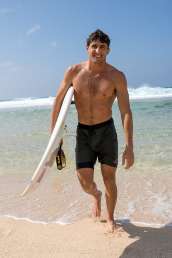

Entering and remaining in a state of flow is something every athlete continually strives for. The flow state is incredibly difficult to explain, because when you reach it, you’re so deeply immersed in your own world that you barely register what’s happening around you. I remember my day in El Salvador (where Fioravanti claimed his first career victory on the WSL Championship Tour, Ed.): everything happened without my having to force anything. I was always in the right rhythm. I wasn’t trying to achieve something at all costs; I was simply experiencing one moment after another. I was in the flow. It’s an incredible sensation, one that’s extremely difficult to find elsewhere. I think the most important thing is not to force it. You have to let it come to you.
Reading the ocean is another essential aspect of surfing. Unfortunately, there’s no book that can tell you exactly how to do it, but that’s part of its beauty: everyone is free to interpret it in their own way. It’s wonderful and frustrating at the same time. You can spend years in the water, learning so much about the currents and how the ocean works, only to find yourself completely out of rhythm during a competition. That’s another reason why I talk about instinct so often. I’m constantly reminding myself to trust it. It means relying on the experience I’ve accumulated over the years, the thousands of hours I’ve spent in the water, the connection I’ve developed with the ocean… I couldn’t tell you exactly why, at a particular moment, I feel I should stay a little further to the left or move slightly to the right. I just feel it. I’ve learned to ‘listen’ to the ocean, to attune myself to it. There’s no exact formula for achieving that connection every single time. If there were, it would all be far too easy.
For me, the ultimate image of that connection is the barrel. What you see from the outside is beautiful, but what you feel when you’re inside is something spectacular. It’s a special moment, almost impossible to describe. It’s just you and the ocean. The very thought of being inside a barrel formed by nature, of experiencing such an extraordinary natural force, is incredible… In that moment, the world stands still. I wish I could give every single person the chance to experience that feeling…
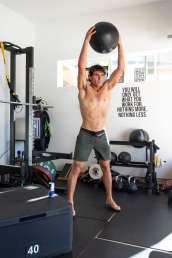

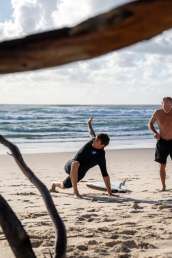
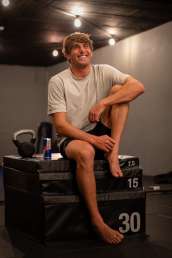
Beyond meditation and the gratitude I feel for this sport, I have to admit that reading has played a major role in helping me take an important step forward in my career. I read a great deal. Sometimes, something you come across in a book is enough to change the way you see sport, or life in general. Reading other athletes’ biographies, watching sports documentaries, listening to interviews: all these experiences have helped me draw connections between different disciplines and find inspiration in other people’s stories.
There are athletes, for example, who consider their sport the only thing that matters in life, something before which everything else loses its meaning. I don’t see it that way. For me, there’s the part of my life I experience when I’m surfing and the part I live outside the water. Those two dimensions coexist perfectly, because I love them both. I want to cherish the moments I spend with my family and friends, just as I want to continue appreciating surfing every single day.
Seeing all the people who came to support me in Peniche, with an incredible number of Italian flags lining the beach, knowing that some of them may have spent a significant portion of what little money they have to be there… I find that truly special, something that transcends sport itself. I appreciate it enormously. I was disappointed that I couldn’t achieve more at this event, for myself, of course, but to a large extent, especially for them. I wish I could have given them more emotions, more beautiful moments for us to share. I feel an immense sense of gratitude.
As I said earlier, seeing young surfers take up the sport because of me is a victory beyond comparison. In Peniche, I met a family of surfers who had decided to name their son Leonardo after me. There’s no victory in the water that could ever compare to that. Seeing a new generation of Italian boys and girls who want to surf like me and embrace the same way of life is another victory in itself. These are things that endure, whose significance extends far beyond any single competition. And, ultimately, beyond surfing itself.”


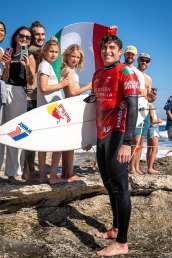

Tommaso Geraci
“Photography and surfing are two passions that developed alongside each other. For several years, they remained separate. I started surfing in Italy, in the same places as Leonardo, around Santa Marinella. Photography, on the other hand, began out of simple curiosity. After high school, I started studying it largely on my own, taking a few courses along the way, without ever imagining that one day I would become a photographer or filmmaker specialising in surfing.
A few years later, I began exploring whether it might be possible to work as a surf photographer in Italy, only to encounter countless difficulties. I spoke to several professional photographers who, in our country, were mainly working in entirely different fields. Many of them discouraged me. But the desire to give it a try never went away. I kept pursuing it until I came into contact with Roberto D’Amico, one of Leonardo’s closest friends and a prominent surfer from our area. Roberto really appreciated my photographs and encouraged me to develop my filmmaking skills as well. That’s how I found my first small assignments in surfing, working with the Federation and Roberto himself. Eventually, Leonardo asked me to work with him.
Our relationship developed naturally. The connection was personal before it became professional. As I mentioned, we’d already spent some time together and established a certain familiarity. Within a very short period, our bond grew much stronger. Now we travel together, share accommodation, make practically every journey together, and experience almost every moment of competition side by side… When you spend that much time together, the relationship inevitably extends far beyond work.
Leonardo made it clear to me from the beginning that he wasn’t necessarily looking for the most talented photographer or filmmaker in the world. Above all, he wanted someone he could genuinely get along with. In some respects, my work is also quite mechanical: Leonardo uses the images as an actual training tool, to review his movements and analyse what he does in the water… My role is also to support him, make his life easier, and help him approach everything with greater peace of mind. I think having someone who can do that is even more important to him than having someone capable of taking better photographs than anyone else.
Naturally, the fact that I’m a surfer myself, albeit an amateur, helps enormously. It helps when I enter the water to film, but also when I’m working at the computer and selecting particular images. Understanding surfing means understanding its movements, its difficulties, its technical nuances… After all, most of my colleagues who work with other surfers are either surfers themselves or people with a deep passion for the sport. I couldn’t do the same job in snowboarding, for example, because I wouldn’t understand or appreciate its technical and stylistic characteristics in the same way.
What I love most about surfing is the emotion it gives you when you’re in the water. The extraordinary thing is that you can enjoy it regardless of your level. Even as a beginner, every stage of learning can bring immense satisfaction. In other sports, the early stages can be incredibly frustrating. Leonardo, for example, also plays golf. I’ve tried it, but when you’re that inexperienced, it’s difficult even to enjoy yourself. In surfing, on the other hand, you can watch someone who has only just managed to stand up on a board experience a joy comparable to Leonardo’s when he rides through a three-metre barrel…


From a photographic perspective, my eye is naturally drawn to the elements of nature that surround surfing. We work in the ocean, immersed in extraordinary environments, often with access to perspectives that are truly unique. When you film from the water, in a way, you bring the viewer into the ocean with you. If I had to choose one image that perfectly embodies that sensation, I’d think of Tahiti, where the most recent Olympic surfing competitions took place and where one of the WSL events is held.
I spend practically the entire day in the water with Leonardo, swimming alongside him and filming him from privileged vantage points. In those moments, I almost feel as though I’m surfing myself, because I can directly experience the energy of the waves and of Leonardo himself. My favourite opportunities, though, are those rare occasions when we manage to travel outside the competition calendar, with the sole purpose of creating beautiful images. Unfortunately, they don’t happen very often, perhaps once or twice a year… But when they do, it’s wonderful, because we have much greater freedom to decide what to do and how to tell the story.
During competitions, by contrast, our work is inevitably focused on performance. Every day, Leonardo analyses his movements with his coach. I prepare all the footage. When we’re staying in the same house, we review the images together. There are countless details to consider, particularly at his level, where the pursuit of improvement and refinement is constant.
From an aesthetic perspective, too, detail is fundamental. A beautiful surfing image depends greatly on the athlete’s style. Style is something you can work on, but I believe there’s also an innate element to it. According to many surfing enthusiasts, Leonardo has a particularly beautiful style to watch. For me, a surfer needs to be elegant, to convey the impression that what they’re doing requires no effort whatsoever. At the same time, they need to express tremendous power. They have to generate force without revealing the effort behind it. They need to make a significant impact on the wave while remaining deeply connected to it. It’s a combination of qualities that isn’t always easy to decipher.
With all this in mind, Leonardo and I naturally share many reflections on the photographs I take. Since he’s the surfer competing at the highest level in the world, ninety-nine per cent of his comments concern the selection of images according to the technical precision of his movements, something that matters enormously to him. Occasionally, though, he also weighs in on the artistic outcome of an individual composition, and rightly so, because ultimately, it’s his image.


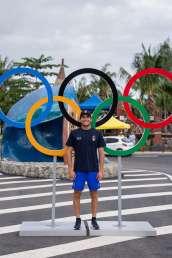
My work also brings me into contact with the world of brands supporting Leonardo. With K-Way, for example, we’ve always had a very positive relationship, above all because of the human connection we’ve established. There’s direct communication and a sense of closeness, strengthened by the fact that it’s an Italian company. They’ve been among Leonardo’s earliest supporters, and that makes an enormous difference. Sometimes, the most complicated part is acting as an intermediary between the demands of brands and media and Leonardo’s sporting commitments. These situations can be difficult to manage, but we always try to do our best. Since performance remains our priority, what I try to do is capture as many moments as possible, then select those that best align with each brand’s needs. During a competition, I can’t freely organise an elaborate photoshoot, so I have to recognise and capture the right images as events unfold.
Another challenge is the need to remain completely flexible. To make myself as available as possible to Leonardo, I can hardly plan my year too far in advance. Things can happen, and have happened before, that completely change our plans for the following months overnight. You can’t anticipate these situations, but you have to be ready to embrace them and manage them as well as possible. You need to be willing to reorganise everything at the last minute, while also accepting that you’ll spend several months of the year away from home.
Then there’s the emotional dimension, which is incredibly intense. The more invested you become in this journey, the closer you grow to Leonardo, and the more personally involved you become in every competition. When things don’t go well, I genuinely suffer too. But I always try to remind myself of something I often say to fans: nobody cares more about the result than the athlete. I understand that people who follow a sport passionately can sometimes be quick to judge or criticise, but they should remember that when an athlete doesn’t achieve the result they were hoping for, nobody feels that disappointment more deeply than they do.
That awareness also helps me navigate those moments. I have to respect what Leonardo is going through after each competition, while also helping him look ahead. Once you’ve analysed a mistake and understood what you can learn from it, you need to reset and focus on what you can do today to avoid repeating it tomorrow. There’s always another competition, another opportunity to improve.


I think Leonardo’s story already has an extraordinary amount to tell. Perhaps all that’s missing is a happy ending. This year, he claimed his first victory at a World Tour event, and that alone, in my opinion, makes his journey remarkable. I’d love to revisit his entire career one day, perhaps when he retires, if only to remind people where it all began.
Today, new generations of Italian surfers have reached an extremely high level and may one day achieve what Leonardo has achieved. But we must remember that Leonardo was born and spent his early years in Italy, developing his talent on our waves. Many of the young surfers who now have the potential to follow in his footsteps spent their childhoods by the ocean. We’d never seen a surfer born and raised in Italy reach the heights Leonardo has reached. I think anyone who truly understands this sport can appreciate just how exceptional that is.
That’s why I try not to think too much about the weight of responsibility that comes with documenting, through images, an athlete of such significance to the history of Italian surfing. I put everything I have into my work, but our team’s primary objective isn’t to create the most beautiful communication or reach the largest possible audience. Of course, those things matter to us too, and we do our best to approach them with care. But Leonardo trains every single day to win, and inevitably, everyone working alongside him comes to share that same mentality.
My greatest satisfaction would be seeing him become WSL World Champion. If greater fame and recognition followed, I’d be incredibly happy for him and proud to have played a part in documenting his journey through my images. But above all, I’d simply love to see him reach heights no one has ever reached before.”


Dennis Scholz | Shaped by Experience
Beyond being a series of complex athletic movements, harmoniously linked together, sport can, on a deeper level, become a form of knowledge. First and foremost, physically, as it shapes and builds the perception of one’s own body; secondly, in terms of imagery, by training the eye to recognize details, codes, and specific characteristics of each individual sporting culture. For Dennis Scholz, this form of knowledge is synonymous with the way he approaches sports photography and his experience, as a whole
Before learning to master light, composition, and exposure, Dennis had already passionately skateboarded, experiencing firsthand the sensations, trajectories, and emotions generated by movement on wheels, and falling in love with that culture. The camera has been—and continues to be—the natural extension of a sensibility already cultivated and developed through the body.
There is something in his photographic and personal journey that echoes the ‘techniques of the body’ described by the French anthropologist Marcel Mauss—namely, the idea that seemingly natural gestures are, in reality, complex systems of learning, belonging, and cultural transmission. A skateboarder, then, does not merely possess a repertoire of tricks; he gradually learns to interpret surfaces, urban spaces, clothing, and musical genres according to an oral, visual, and stylistic tradition that remains largely incomprehensible to the outside observer. And it is precisely this idea that Scholz has conveyed in his photography. Portraying the sport and its highest performers in his photographs means, above all, recognizing that every discipline has its own code: composed of rituals, rules, details, and conventions that must be respected without sidestepping the culture one is attempting to represent.
Sport thus becomes a true form of intellectual and visual education, in which the athletic gesture never exists as an isolated entity, and its true meaning lies in the relationship with the surrounding reality. This insight is cherished and applied by Dennis Scholz in ever-changing sporting contexts—spanning running, tennis, and other sports —with the same curiosity and enthusiasm to learn.


Photography entered your life through skateboarding rather than the other way around. Before you knew anything about photographic language, you already understood movement through your own body. Do you think your way of seeing was first shaped physically through skateboarding? And how did your relationship with skateboarding and skate culture originally develop?
“I had essentially been skateboarding my entire life. I started when I was six years old and, from that point onwards, I simply kept skating constantly. Eventually, my friends and I began filming one another. At that age, the ultimate goal was always to get a clip of yourself skating to see what a trick looked like and I gradually found myself becoming even more interested in photography. I remember getting hold of an old skate magazine at a time when skate photography still existed primarily through print. This was before Instagram and before images were circulating constantly. I might see only a handful of new skate photographs each month, and those images became something I genuinely waited for. I remember turning the pages and beginning to wonder: How did they make that? How was that fisheye photograph taken? How did the photographer manage to get so close? Where is that light coming from? Those questions were really what made me want to pick up a camera myself.
I still think skateboarding is one of the most difficult sports to photograph well, particularly when you are talking about action photography, because there is often one precise moment in which everything has to come together. At that time, skate photography also had an incredibly strict visual language. There were almost established rules: certain tricks were expected to be photographed with a fisheye, you might be working with three flashes, and there was one exact moment in which the movement needed to be captured. The technical expectations were extremely high. Learning to make a genuinely good skate photograph therefore meant going from knowing virtually nothing to having to master a fairly sophisticated combination of timing, lighting, positioning and technique. I found that fascinating. I remember thinking that if I could one day produce an image like the photographs I was seeing in those magazines, that would be incredible. Quite funny how this has taught me the urge of being technically absolutely on point, but also how important it is to do things differently, in your own way.


My first camera was actually an old compact digital camera that belonged to my parents—one of those tiny cameras with a very small LCD screen. Obviously, there was no fisheye lens available for it, so my friends and I somehow got into the physics room at school, where they had all these little pieces of curved glass for experiments. I took a few home and started building something myself, literally holding different pieces of glass in front of the camera until, eventually, one of them produced something that vaguely resembled a fisheye effect. Those were really the first steps: a lot of DIY experimentation, a lot of simply playing around and trying to understand how an image could be made.
Without question, having skateboarding as a physical practice helped me understand movement more generally. I was not photographing professional skaters at the beginning; I was with friends who were roughly at my own level. We were simply experimenting together. But because I understood how a trick worked, how the body moved through it and where its decisive moment occurred, I already possessed a certain instinct for when the photograph needed to be made. That understanding has stayed with me in everything I have photographed since. Knowing the movement from the inside gave me a kind of credibility, but also an understanding of the emotions that accompany sport. I think that background ultimately opened a number of doors for me.”


To what extent did Berlin and its skate culture shape both your visual perspective and your development as a photographer? And do you remember the point at which you realised photography might become more than skateboarding itself?
“I actually grew up in a much smaller place, about two hours outside Berlin. But as soon as I became serious about skating, it became obvious that I needed access to better spots and a larger community. So as soon as I was legally able to move there, I did. Being in the city full-time changed everything. Suddenly there was an enormous amount of potential around me. I met people who allowed me to practise constantly, and I would say that Berlin is where I really began photographing seriously. I had access to locations, to people who were motivated, and increasingly to skaters who were genuinely talented. Even though Berlin has a relatively large skate scene, skateboarding itself is still a fairly small world. You enter the community quite quickly. Within a relatively short period of time, you begin meeting everybody, including some of the more established figures within the scene. For me, things developed very organically from there. I began getting my first small jobs, and eventually something resembling a career started to take shape. Berlin was unquestionably a major influence because it became the perfect training ground. There was always something happening.
For a long time, however, I continued to photograph skateboarding primarily because I loved it. Only gradually did it begin to become professional work. There eventually came a point, though, when doing it every day became exhausting. I would carry this enormous backpack filled with lenses, flashes, tripods and everything else, hoping that by the end of the day I might have one photograph I could sell. At a certain point, I realised that this was beginning to affect my own relationship with skateboarding. I was seeing skateboarding everywhere. I was retouching skate photographs, meeting skaters constantly, spending entire days photographing skating—and then I no longer felt like skating myself. That was probably the moment when I began to think that perhaps there was another world outside this particular microcosm.
Interestingly, I never made a conscious decision to search for a completely different photographic career. I did not suddenly start producing an entirely new portfolio or aggressively pursuing other kinds of commissions. The transition happened quite naturally. People began approaching me to photograph running. At first it might be a local run club or a smaller brand project, and from there things gradually expanded. Again, Berlin was fundamental. Meeting people in the city happens almost naturally if you are open to it. I am quite an outgoing and positive person, and over the years I met an enormous number of people. Somehow, those relationships allowed my work to evolve from being almost exclusively about skateboarding into being commissioned for running projects and other sports. Berlin has always been an extraordinary environment for testing creative ideas. It gives you the space to try things. It encouraged me to search continually for another perspective, not only literally in terms of where I placed the camera, but conceptually in terms of how something familiar might be seen differently.”


You once said that a skate photographer should ideally skate themselves, because understanding a movement from within allows you to anticipate how it might exist within a photograph. Your work has since expanded into running, tennis and many other sporting environments. How do you approach a discipline you have never practiced yourself, and how do you develop an equivalent degree of understanding?
“Sometimes I actually think not knowing everything about a sport can be useful to do things differently. A lot of situations require a deep understanding of the particular sport and movement, but in general it can also be good to project completely different perspectives on something. For me, the fundamental requirement when photographing a discipline you are unfamiliar with is simply being willing to understand it and being genuinely open to learning. Making the photograph is one thing, and obviously you arrive with your own ideas, but ultimately—even on a large commercial production— a very close relationship between the photographer and the athlete is essential. You need to communicate your idea clearly enough that the athlete understands what you are trying to achieve, but at the same time you have to be willing to acknowledge their expertise. Sometimes I will simply tell someone, ‘I need to rely on your professional knowledge here.’
I photographed Carlos Alcaraz when, quite honestly, I knew almost nothing about tennis. I essentially thought, I am not entirely sure what is happening here, but we will figure it out together. Ironically, I started playing tennis shortly afterwards because I found the experience so inspiring. But regardless of the sport, understanding how it should be represented—the correct movements, the meaningful moments—is absolutely critical. That remains one of the fundamental responsibilities of sports photography. At the same time, I do not think any sport is so complicated that you cannot begin to understand it if you approach it with curiosity, speak to the right people and allow the process to become collaborative. A great deal depends on your attitude. If you arrive believing that is a team effort, then the entire atmosphere changes. I like breaking the ice, talking to people, creating a good relationship on set and allowing everyone involved to contribute what they understand best. That approach has served me quite well honestly.”


Today, brands are constantly searching for the visual codes of ‘authenticity’, particularly when entering sporting communities with strong cultural identities of their own. Do you think having grown up inside one of those worlds has given you a greater ability to recognise and photograph that authenticity within other contexts?
“100%. I think growing up inside a sport with such a strong cultural identity, and learning its codes in great detail, gave me an awareness that those codes exist everywhere. Once you have experienced one of those cultures from within, you become much more sensitive to the fact that every sport has its own language, and that those languages cannot simply be ignored. I have seen people photograph running, football and even skateboarding without paying any attention to that. They might produce an image with a beautiful composition, but the photograph is fundamentally wrong because the movement makes no sense, or they have captured a moment that somebody inside that culture would immediately recognise as inauthentic. So I think having gone through that process with skateboarding gave me a very strong foundation. It taught me first of all to recognise that these codes exist, but also to understand that they are completely different from one discipline to another.
Today I find that particularly interesting because, especially since Covid, many sports have become much more personal and much more culturally oriented. There seems to have been a movement away from pure competition and towards community. Cycling is no longer necessarily about achieving the fastest time. Running can be about going slowly, being outside, competing with yourself, spending time with other people. I find that shift wonderful. This movement away from performance as the sole measure of sporting value has also benefited the way I photograph sport, because I was never particularly interested in competition alone. Of course, competition matters enormously to many people, and I completely respect that. It is simply a question of perspective.
I have always thought that, first and foremost, you practise a sport for yourself, for your own sense of wellbeing, with your friends. Perhaps that comes from skateboarding as well. You meet at a skatepark and there might be several extremely talented skaters alongside people who have only just begun. But there is still this instinct to encourage one another. Someone might simply ollie for the first time and everybody around them will be genuinely excited because, for that person, it represents progress. I have always loved that. And I am genuinely excited to see that mentality appearing in so many other sports—particularly disciplines that historically were understood much more through performance and competition. For me, this cultural transformation is incredibly compelling.”
One recurring characteristic of skate photography is that the action rarely exists in isolation: architecture, textures, streets and the surrounding environment remain strongly present within the frame. How important is it for you, even today, to preserve the world around an athlete?
“It is extremely important. In some ways, I would even say that what surrounds the movement can be as significant as the movement itself. There is always so much happening around an athlete. The environment, the atmosphere and, above all, emotion all influence the way someone moves and the way that movement is perceived. I have always been interested in that broader dimension of the image. Sometimes the most revealing photograph is not necessarily the decisive sporting gesture, but an extreme moment of emotion—someone visibly fighting for something, for instance.
You can photograph a face incredibly close and, if the image is made in the right way, people may still understand which sport that person belongs to. The same is true of smaller details. You might photograph only a wrist, a hand or a fragment of the body, cropped very tightly, and still evoke an entire sporting language. Those details fascinate me because they can carry an enormous amount of emotion and often tell a story that extends beyond the movement itself. The surrounding environment is equally important, although it is obviously much harder to control. Perhaps this goes back to my early instinct in skateboarding to look for another perspective. I have always been interested in seeing the world around the action rather than isolating the athlete completely from it. What interests me is finding another way into the subject—another angle, detail or relationship between the athlete and the space around them—while still remaining faithful to the culture and authenticity of the sport”


You began by photographing friends in situations that were largely spontaneous, while commercial photography later introduced briefs, schedules and carefully controlled environments designed to produce a specific image. After moving repeatedly between these two worlds, what have you learned about the relationship between control and accident? Have the two ever merged within your work?
“I always try to introduce as much as possible of my own creative perspective, even within a highly structured commercial shoot. I am constantly asking whether there might be another way of approaching an image—something slightly less obvious than what was originally planned. I actually think that is part of my responsibility as a photographer. If every element has already been predetermined, if the client knows exactly where the subject should stand, how the image should look and precisely what the final result is supposed to be, then theoretically they could hire almost anybody to execute it. What I can bring is that additional layer of interpretation. So even on large commercial productions, I try to remain attentive to those small creative impulses that emerge while we are working. Sometimes that can complicate things slightly, because schedules are tight and everything has already been planned, but most clients ultimately appreciate it. Once we have made all the photographs we know we need, I will often ask for one or two additional rounds in which I can work more instinctively. Perhaps I suddenly feel that we should introduce some motion blur, change the camera, move closer or simply follow the athlete rather than directing them. I almost always carry a small second camera with me for precisely that reason, I want to be able to leave the main camera behind, move immediately towards that moment and photograph it before it disappears. Quite often, those are the images that contain the most energy. There is something instinctive about it that is difficult to explain. You suddenly sense that you should move closer, change your position or follow somebody, and you simply have to listen to that impulse. Sometimes it produces something remarkable, sometimes it does not. But the important thing is allowing yourself to try.
So for me, control and spontaneity are not necessarily opposites. The structure of a commercial production gives you a framework, but within that framework I think you have to preserve enough openness for something unexpected to happen. Ultimately, it is about putting as much of yourself as possible into a project. I think brands have begun to understand that sport can be communicated much more convincingly through those moments than through an entirely controlled representation of performance. Genuine emotion, imperfection and the unpredictable energy of a real encounter still belong to something fundamentally human. Recognising those moments requires instinct and, ultimately, taste.”
After spending so many years photographing movement, athletes, and sports cultures, is there something fundamental about the experience of sports and photography that, in your opinion, might overlap or share similarities?
“One thing I have become increasingly aware of, both when watching athletes and when photographing them, is this idea of entering a flow state. When an athlete reaches that point, there is a moment in which they seem to stop consciously thinking about what they are doing. The movement becomes instinctive. Everything aligns, and they simply perform. I recognise something very similar in photography. There are moments during a shoot when I gradually find a rhythm and, at a certain point, everything seems to click. I stop overthinking. I am no longer consciously analysing every decision. I am simply following something more intuitive—a creative instinct that seems to come from somewhere inside me.
Perhaps that is one of the things I find most beautiful about sport and photography: both can bring you into this space where effort and instinct briefly become indistinguishable. And it is not something you can entirely control. I can experience that feeling while photographing almost anything. It is simply that moment when you sense that things are working, that you are responding correctly to what is happening around you, and that you should trust the process rather than interfere with it.”


Obstacle | Dominik Wagner
Dominik Wagner’s lens takes us through the streets of Amsterdam, transformed into temporary sets for a series of compositions and portraits that elevate both the artistry of skating and the identities of those who inhabit it
A series with a beginning, yet no end. Set across the streets of Amsterdam, ‘Obstacle’ unfolds as a session in perpetual becoming, where Dominik Wagner’s gaze as an inline skater both contextualises and extracts a constellation of tricks from their natural realm. Pavements and poles. Street signs and walls. In his images, everything speaks of movement and form. But also of identity, as revealed by the parallel series of portraits devoted to the skaters drawn into this flow of diptychs.
What emerges is a rhythm shaped by doing and being. The same rhythm we encountered in a long conversation with the inline skater and photographer, transposed here into a stream of consciousness that brings to the surface both the deeper meaning of the project and the trajectory of the life behind it.


“I’ve been skating basically my whole life. From the age I can remember, I was always skateboarding, ice skating, skiing, whatever I could do. But when I was ten, I got my first pair of inline skates, and from that moment I was completely consumed by it. There was nothing else in my life. Years later, skating is still my everything. It shaped how I grew up, how I see the world, and so many different parts of my life. My partner, who I have two kids with, is also an inline skater. We met through it. All of my best friends are part of this culture. I travelled around the world thanks to it. And photography became part of that world too. Skating is present in almost every little aspect of what I do. It may sound cheesy, but it feels almost like part of my DNA.
It definitely changes the way you look at a city. When I walk through the streets, there are constantly objects that immediately catch my eye. I think: “This is skateable. You could do this trick there. What if somebody tried that?” It happens everywhere, all the time. I see objects in a completely different way, because skating teaches you to read the city through possibility. That became really important for the ‘Obstacle’ project. I wanted people who have nothing to do with skating to understand, even just a little bit, what it means to look at something as a skater. To zoom in on an object and suddenly see it differently.


As I said, photography came later than skating in my life. I was in my early twenties, I had just finished school, and I was skating a lot, but I was also a little bit lost. I started thinking that I probably couldn’t skate for the rest of my life and that, at some point, I had to think about a career. Somehow, almost unconsciously, I moved towards media, videography and photography. It had always been around me. I had friends working in that field, and when you grow up with skate magazines you constantly consume that kind of imagery. So, at some point it just hit me.
I bought a camera and started creating a portfolio. At first, it had nothing to do with skating. I actually wanted to separate the two. When I was skating, I wanted to skate; when I was photographing, I wanted to photograph. Then I moved to Berlin to study photography. It was there that one of my teachers told me that what I had going on was a pretty unique combination, and that I should actually work on it. From then on, I never stopped. For many years, my skate photography was much more documentary. Of course there were action shots, but I was mostly following situations as they happened. This project was different. It was the first time I really planned something and tried to take complete control of everything.


It all started with one very specific image I had in mind. I photographed one of Amsterdam’s iconic poles, marked with the city’s three Xs. The skater involved in the picture, Levi van Rijn, is one of the best in the world at the moment and he is based in Amsterdam, so we shoot together quite a lot. I wanted to bring the photography to another level, and I had this idea of capturing a trick on that pole while completely blending out the background. When I finally got the image, I realised how strong it was. So many things came together in exactly the way I had imagined them. From there I started thinking: I could do this with that object, or with this skater, or with a completely different style. The project expanded.
What was always in my mind was minimalism. If I can reduce something to its core, to the most important aspects of it, and really show that, then I’m happy. That is what I wanted to achieve. After shooting skating for so many years and doing so many different things, I also felt that I personally needed a next step. I wanted to think a little bit outside the box and create something that, at least in this form, I hadn’t seen before. It wasn’t a conscious decision of saying: now I want to make art. The idea simply came through that first photograph, and then seeing how people reacted to it pushed me further.


The portraits became part of the project almost by accident. Over the last few years I had started focusing more and more on portrait photography. It had always been part of me, but lately it had become much stronger. At the beginning, when I was already putting all this effort into bringing a white backdrop somewhere, I thought: “Why not also make a portrait?” At first it was almost just an extra thing. Then the portraits became so strong that they started to feel completely equal to the skate photographs. With some people, the portrait almost became more important to me than the skate shot itself. It made the project feel balanced. Sometimes with skate photography you see the skater and you see the trick, but you don’t really see the face. A portrait gives you a fuller sense of who that person is. For me, the two images gradually became inseparable.
Interestingly, I found out that there’s also something very similar about skating and photography. Of course, there’s probably more adrenaline involved when you’re doing a skate trick. But especially with this project, so much work went into each image, and so many things had to come together at exactly the right moment. There can be a lot of tension in that process. Then everything finally aligns in that one instant and you know: okay, we got it. It really does feel like landing the trick yourself.”


A Tender Gaze | Henry Lamine Diagne
Henry Lamine Diagne’s soft and delicate glance transports us into a different realm of sports, where athletes and communities are portrayed in depth. It is a visual space in which the spectacle of athletic performance gives way to the vulnerability of human identity and the attachment to the cultural system to whom it belongs
For this young photographer, born in Switzerland and raised between Paris and Senegal, photographing athletes means, first and foremost, removing them from the merely performative dimension. Through the use of portraiture and his background in the fashion world, Henry humanizes his athletic subjects. They are no longer statuesque, iconic figures, but human beings through whom we can observe a culture and its unique characteristics from a privileged perspective. With their gestures, rituals, the environment surrounding them, and the communities to which they belong, these figures convey something that goes beyond the result, whether victory or defeat.
It is precisely this consciousness that defines much of Henry Lamine Diagne’s photographic practice. Portraiture meets documentary; editorial photography embraces the unpredictability of observation; fashion enters the world of sports without reducing it to a mere aesthetic surface. His method thus proceeds through a constant alternation between construction and observation. What matters to him is that something authentically human remains in the image, something that can be recognized even by those who have never directly experienced sports. His photography thereby becomes an exercise of intimacy and interpretation.


Sport, fashion or campaigns, what first educated your eye? Was it photography itself, cinema, the street, your family, music, or the cities you lived in? And how did photography first enter your life?
“I grew up in Switzerland. My mother is Swiss but my father is from Senegal, and because of his work we travelled a great deal when my brother and I were young. My mother was always very attentive to exposing us to art: she would take us to museums and exhibitions, and she almost invariably carried a small Nikon F100 film camera with her. I think that was probably the first thing that made me curious about photography. I would take her camera and photograph my younger brother, then whatever happened to be around me. I would photograph my neighbourhood, my family and the people around us. I suppose that was where it all began.
I think I got my first personal camera when I was around 13. Later, I attended photography school in Switzerland, which I finished when I was around 19. By then, I already knew that I wanted to explore fashion, so I moved to Paris. In my mind, Paris was almost the Real Madrid of fashion. I thought that If I could make it there, I could make it everywhere. It represented the highest level. I had very little idea of what I was actually entering, but I remember thinking: this sounds difficult, so I am going to do it. I can do it. I began working as a lighting assistant and, very quickly, I was given an extraordinary number of opportunities. In Switzerland, I had been trained in lighting in a very rigorous way. The working culture was extremely disciplined: you arrived on time, you remained focused, you were precise and consistent. That helped me enormously when I arrived in France. I came in with the mentality of wanting to do everything properly. Soon I started travelling with photographers, learning the profession by working in their shadow. That experience also made me understand that photography was a real industry. Until then, many of my teachers had warned me that it was an extremely difficult profession and that there was no guarantee I would ever be able to make a living from it. But when I started working with established photographers and lighting their sets, I could see that many of them made it.
I remember thinking that I wanted that kind of life—not because I ever dreamt of being rich, but because financial stability could provide a certain freedom. It could allow me to travel, to move, to make my own work. Those things are connected. So I began to think that perhaps I could use that freedom to pursue other projects that mattered to me. Then Covid happened. At the time I was still working as a lighting assistant, and afterwards I felt that I needed to challenge myself. The interruption gave me an opportunity to reset, to ask myself what I actually wanted to do and, more importantly, what kind of photographs I wanted to make. After that period, I essentially restarted my career, this time as a photographer.
Fashion was naturally the first field I entered because I already had connections and relationships within that world. But the more interesting question became: now that I am the photographer, what do I actually want to say? I went to Senegal and began photographing friends there. Some of them were wrestlers, and wrestling has an enormous cultural presence there. I started photographing these friends and, through them, I also met several marabouts, who represent the spiritual dimension surrounding the sport. I spent time with them, and I suddenly realized how interesting it was to photograph an athlete not simply as an athlete, but as an entry point into an entire culture. The sport became a way of reaching something deeper. Without initially intending to, I found myself photographing a very significant spiritual dimension of my own culture. I had never really had access to that world before.
Has sport always been part of your life, or did it only become one of your interests later, once you began to consider it as a photographic subject?
“I think I probably inherited my love of football from my father. We used to play a lot, and sport brought with it a very strong competitive mentality. My earliest memories of it are connected to this idea of wanting to be better than I had been the day before, of trying to improve every time I stepped onto the pitch. My father would come and watch me and my brother play. For a long time, it became one of the principal ways in which I expressed myself. But at that stage there was nothing particularly specific or intellectual about my relationship with sport. I simply loved it.
Growing up in Switzerland, we had access to many different sports, so I also played tennis, ran, cycled and tried all kinds of activities. Sports were simply everywhere in my childhood. What is interesting, however, is that none of that was initially connected to photography. When I first began taking pictures, it never occurred to me that I might one day photograph athletes. In that sense, I actually arrived at sport photography through fashion.”


Your work often seems drawn to what feels slightly suspended: a body, a gesture, a moment that exists somewhere between action and stillness. Are you particularly interested in these in-between instants? If so, why?
“From the very beginning, I wanted to avoid the spectacular. I feel that a great deal of sports photography is concerned with spectacular moments and spectacular actions, whereas I have always been much more interested in approaching athletes through portraiture and in revealing their sensitivity, their doubts, their vulnerability and their uncertainty. Those are dimensions of athletes that, in my opinion, remain relatively absent from mainstream sports culture. There is often a tendency to represent them almost as superhuman figures, when in reality they are far more complex than that. I approach athletes first and foremost as human beings. I am always looking for those moments in between. Of course, sometimes you win and sometimes you lose, but there is an enormous emotional territory between those two outcomes. So many things happen before the victory or after the defeat, and I feel that this intermediate space is still not being shown often enough, or at least not always in the way I would like to see it represented.”
At Athleta Magazine, we try to approach sport not only as performance, but as a cultural and artistic language. When did you first begin to look at sport as an image rather than simply as an event or a form of performance?
“When I decided that I wanted to become a photographer, I suddenly had to think about who I was, but also about the way other people perceived me. While photographing wrestlers in Senegal, I realised that athletes could function almost as cultural figures. I think that was probably my first real understanding of sport in that sense. Until then, I had mostly been working on editorials and campaigns.
When I began producing photographs for myself, as personal work rather than for a client, I had to reconsider the entire way I approached image-making. When you work commercially as a creative, you are always conscious of the different elements a brand needs or expects to see within an image. There are certain details, references and requirements that you naturally have to incorporate. When you make something for yourself, however, there is no longer a brand telling you what the image needs to contain. You have to decide what matters, what you want to retain and what you actually want the photograph to communicate. I think that process forced me to think for myself in a much deeper way. Then, through the wrestling project, I realised that sport could become an opening onto something much larger than action itself.”


Sport is often photographed through speed, spectacle and victory. Your visual world feels quieter, more atmospheric, more attentive to the human presence surrounding the action. What do you feel remains under-photographed in sport, and which emotions do you try to evoke through your sports photography?
“Through sport, you can communicate emotion, and emotion is something people can recognise regardless of whether or not they are athletes themselves. When I look at a photograph I have made, I am waiting for it to give me a particular feeling. Whatever that emotion may be, I want someone looking at the image to be able to recognise something of their own experience within it. If the photograph contains sadness, for example, I want the viewer to feel that sadness. They don’t need to be athletes in order to relate to it. For me, it is largely about creating the conditions for an emotion to emerge and then allowing people to receive it in their own way.
When I approach an athlete, for example, I might say: ‘Do you remember a moment when you felt like this? All right, let us try to bring that feeling towards the camera.’ Sometimes it works and sometimes it does not. If it does not, I may simply allow them to continue doing what they are doing, and at that point I will almost become a documentary photographer, observing rather than directing. Then, I might realise that a particular composition is visually very strong and ask them to repeat a step, to stand in a particular way or to move slightly differently. Suddenly, the process becomes closer to a fashion editorial. I enjoy moving between those different modes of image-making—documentary, editorial, portraiture—and understanding what each of them can bring to the photograph. Most of the time, however, is a portrait of an athlete because I want to reveal something about their attitude and character. For that reason, I usually take time to understand the person standing in front of my camera. I try to help them bring something internal into the image, something they have genuinely experienced. Athletes live through these emotions with extraordinary intensity, so they often understand quite quickly what I am asking. It requires a little more time, perhaps, but moving back and forth between the language of editorial photography and that of documentary photography is something I find incredibly enjoyable.”
Having worked in the world of fashion, do you also see the athlete as a performer, as a body in motion, as a character, or as something else entirely?
“I feel that every athlete has their own personality. The way they practise their sport is also, to a certain extent, the way they present themselves to the world. Clothing is only the most immediately visible part of that identity. Whenever you photograph an athlete, you are inevitably photographing fashion, movement and tension at the same time. In my mind, those elements have always been interconnected. I do not really feel the need to place myself within a single photography category. Within one project, for instance, you might encounter a very classical portrait that is simply a portrait, and then suddenly come across an image that feels much more overtly connected to fashion. I find it very stimulating to move between these different territories and to continually reinvent the relationships between them.”


Your work often moves between fashion and sport, two worlds that both use the body to communicate identity. Do you see them as separate languages, or as two expressions of the same visual research?
“I think imagery in general has increasingly moved beyond its traditional categories. Different visual worlds are beginning to overlap and connect with one another, and I find that incredibly exciting. If they remained entirely separate, I think there would eventually be something repetitive about them. I really enjoy seeing those worlds merge. When you look, for example, at someone like Kylian Mbappé becoming an ambassador for Dior, to me that feels significant. It makes complete sense. Athletes today are obviously enormously influential figures, but beyond that, they also embody certain values and cultural meanings. I find this convergence between sport and fashion fascinating because it creates another way of reading the contemporary world. One visual language enters another, and in doing so they can produce something new.”
Your work often seems to move through cities, communities and cultural crossings. How important is geography and local culture to your photography? And how have different places shaped the way you see sport and the way you photograph it?
“For me, travelling means having to reconsider my surroundings every single time, and I find that extremely beautiful. You arrive somewhere, have to learn how to read a new environment, understand how it functions, and then try to translate what you have understood into photography. That process is probably one of the reasons I enjoy travelling so much. If I go to Turkey to photograph an athlete, it may take me a week or two simply to begin understanding why people practise the sport in a particular way, what surrounds it culturally, and what those gestures mean within that specific environment. I find that process incredibly stimulating. Photography forces me to spend time with people whose worlds are completely different from my own.
Growing up in Switzerland and also spending significant periods of my life in Senegal had a profound influence on me. Dakar and Paris, in particular, became part of my creative process; they are places where I learnt how to develop and process ideas. Switzerland is equally important because it is where I grew up. I would say that those three places have deeply shaped my taste and, more broadly, the way I approach photography.”

Sport imagery today is produced in enormous quantities: campaign images, social content, match photography, personal branding. Do you think this abundance has made sports photography more creative, or more repetitive?
“I do see a lot of images that look very similar, to be honest. But overall, when I look at the new generation of brands and at the sports that are becoming increasingly culturally visible, I also see an enormous amount of imagination. The way certain brands and athletes present themselves is often very exciting to me, so I remain quite optimistic. Of course, there are many images that repeat the same ideas and visual formulas. But then you encounter something that feels genuinely different and immediately good. Sometimes the underlying idea is not even radically new; what changes is the way it has been executed. Just a different styling, for example, can completely transform an image. Even within an established visual vocabulary, there is still an enormous amount of room for personality and invention.”
What do you think contemporary sports culture still needs to move beyond?
“I think everyone dreams, in some way, of being free. Sport can represent a way towards that freedom. It gives people an opportunity, however temporary, to step outside their normal lives and express themselves differently. I think that is partly why the wider culture is so interested in sport at the moment. A lot of people spend most of the year working, with perhaps only a few weeks of holiday, following routines in which there is not always much space for personal expression. Sport can become one of the moments in which they are able to express themselves physically and emotionally. It also gives them the opportunity to meet other people and to become part of a community built around a shared practice. In that sense, sport can function almost as a refuge. When I look at contemporary sports culture and the imagery surrounding it, I think it is moving in an interesting direction.”
Which sport have you not yet had the opportunity to photograph in depth, but would like to explore next?
“I recently started playing golf, and I fell in love with the sport. I have only been playing for around six months, so everything still feels new to me, and I would love to explore photographic opportunities within that world. For the moment, though, tennis is probably my main playground. I find it an incredibly elegant sport, but at the same time it has become deeply connected to contemporary culture.. There is a great deal happening around tennis, and I feel there is still so much visual territory to explore. That process of reinvention is something I find extremely interesting.”


This Is a Song of the Valleys | The Mecca of Welsh Rugby
The gaze of RiseUp Duo moves across the gentle yet austere landscapes of the Welsh Valleys. Guided by the voices of Dai Richards, a master collector of rugby history, and Ralph Waldin, spokesperson for the 140-year-old Treorchy RFC, they portray the cultural and social significance of the oval ball within a geography long shaped by mines and tries
“This is a song of the Valleys | Of rivalries, communities and tries | Where rugby breathes and never dies,” read the pages of Athleta Magazine Issue 13: more precisely, those of the ‘Up and Under’ reportage. The words draw inspiration from the verses of the brilliant comedian and singer-songwriter Max Boyce. Rising to the upper reaches of the British charts in the 1970s by singing the rugby myths of the Welsh Valleys—a land that has never ceased to produce and pass them down—his career stands as a testament to what the oval ball has represented, and continues to represent, within this distinctive corner of the world.
Cultural heritage. Social dynamo. Familial identity. Natural structure. Interconnected definitions that together render something tangible of the significance rugby has assumed, since the mid-nineteenth century, within small communities enclosed by undulating hills. Villages and towns populated largely by miners who, between the posts, composed an unforgettable—and still unforgotten—sporting melody: one that continues to produce international talent and fiercely contested local derbies even today, despite profound socio-economic change and ongoing depopulation.
This is the song of the Valleys. A song with rugby at its very centre. So attest the voices of collector Dai Richards and Treorchy RFC Vice Chairman Ralph Waldin. Their lives and testimonies, accompanied by a series of exclusive photographs, reveal why rugby continues to breathe and endure in a part of Wales that made a religion of the Game.


Dai Richards – Rugby Relics
“My first real encounter with rugby as something material came almost by accident. Every November, for Guy Fawkes Night, our neighbours and my family would build a bonfire together, and as kids we would go around collecting old newspapers and anything people were willing to give us to burn. One day, somebody handed me a programme from Wales against England in 1965. I looked at it and thought, I can’t burn that. It’s too good. In many ways, that was where everything began.
My father had probably taken me to local rugby matches before then, but I wasn’t particularly interested in watching. I would spend most of the time exploring whatever was around the pitch. But in the Welsh Valleys, rugby eventually becomes part of your life whether you consciously choose it or not. We played it at school. I scored my first try when I was nine. My teachers were rugby players; my PE teacher played for Aberavon, one of the leading sides, and so did my physics teacher. Rugby was simply everywhere. It was social, cultural, part of the fabric of the place. You couldn’t really avoid it.
During my adolescence, another relationship with the game was developing. I had started collecting football programmes, but gradually football gave way to Neath rugby club programmes and then to rugby memorabilia more broadly. When I was seventeen, I went to a dealer looking for some programmes I wanted and discovered that he had already sold them. I remember thinking: How do I get to these things first? The answer was to become a dealer myself.
Initially, buying and selling was simply a way of reaching material for my own collection before anybody else could. Then it grew and grew. That was around 1978, so I have now spent almost half a century accumulating rugby history. There is so much of it that I’ve had to hire twenty-foot containers simply to store everything. Since 1991, it has been my full-time profession. At a certain point I realised that what had begun as wheeling and dealing to sustain my own collecting could actually become a living. Today there are really two sides to what I do. There is Rugby Relics, which buys and sells, and there is the museum collection.
They are connected, but there is a very clear line between them. The museum material is not there to be traded. There is one exception that matters to me. If somebody has a deeper connection to an object than I do, I will consider returning it to them. If I own a cap and the son of the man who originally wore it comes to me wanting it back, then his relationship with that object is greater than mine. That matters. I need to know that the object is going somewhere it belongs, rather than to somebody who simply wants to buy it and sell it again. Because although this is a business, I still see the beauty in these things. Certain objects possess something beyond their physical form. There is an aesthetic value, certainly, but also something spiritual. And I think there has to be an integrity in the way you handle them, because ultimately you are dealing with people’s histories.
My favourite object probably explains that better than anything else. It is a small book called a Thumbograph, which belonged to a young woman in 1905. Originally, there was an ink pad inside: people would press their thumb into it, leave their thumbprint on the page and sign their name beside it. When I first bought the book from somebody in the north of England, I knew almost nothing about her. Then I appeared on a British antiques programme with it, and her granddaughter contacted me. Incredibly, she lived less than a kilometre away from me. I discovered that the house mentioned in the book was actually in Swansea and that its owner was the daughter of the Lord Mayor of Swansea. Suddenly, this object I had found hundreds of miles away had returned to its own geography.
Because of her family’s position, she moved among some of the most important rugby figures in Swansea and Wales. She met members of the famous 1905 All Blacks and, the following year, the Welsh team. Ten of the Welsh players associated with that extraordinary 1905 victory over New Zealand appear in the book. Among the names is Gwyn Nicholls, the captain of that Welsh side, and then there is Arthur Gould, generally regarded as the first Welsh rugby superstar. And the book is still alive. Where blank spaces remained, I began inviting more recent players to add their own thumbprints and signatures. So an object that began with one young woman meeting rugby players more than a century ago continues to accumulate the game across generations. That is what fascinates me. The object carries time.
My collection has always been revolving. It is a business, so things inevitably come and go, but the purpose has never really been to possess everything. What matters to me is recording the history of rugby through its memorabilia, using objects to explain the story of the game. That is why I am interested in everything, not simply the great names. I have boots here from the 1880s or 1890s, the kind of boots some of those early Welsh players would have worn. And when you look at them, you have to remember that many of these men were miners. Those might have been the same boots they worked in during the week before putting them on again to play rugby on a Saturday.
That relationship between mining and rugby is fundamental to understanding the Valleys. I grew up in Port Talbot, which was a steelworks town rather than a mining community, and I think there was a difference between the mentality of men working in steel and those going underground. Mining was harder, more dangerous. When I played in the very early 1980s, I played alongside men who had been miners, and they were hard men. Very hard men. The rugby reflected that. The team I played for never really went out to play rugby. We went to war. And that is what rugby had been like here through the 1950s, 1960s and 1970s: almost a war between mining villages, between one community and another. That mentality wasn’t naturally mine, but once you were on the field you had to enter it because everybody around you was fighting in the same way.
The mines created communities in a very particular way. People lived close to where they worked. You might walk half a mile to the mine or five miles, perhaps even climb towards one at the top of a mountain, but your work, your home and your community all belonged to the same geography. Even the coal itself was part of that intimacy with the land. In the valley opposite here, all seven layers of the geological strata come to the surface. Every seam had its own name, and they used to say that a miner could identify which seam a piece of coal had come from simply by looking at it. That world has largely disappeared. People now travel in from elsewhere to work. They are no longer necessarily born, employed and socially rooted within the same few miles. So inevitably there has been a disconnection between the communities and the mines, and rugby has been affected by that too.
The game is still deeply present in parts of Wales, particularly when you move through the Heads of the Valleys. Those remain rugby strongholds. The coastal towns are different. Historically, rugby belongs much more intimately to the mining communities and the Valleys. But even here the balance is changing. I would say rugby is dying in terms of participation. My old club is struggling to field one senior side now. At one time, it ran two. Part of the problem is simply the nature of the game. Rugby is a contact sport, and people have jobs and lives outside it. It is difficult to put your body through a match and then return to physical work. When I played, it could take me two or three days to recover, and I wasn’t even a forward. Society has changed as well. I think we are moving away from that kind of contact sport. Perhaps that is one reason I have become increasingly interested in going backwards, towards the origins of the game itself.”


Ralph Waldin – Treorchy RFC
“We are in our 140th year now, and we are very proud of that. Treorchy has a rich rugby heritage, particularly for a village of this size. We have always produced players who have gone on to play at a very high level, including internationally, and I think a lot of that comes from the strength of our mini and youth rugby. Our latest example is Tomos Williams, who played for the British & Irish Lions last year. He is a Treorchy boy. He came through our mini rugby system, just as so many others have done before him. I know his parents very well and his best friend is my son. There are photographs of the two of them together here from ten or fifteen years ago. That is what makes it special. You see somebody as a child playing rugby here, within the village, and years later he is playing for the Lions.
This is a pattern shared across the Valleys, a true breeding ground for Welsh internationals thanks to the remarkable standard of rugby found throughout the region. And it is a process driven not only by its best-known or highest-level clubs, but by the smaller ones too. But rugby in the Valleys is not as strong numerically as it was thirty or forty years ago. When I was playing, we had two senior teams. There might be forty-five or fifty players training twice a week. We don’t have that anymore. We no longer run a second senior side, and very few clubs around here do because there simply aren’t enough players.
Our strength is that we still have mini rugby and a strong youth system, so there is a flow of young players coming through. Other clubs are not so fortunate. There are teams only a few miles from here struggling every week simply to put a side on the field. Some clubs may eventually have to fold. Part of the problem is that there are so many of them. Around here you can find a rugby club every two or three miles. In purely practical terms, perhaps there are too many clubs for the population we have today. But try telling a village that its rugby club has to disappear. You can’t. The identity is still too strong. Rugby here remains tribal. When you play the club down the road, it becomes a real local derby, something much larger than an ordinary league match. Every community has its own identity and its own club, and people remain deeply attached to both.
Last season we played a local side and there were thousands of people around the field. For a normal senior home game, we might get around five hundred spectators. For a bigger match it can be more. And when Treorchy plays away, people travel. We take a proper crowd with us. That tells you what the club still means to the community. We couldn’t survive without them. We have an initiative called Friends of Treorchy, where supporters, members and friends of the club contribute fifteen pounds a month. We have around a hundred people doing that. That money keeps the club going. If those people stopped contributing, there would be occasions when we would struggle simply to open the doors. But they don’t stop. They have been doing it for years. Every month, they give their fifteen pounds without question because that is their way of supporting the club.
And the significance of this place has never ended at the touchline. Max Boyce played here before anybody really knew who he was. His first live album was recorded in this club, Live at Treorchy. At the time, they were struggling to fill the hall. It was a weeknight, he was still relatively unknown, and initially they could barely sell a hundred or a hundred and fifty tickets. Eventually they filled the place, it became a great night, and the record went out into the world. That album helped launch his career. He came back recently, fifty years after that performance, because he still has such fond memories of Treorchy. There is something special about the fact that a record which travelled so far began inside a village rugby club like this one. But that is what these clubs have always been.
The clubhouse is not simply somewhere players come after a match. People have weddings here. They celebrate birthdays here. There is live music, parties, family gatherings. For generations, places like this have provided a space in which the community can come together. And that role has probably become even more important as other gathering places have disappeared. We used to have so many churches and chapels along the high street. Most of them are closed now. Many of the pubs and social clubs have disappeared as well because there simply wasn’t enough trade to sustain them. Every time one of those places closes, the community loses another space where people used to meet.
The rugby club is still here. In that sense, we have become something of a stronghold for the community. Rugby gives the building its identity, but what happens inside it extends far beyond the game. Perhaps that is why preserving these clubs matters even when playing numbers decline. If a rugby club disappears from a place like Treorchy, you don’t simply lose a team or a pitch. You lose one of the remaining spaces in which the community can recognise itself. The match may be what happens on Saturday afternoon. The club belongs to the rest of the week as well.”


Behind the Lights - Florence Pernet
Born and raised inside the Parisian football world, Florence Pernet nurtured the dream of photographing her idols from a very young age. Through her camera, she has learned to capture some of the most iconic moments in contemporary sports with a personal, sensitive, and increasingly distinctive perspective, eventually transforming her vision into a true aesthetic signature
A shy Parisian girl driven by the desire to enter the Parc des Princes not just as a fan, Florence found in photography a form of expression and, at the same time, of interaction. A way to get closer to what she loved without necessarily exposing herself, observing and capturing that world through the filter of her own gaze.
Once she achieved that first goal, she realized her path could open up to bigger dreams. Event after event, her photography began to evolve, refining her search for detail, composition, and the visual rhythm of her images, seeking to document what unfolded in front of her eyes, and to capture its subtler essence, which often lies on the margins of the highlights, in the smallest gestures, pauses, and postures, in the moments when sport ceases to be a performance and becomes history.
Staying true to a deeply personal vision, one that is now widely recognized and appreciated, Florence Pernet has carved out a niche for herself in the world of sports photography with images that transcend the speed of the present while delving into the timeless epic nature of some of the world’s most important sporting events.


Paris & the love for Football
“I can’t say for sure whether Paris has influenced me directly through that fashion-oriented spirit the city is often associated with. Yes, I was born and raised there, but I don’t necessarily feel that it was the city’s glossy, elegant image that shaped my photographic vision. Perhaps, on an aesthetic level, I’ve absorbed something from the richness of the Parisian photography scene, but not from fashion in its most obvious sense.
What really influenced me, however, was definitely the city’s sports culture. Ever since I was little, I’ve always loved football, and I’ve always dreamed of photographing a match. When I started taking photos, my first subject was music, but sports, particularly Paris Saint-Germain, were always on my mind. I don’t remember the exact moment football entered my life. As a child, I played at school, but culturally and visually, my first major memory is probably of the 2006 World Cup and the French national team. It was a powerful image to grow up with.
For me, photography has always been a form of expression, a way to communicate. Through photography, I’ve been able to witness incredible sporting events firsthand, and, hidden behind my camera, I’ve been able to tell those stories the way I wanted to—in a personal way. I’ve always been a rather shy person, especially when I was younger. When I started getting accredited as a photographer, I learned to use photography as a form of interaction. With a camera, you don’t necessarily have to interact directly with the players or the audience, but at the same time, you can be in the place you love, taking pictures, observing, and building a connection through the lens. It was, and still is today, my way of staying close to what I’m passionate about.”
Changing lenses
“My first real goal has always been to photograph a PSG match. At first, I didn’t have any contacts in the sports world, so I started thinking about how I could turn that dream into a reality. I began photographing and filming some French YouTubers who talked about football and who, at the time, were fairly well-known. Thanks to that work, I managed to get the contacts I needed to get press credentials and enter the Parc des Princes as a photographer. I still remember that first time: it was unforgettable. People liked the photos, and I got the chance to go back and photograph other matches. At that moment, I realized that maybe I could pursue even bigger dreams, that I wanted something more. I’ll always be grateful to the club, the management, and the players for giving me that opportunity and that visibility, which allowed me to grow professionally.
At the same time, though, after constantly photographing PSG, I began to feel like I had fallen into a sort of loop that was somehow limiting my creativity. It felt like I was doing the same thing weekend after weekend. I wanted my photography to evolve. I didn’t want to keep capturing the same moments over and over. Since I had access, I started experimenting. I started trying different things, shifting my lens toward angles, details, and viewpoints that were less visible, less explored. I didn’t want to stop at just the action or the goal, but to look for a glance, a reaction, a gesture. Then I was lucky enough to experience the Olympics at home, here in Paris, and that event gave me the chance to photograph new sports in unique locations, and to really stop and reflect on what my path was, what my vision of sports was, and what I wanted to convey through my images.
As I shifted my focus away from football, I realized that every sport has its own unique qualities, its own beauty, and its own fascinating aspects to explore through my work. This gave me the desire and the drive to become increasingly interested in the beauty of lesser-known sports, smaller teams, and more niche events, both in France and across Europe. Ultimately, all of this led me to photograph the Olympics, the Champions League, and many other events once again. It was a process through which I came to understand that sports, in all its forms, could become a space where I could express my emotions and my perspective.”


Develop a personal style
“I think anyone who takes photographs wants to develop their own personal style, one that makes them recognizable and appreciated. When you start shooting major events, like the Olympics, you realize that all the photographers are in the same spot, and many often are hired to cover the final result of each sport. During the Olympics in Paris, I didn’t have any ‘photo access’ so I decided I would do something different, creative, showing people my perspective during those moments of sporting glory. What started as less access and possibility switched into exploring other points of view. In a way, I try to convey to the viewer what I was feeling. I enjoy working on the photos, reviewing them, and uncovering specific details that can evoke personality. For example, Jude Bellingham always has holes in his socks at the calf level; by focusing on details like that, I try to highlight the player’s personality and tell a story. I really like this kind of approach.
When I first started taking photos and filming, I was often at sports events, and I was able to capture what looked to me like a celebration, a moment of intensity, energy, and connection. At first, I’d find myself thinking: what if I miss the decisive moment? Then I started to wonder what a ‘moment’ really means. Because if you don’t know the game, if you don’t know what’s happening on the field, you can’t tell if what you’re watching is truly a celebration, a moment of tension, a key play, or just one visual fragment among many. So, I began to feel freer. I realized that perhaps it was even a good thing to miss the moment everyone was looking for, because that moment, after all, would be captured by other photographers. This allowed me to explore other ways of photographing: images that are less didactic, less tied solely to the need to document the action.
In football, especially, I’m really interested in exploring the narrative of identity. Every gesture, habit, and visual element tells a story. In other sports, it’s different for me: I have to learn, study, observe, and understand what the right cues are, what the important details are, and what angle or framing can truly capture something authentic. But I believe that football culture has greatly influenced my way of photographing, precisely because it is a language I know, one I can read and handle. Perhaps, in some way, I bring this ability elsewhere too, into other sports, even when I don’t know them in the same way. I believe that knowing the sport you’re photographing helps a great deal. If you know a little more about what you’re looking at, you’re able to point the camera at elements that might escape an observer less familiar with that world. Knowledge allows you to sharpen your gaze, to understand where something is happening even when nothing obvious is taking place. At the same time, however, this habit of observing details can also be useful when you’re dealing with sports you know less about. You might be able to sense an athlete’s personality without knowing anything about him or her. You can begin to recognize it in the way she warms up, the way she dresses, the way she touches her hair—in small gestures that reveal an attitude, a certain presence. In this sense, photography allows us to get closer to an athlete’s personality not only through performance, but through what precedes it, surrounds it, and makes it human.”


Stay true to yourself
“My visual language isn’t something fixed or definitive: it keeps changing. I learn every day, I edit every day, and every day I edit in a slightly different way. However, within this constant evolution, I always try to stay true to something that feels authentic to me. I’m interested in creating images that are in some way timeless, capable of existing beyond the specific moment in which they were taken. For me, this is also the difference between focusing solely on the celebration or seeking something deeper instead. Celebrations are wonderful, especially in football, and can become powerful, collective, almost ritualistic images. But when you follow a team like PSG for an entire season, week after week, at a certain point you realize you can’t limit yourself to photographing just the celebrations or the most obvious moments—the ones you might find in every match. You have to look for something else. You have to find a way to create images that have a lasting quality, a complexity, a sense of intimacy. The Olympics helped me tremendously. Having to photograph many different sports, often a new one every day for fifteen consecutive days forced me to work quickly, to figure out fast what I wanted, what interested me, and what truly resonated with my perspective. It was there that I began to recognize my style more clearly. I realized that, even when moving between very different disciplines, I was still able to find a certain consistency, a certain way of seeing. From that moment on, I began to follow it more and more. I continued to seek out what felt close to my vision, to repeat it, to refine it, to transform it. Even today, the way I frame an image, the way I choose a detail, the way I construct the visual rhythm of a photograph, remain fundamental elements of my work. They are tools through which I seek not only to represent sport, but to get closer to its subtlest identity, the one that often lives on the margins of the action, in the smallest gestures, in the pauses, in the postures, in the in between when the athlete ceases to be merely a body in motion and becomes narrative.”


Olympics
“I think the Paris Olympics were wonderful, and in a way also very unique… almost amusing to me in their everyday nature. After spending entire days photographing events, athletes, places, and incredible moments, I would simply return to my own home. There was something both strange and beautiful about this: experiencing an event so immense, so rare, so historically significant, and at the same time living through it from within my own city, with a certain sense of familiarity. I photographed the French national basketball team, the American Dream Team: moments that were incredibly emotional for me. I felt grateful and lucky. The last Olympics in Paris had been a hundred years earlier, and having the chance to experience them as a photographer, in my own city, was something enormous. I felt the Olympic spirit most of all through the fans: everyone was happy, open, filled with a collective energy. It was an authentic moment of sport.
At the same time, probably because I was at home, I didn’t quite see them as the major global event they were. Paradoxically, I realized much more that I was photographing the Olympics when I found myself in Italy this winter. Everything was different there. I had never photographed in the mountains, nor had I ever really dealt with winter sports. It was physically exhausting: moving around all day in the snow, working in new conditions, constantly adapting. Everything was a discovery. But it was precisely this sense of newness that inspired me so much. It forced me to create different compositions, to seek out new visual solutions for sports I had never photographed before. It was wonderful to see some of the images go viral on social media, especially since I had absolutely no idea that was happening while it was happening. I was in Livigno, a small town, all by myself. I had no idea how many people were watching those events on TV or online at the time. I was working immersed in that physical environment, almost isolated, and only later I realized how far those images were reaching.”


Enjoy the moment
“When I think about the players I’d like to meet or photograph, it’s hard to answer because there are just too many. But maybe I’d say Zidane. If I were to photograph him, I think it would be a truly special moment. Usually, when I’m working, I always try to be very professional. I don’t ask for autographs; I don’t want to make situations awkward or turn work into something personal. But if there’s one person I’d ask for an autograph, that person would be Zidane.
Looking ahead to the next phase of my work, to my evolution, I honestly don’t know exactly where the path I’m on will take me. The World Cup took place, but I didn’t apply for accreditation, because I thought in the United States it would be huge, complex, maybe even a little crazy. As a huge football fan, I thought it would be wonderful to watch it on TV, from Paris, hoping that France could win. Sometimes I simply feel the desire to watch, and to let an event unfold without photographing it. Because when you’re taking photos, in a way, you can’t experience it in the same way. You’re in the middle of the event, but you’re also behind the lens, focused on what you have to do. In this case, I’d just like to enjoy the moment.”


Chasing Light | Josh Tu
At first glance, a tennis court can seem like a stubbornly repetitive place. A rectangle, a net, a geometry of lines dominated by the serve, forehand, and backhand. The same movements repeat, point after point, match after match, season after season. It is precisely this reality that compelled American photographer Josh Tu to look deeper into the sport, finding a new creative space under the net
His path has been an unusual one. Before tennis, there was American football and college sports culture—through which he developed his visual sensibility—but no photography school or formal academic training in image-making. His training took place directly on the various sports fields he frequented and through the gradual discovery of what light can do to a body, how a color can alter the emotional temperature of a scene, or how a detail can tell a story beyond the winning shot that dominates the scene.
‘Chasing light’ is one of the phrases Josh uses to describe his work, expressing his desire to move tennis beyond the mere documentation of a point, to go beyond the sports imagery that merely records the action. He seeks out what a match or, more generally, a sport, does not immediately reveal.
Thanks to his vision, Josh Tu, who has been part of the top-tier tennis circuit for years alongside names like Ben Shelton, Coco Gauff, and some of the leading figures of the new generation, observes the continuous transformation and innovation of this sport and its athletes from a privileged, intimate, and respectful vantage point, offering us images that transcend the boundaries of the tennis world.


Before tennis entered your visual world, what first drew you to photography as a way of understanding sport?
“I actually began as a videographer in high school, probably around six years ago. I played soccer for my high school team, and I simply wanted to make cool little videos for our team.. At that point, I had never really considered myself a photographer, nor had I approached anything with a particularly artistic eye. I enjoyed making them, so I kept experimenting with it for a while, making small videos for different sports teams without ever thinking too seriously about where it might lead.
Then, during my senior year of high school, COVID arrived, and everything shut down. There were no sports happening anymore. At the time, I was living in Columbus, Ohio, right next to Ohio State University. Their basketball team could no longer afford to keep their videographer, so they were looking for an Ohio State student to come in as an intern and make videos for them. I was still in high school, but I was in the area, so I applied anyway. Somehow, I convinced them to hire me, even though I had no professional experience at all. I ended up having an incredible amount of fun. I traveled with the team, and I began to really enjoy the atmosphere of sport, even when there were no fans in the arena: the feeling of a team preparing to go out and perform, the lights, the emotion, the tension. That was when I began to fall in love with it. Over the next four years at the University of North Carolina, I started shooting more and more. I worked with the football team there, and I think it was only after a couple of years that I began to develop something resembling a style and to see things in a more artistic way.
It is funny, because growing up I was never particularly involved in visual arts. I always loved movies, television and that kind of visual storytelling, and I liked to draw when I was younger, but for most of my childhood I was not especially drawn to art. Then, a couple of years into college, something began to click. I started to notice the way light affected things, the way color worked, the role of composition, and how all of those elements could change the feeling of an image. I am completely self-taught. I have never taken a formal class. For me, everything came through experimentation and a great deal of failure, gradually beginning to understand what looked right to my own visual eye.”
Before sports became subjects of your photography, were you already interested in sport? What were your favorite sports growing up?
“Sports definitely came before photography. There are pictures of me with my dad wearing Ohio State football jerseys. That was the school he graduated from, and it was only about twenty minutes away from where I grew up. Ohio State was successful, so it was easy to fall in love with sports. I loved the atmosphere of it, especially college football in America. That was the big one for me. At Ohio State, you have more than one hundred thousand people in the stadium, everyone screaming, fireworks going off, all of that energy. I loved the pageantry of it. I also loved the way sport could build a community. Technically, it may not affect you directly, and you may not be part of the team itself, but once you are a fan, you suddenly belong to something much bigger. You are connected to hundreds of thousands, even millions, of other people who feel the same way, who celebrate with you, who talk about it with you, who experience the sport alongside you. That communal feeling was always something I loved.”


At UNC, you were already working inside the visual language of sport, especially through football and college athletics. What did American college sport teach you about emotion, ritual, identity and visual storytelling?
“I think college sport is an incredible environment for a sports photographer trying to start out in the United States, because it exposes you to everything. These universities have thirty different sports programs, and when their teams compete, those teams are deeply woven into the identity of the university. The students care about them, they show up, and the players are competing not only for themselves but also for the institution they represent. That is a great environment to learn. I was also very lucky with UNC. Visually, the colors were extraordinary. That shade of Carolina blue is not something you find in many other places. The natural backdrops around a lot of the stadiums, with the trees and the greenery, made it a very visually pleasing place to work.
I think it took me a couple of years at UNC before I really began looking for storytelling moments: the detail of what a player had written on their wrist tape, the personal message they might carry there, something written on a shoe, or some small visual trace of their life story. I became interested in who the leaders on the team were, how their energy and leadership affected others, and how those small details could make an image stand apart from a normal sports photograph. I have always believed that sports photography cannot simply be about sitting in the same place and pressing a button when something happens. At least in my recent work, I have wanted the images to contain something more: some kind of emotion, of meaning, some trace of artistry. Four years at UNC gave me the repetitions I needed. Shooting every week, over and over again, constantly forced me to change my focus and to keep searching. Those repetitions pushed me to discover what I was looking for.”
Do you remember the first tennis photograph you made that felt different from simply documenting a point? an image in which you felt you had captured something closer to the soul of the game?
“I knew absolutely nothing about tennis before I started photographing it. My first ever tennis match was Ben Shelton against Taylor Fritz on Center Court at Indian Wells in 2023. It was my first live tennis match, and I did not know how the sport worked, who was serving, how many sets there were, or how the scoring system functioned. I was sitting in my seat and didn’t have media access. The woman sitting next to me started chatting with me, and she realized very quickly that I did not know anything about tennis. So she began explaining the sport to me: how the scoring worked, what was happening in the match, all of that. From that very first experience, I honestly had a lot of fun with tennis. It is a uniquely repetitive sport compared to almost everything else. The court is relatively small, and much of the time the players are doing the same things over and over again: a serve, a forehand, a backhand, maybe a slice. It is not often that something entirely new happens. That was different from what I had experienced in football or basketball, where there are many players moving across a large field or court, and where the action contains so much variety. At first, tennis felt restrictive to me. But the more I photographed it, the more I began to appreciate that the repetition itself forces you to become creative.
A player might hit a forehand from the same corner a hundred times in a match. So instead of just sitting there and taking a wide, plain image of it, I began asking myself how I could make it better. Is there an angle I can reach? Is there a side of the court where the light falls differently? Should I slow the shutter speed down? Should I focus on the hand, another part of the body, the shoes, the shadow on the court? Tennis forces you, as a photographer, to slow down, to search for other things, to notice details, and to appreciate the quieter visual qualities of the sport.”


You have described your work through the idea of ‘chasing light.’ In tennis, light is never neutral: it changes from Melbourne to Paris, from Wimbledon to New York, from practice courts to stadium nights. What does chasing light mean to you when you are photographing tennis?
“For me, light is everything when it comes to making images. From a technical standpoint, everything we see is light, or the absence of it. But on an artistic level, when you have interesting light, you suddenly have the opportunity to do something more with an image. There are harsh areas, there is darkness, there is contrast. I love seeing the interplay between light, the lack of it and what can be done with that relationship, whether it is the player’s shadow, or the player moving through a patch of light while the rest of the court is in darkness. There is so much creativity that can emerge from those situations. I also love the way stadiums are built differently. Sometimes, in the middle of the day, a crowded center court will have a harsh line cutting through the court, with one part completely in the sun and the other in darkness. At certain stadiums, at the French Open or the Australian Open, the light peeks through the rafters and creates small openings that fall onto the court.
I remember shooting in Madrid a couple of years ago, and the light was falling only on the players’ bench. It was just Ben sitting there with a towel over his head, and the whole scene felt incredibly dramatic. I loved that image. I would love to shoot more work like that, but it can be difficult because I do not always have complete access, and therefore I cannot always get to the places where those angles are possible. Usually, I am sitting in the player’s box or somewhere in the stands. But when those opportunities appear, and you can experiment with light in that way, those are always my favorite images.”
What do you look for first when you arrive at a tennis venue: the court, the crowd, the architecture, the player, or the atmosphere? Are there certain visual details in tennis that you feel are still under-photographed?
“I love the variety of tennis venues. When I arrive somewhere new, I am always asking myself: what is different here? What is unique about this place? Is it the player wearing a new kit? What are the colors? Do they match the court?. It took me a while to photograph tennis on clay for the first time, and when I did, I absolutely loved the texture of it and the way it changes throughout a match. You can photograph a player hitting their racket against their shoes and the clay coming off, or sliding across the court with clay flying up around them. That is something new and different, something you do not usually get when shooting on hard courts for most of the year. The background of each stadium is different. The sun might be falling in a particular way, with a shadow across the court. If I am shooting from one angle, the player might be backlit, front-lit, or from the side. I am always thinking about how the light will change during the matches. Maybe something looks interesting now, but in an hour the sun will have moved, the shadow will shift, and the player might become more silhouetted.
As someone who gets bored very easily, I am always searching for something I can do in that place that I have not done before, and hopefully something that no one else has done before. At the end of the day, that is the point for me. I am not a journalistic photographer in the strictest sense. I very much try to be as artistic as possible. Trying to push the boundaries”


You have worked very closely around players such as Ben Shelton, Coco Gauff and others. What changes when you are no longer simply photographing an athlete from a distance, but entering their rhythm, their travel, and their private space?
“Every athlete is different in terms of how they want to interact with the people around them, including a photographer. The main thing to remember is that they are also just normal people. At the end of the day, if you treat them well, and treat them as you would treat anyone else, that is what most of them are looking for. But developing and building trust, and eventually friendship, is not easy. Athletes are photographed constantly. They are usually surrounded by media, and much of the time it is not necessarily something they have consented to or something they want around them. So to have the trust of an athlete, to be able to have your own camera around them, is really unique. It is about making them comfortable, making sure they know that whatever you are creating is for them and with them. Portraying them in a way that feels real, making them look good and feel good. There is a lot of trust involved, and then friendship can develop further down the line.
Part of that is knowing when to be a fly on the wall. The best images often happen when the athlete does not even know you are there, when you are not intruding on their moment. I think a lot of people need to remember that when working with athletes. You are there for a job. You are not there simply to hang out. So you have to understand what to capture, when to capture it, and how to capture certain moments in a way that does not feel intrusive.”
Through your work with Ben Shelton, you are documenting not only a player, but also a new figure in tennis: young, expressive, powerful. What do you think Ben represents visually in the current tennis landscape?
“Ben is an incredibly exciting player to photograph on court. If I were coming into tennis without knowing anyone and someone asked me which player I would most want to shoot, it would probably be him. He plays with so much passion and energy. He has such a big game, and his reactions are powerful. He is simply very good for photography.
I think tennis, especially a few decades ago, was often very understated. Players were not really allowed to celebrate, to be emotional, to be loud, or to show that kind of energy. But in American sports, coming from football and basketball, people are screaming all the time. The players are loud, they are physical, they get in each other’s faces, they talk trash. I love that kind of energy. It’s perfect for phenomenal photography and amazing stories. In tennis, Ben is one of the rare cases where you do have that extra passion and energy. For me, that makes him much more joyful to photograph than many players who remain very subdued. Of course, if that is how a player wants to be, that is completely fine. They are performing at an extremely high level, and they have to remain focused. But for me, as a photographer, it is more enjoyable and it makes for stronger imagery when you have a player who is willing to be himself out there and put everything on the line.”


Do you feel that the tennis world today wants photographers to see beyond the match?
“Tennis has obviously experienced a renewed surge in popularity over the past few years. I remember that when I first started working on tour, I was one of the only photographers walking around specifically for a couple of players. It was still a very new thing. Tournaments did not always know exactly what was happening, or how to treat that kind of presence. Most players were not yet used to bringing photographers or videographers around them in the way athletes in other sports had already been doing for ten years or more. But it has caught on very quickly. Now, many of the top players have personal photographers or filmmakers traveling with them, or their agencies will bring people in to create content across different players.
Today, there is such a strong demand for content, and I think that is a great thing. It grows the sport, the players, their brands and their audiences. But with that demand, you also have to be very intentional about what you make, the quality of what you create, and what you choose to put out into the world. Different players like different things. Some players post content themselves. They make small TikToks and things like that. Other players are less interested in that side of it. From my perspective, my job is to create the best-looking imagery I can for them: high-quality content that, hopefully, will resonate on social media as well.
It is an interesting balance. On one side, you want to be artistic with your photography. You are thinking about composition, light, atmosphere, and all these visual details. On the other side, part of the job also involves understanding what receives the most engagement on social media. So suddenly, after focusing on all these more refined photographic elements, you also have to turn around and shoot something on an iPhone, or make an iPhone video.”
Tennis is experiencing a very strong cultural moment: fashion, cinema, social media, celebrity, youth culture, and performance are all converging around the sport. From your perspective, why do you think tennis has become such a powerful visual language again?
“I am not a great expert on the history of tennis, so I could be completely wrong, but right now there are many new young players entering the conversation. They belong to the social media era, and because of that there is much more access to them and to the sport itself.
It is the combination of these fresh personalities, both men and women. It feels like every week there is a new player having a breakout run. These young people care about social media, and their names are reaching wider audiences. The brands are recognizing that too: Tennis is a beautiful sport, and it carries all of these traditions. There is so much room within that tradition to bring in fashion, or to create other kinds of marketing and sponsorship opportunities. Still, I think everything in life comes in waves; culture moves through trends. Right now, tennis is trending upward. Maybe at some point it will trend down again, and then rise once more. But at this moment, there are so many opportunities around the way players dress, what they do off the court, and the passions they carry beyond the game.”


The visual culture of tennis is changing quickly. What do you think the next generation of tennis photography needs to move beyond?
“That is a good question, and I am not completely sure. There has obviously been a strong push recently, as tennis has become more popular, to look at the sport through a more artistic lens. Now there are so many photographers in tennis bringing their own distinct point of view to it, and I think that adds a great deal to tennis photography. There are important names out there working in this space, trying to push the boundaries of how tennis can be seen. For a long time, perhaps for the past fifty years, there were not as many people pushing creativity in tennis. Now there is much more of that. With the arrival of digital cameras that can shoot fifty frames per second, there are simply more opportunities. There are more eyes on the sport. Many new and unique creatives, both playing tennis and capturing it. I am not entirely sure what the next development in tennis photography will be. I do not know how many more angles you can find on a tennis court, and obviously the sport itself is not going to change too much. But I am excited to see where it goes.”
Is there a tournament, player, or tennis environment you still dream of photographing in a deeper way?
“I feel very lucky, because I have just done my fourth Wimbledon. It is one of my favorite tournaments to return to every year, and I think very few people who have the chance to go to Wimbledon would tell you otherwise. I love the green, my favorite color, so being able to photograph those courts and the legendary white kits is incredible. I love seeing what the brands come out with, because obviously the clothing has to remain predominantly white, but within that restriction there are textures, details, and small nuances that become really interesting. Wimbledon is simply a fantastic backdrop for tennis. There are the fans, the people in the queue, the whole atmosphere around the place. There is a great energy there.
I also had the chance to do the ATP Finals last year with Ben, and that was incredible. Every time I get to return to these places, it is a great opportunity and a great experience. I am extremely grateful to keep doing it. I had the chance to photograph all four Grand Slams, which is amazing. I think I would love to shoot the Olympics. Any photographer would probably love to shoot the Olympics, but for me that would be a dream, especially here in Los Angeles. That is the big one I have not done yet.”


In Pursuit of Muscle - Marcie Docherty
Masculinity is neither an immutable concept nor something inscribed within the body. Rather, it is a constellation of gestures, postures, behaviours and codes through which identity is constructed, recognised and continually reaffirmed within a given culture. It is precisely this system of signs that In Pursuit of Muscle, the photographic project by Marcie Docherty, places under scrutiny, adopting sporting practice as a privileged point of view into a broader exploration of human sensibility
At the foundation of the work lies Judith Butler’s theory of gender performativity. According to the American philosopher, gender does not correspond to an originary truth preserved within the interiority of the individual; instead, it takes shape through the repetition of socially codified acts. The manner in which one moves, dresses, occupies space or presents oneself to the gaze of others does not merely express an identity that already exists: on the contrary, it actively participates in producing it. Within Butlerian thought, the perlocutionary act refers precisely to the effects that words, actions and gestures generate in those who witness them. The meaning of a pose, a trained body or an apparently spontaneous attitude therefore resides not only in the intention of the person performing it, but also in the response it is capable of eliciting. Recognition. Belonging. It is within the unstable space between display and perception that masculinity becomes, before identity, a form of representation.
Simply summoning the imagery of gyms, changing rooms and playing fields in late twentieth-century England for an immediately familiar visual repertoire to emerge: the severity of training sessions, bare bodies before mirrors, the stagnant smell of sweat, tattoos, white vests, flexed biceps. Fragments of a collective ritual that, particularly within Britain’s peripheral communities, helped to define a particular popular understanding of masculinity. An identity constructed through strength, the complicity of the group and a sensitivity almost invariably held beneath the surface.
With In Pursuit of Muscle, Docherty appropriates this visual language in order to penetrate its contradictions. Photographed on film, the young protagonists of the series walk, train, dress or simply linger in front of the camera. Yet even within the most ordinary of gestures, every pose appears to participate in the construction of a desired masculinity.
Moving along the threshold between documentary photography and constructed portrait, Docherty observes her subjects without succumbing either to idealisation or caricature. Her lens dwells upon the fissures and minute details of the masculine codes, creating a space of negotiation between the subject and the composition of the image. On one hand are the gender norms sedimented through history and social convention; on the other, the possibility of appropriating and rearticulating them. The project inhabits this tension and renders it visible. Masculinity thus emerges as an unfinished identity, a form continually rehearsed before others: a choreography learned, repeated and, sometimes, unconsciously transformed.


US Open State of Mind
A Portrait of the American Slam and Its Unrivaled Identity
New York doesn’t just serve as the backdrop—it’s the gravitational force pulling everything in, even the arc of a tennis ball slicing through the twilight sky above Flushing Meadows. In Martina Rosati’s images, the US Open feels like both a pop festival and an urban prayer: neon and shadow, concrete and sweat, applause ringing out like steel on steel.
The stands are a buzzing mosaic of languages and longing. Wall Street spills into Queens at sundown, Broadway changes stages and calls serve. Here, tennis speaks with carved-out accents, quickens the pulse, and forces the eye to stop—to listen.
The crackling concrete of Arthur Ashe Stadium mirrors the city it inhabits: bold ego, visible flaws, fearless beauty. The court becomes an amphitheater of currents and lights—a bridge between the edges and the dream. Chalk dust in the air, fists clenched, braids whipping with each changeover. This is American tennis: part spectacle, part rivalry, all ambition.
The deep blue courts cool the city’s pace. Noise turns lullaby. There’s an alternative Thanksgiving happening on these late-summer nights. Families, friends, wanderers with MetroCards in their pockets—all moving together in procession, bound by a shared ritual.
Each rally is a shard of history, each tiebreak a subway train you can’t afford to miss. And when night draws its long breath, New York reclaims its pull, with the US Open as its raucous ambassador. Because here, every point tells the story of New York to a crowd that can hardly believe it.
Through Martina Rosati’s lens, we enter the 2025 edition of the US Open—experiencing its atmosphere in real time, and its layered vibes.


US Open, the Center of the Tennis Universe
Everything gravitates around New York and its vibe, even the tennis aesthetic, as Chris Caporaso's shots show
“I used to go to the U.S. Open on my birthdays and sit in the nosebleeds….” Andy Roddick’s testimony is more than just a vintage teenage photograph. The former world No. 1’s memory describes a Slam that still manages to raise the glamour and significance of his homeland, New York City, the ‘Center of the Universe.’ The US Open is an American folk festival, an atypical Thanksgiving painted with volleys and aces. It is the architecture of Manhattan, the rhythms of Wall Street and the traffic of Broadway, a bright SoHo party that attracts eyes from around the world. If, as Yannick Noah once said, on the streets of the Big Apple every foreigner feels foreign to the core, it is also true that, in the stands of Flashing Meadows, the New Yorker feels New Yorker to the core, and that any tennis fan breathes the essence of a unique metropolis. Even from the nosebleeds.


Chris Caporaso’s lens takes us into this tennis world, portraying its scenery and morphology. The gallery and words of the Australian photographer confirm the unique appeal of this event, as well as the universal fascination with New York’s tennis paradise.
“The US open experience is hard to explain in a few words. The nostalgia of the event for me spending a lifetime watching these green and blue courts from 17,000km away to being here at Flushing Meadows. Everything hits different, the crowd is different, gives energy on another level here. Not captured in this set is how much tennis takes over the best city on earth. Hard to walk these streets and not see something tennis related from kids with racquets in their backpacks to murals of players and other brand related content.”
We talked with Chris in our special Behind the Lights column. You can read that article here. And we also watched his Australian Open’s perspectives, check them out here.


