


The love for painting, like the one for a sport, often arises from an instinct, the primal need to express oneself through a gesture. In the work of Nigerian artist Jayarts, tennis becomes an additional visual tool through which to continue narrating the story of the human experience and its fragilities
Growing up in Nigeria, far removed from both institutional art circles and the exclusive world of elite tennis clubs, Jayarts felt the urge, even as a child, to cut out images, photographs, and portraits and rearrange them. Drawing and painting soon followed, accompanied by a growing realization that art could offer a personal space of freedom: a safe haven where he could transfer his thoughts, intuitions, and fragments of daily life onto the canvas.
His practice has thus taken shape around seemingly ordinary scenes: women in the kitchen, slow mornings, romantic encounters, dance halls, and moments of both intimacy and solitude. These are fragments of life through which he explores concepts that are as fundamental as they are universal: love, relationships, joy, and loss. It is within this very universe that tennis has naturally found its place. As in a dance, tennis combines pause and acceleration, instinct, expressiveness, and athleticism, allowing this Nigerian artist to bring the game back to a territory already familiar to him: that of music, movement, and the emotions that permeate everyday life.
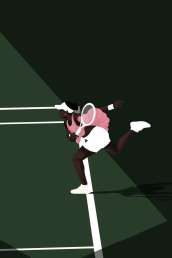
Bodies that move, shapes that change, gestures that generate beauty, like a broken racket, a tearful athlete, or a winning shot, are part of a perspective in which the tennis court ceases to be simply a space delimited by lines and becomes a stage on which the same tensions that permeate the rest of his painting continue to manifest themselves, transforming tennis into a choreography of life.

You grew up in Nigeria, and your artistic style seems deeply connected to the world and history around you. What did creativity look like in your childhood? Were there people, images, music or experiences within your family and environment that first made you understand that making art could become a way of expressing yourself?
“I would not say I grew up within an artistic environment in any formal sense. There was no art community around me, and I did not come from a family where making art was something particularly encouraged. I simply remember being very young—perhaps three, four or five years old—and becoming fascinated by cutting up pieces of paper, gluing them together and creating things from different images. Looking back, I realise I was making collages without even knowing what collage was. I just loved taking separate images, photographs or pictures of people and transforming them into something else. I did that for quite a long time.
Then, when I entered school, I started drawing more. I would make football sketches and things like Supa Stickas, drawing alongside some of my classmates. It was not until secondary school that I suddenly realised there were many other people doing similar things. That was an important moment for me. Before that, I had mostly been doing it alone. For a long time, I did not even have friends who fully understood what I was making. Then it almost became a small community. I always compare it to street football. You know when people gradually gather somewhere, divide themselves into teams and start playing? Drawing became a little like that inside the classroom. Different people would come together, somebody would choose a particular subject, and we would all start drawing.
Art became a way of connecting with myself. A way of taking something that existed inside my head and placing it onto paper or canvas. It gave me something to do that felt meaningful. Something clicked. I began to understand that art was perhaps the one thing I could genuinely do. I could not really play sports in the way everybody else seemed able to. So art became a kind of safe place for me. Something I could inhabit.”
Nigeria, and Africa more broadly, has an extraordinarily rich tradition of artistic and cultural expression, from visual art to music and many other forms. Even if your family was not directly involved in art, are there memories connected to your background or upbringing that you feel have shaped your practice more indirectly?
“Even now, I am not entirely sure where the artistic instinct came from. I have asked my family, and they do not really know either. There was nobody making art in my family. Even today, I am essentially the only one. I think I became accustomed quite early to moving through things on my own. I have had that experience many times. Earlier in my life, that could be very difficult. I would wonder, ‘Why am I doing this alone?’ Now I am much more comfortable with it. I have learned how to continue even when there is nobody immediately beside me doing the same thing. The one person who showed some particular interest in what I was making was my grandmother. A few times she told me that she used to do things like this. She recognised something in it. My mother’s sisters also paid attention to what I was doing. It was not necessarily encouragement, but it was more an acknowledgment that I was doing something.”
What role did sport play in your childhood? And what about tennis specifically? What is your earliest memory of the game? Did it first enter your life through playing, watching particular athletes, or through something else entirely?
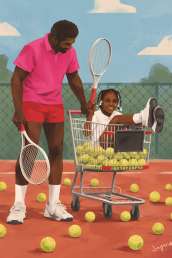
“My father was obsessed with the Williams sisters. I still do not entirely know why. He talked about them constantly. He would tell us about how they had started playing when they were very young, about their father and the role he played in their development, and how they eventually became these extraordinary tennis players. He probably did not know every detail of their story, but that particular part fascinated him. For me, though, none of that really connected until much later, when I began making paintings about tennis. I do have one very early memory. I must have been around five or six years old. My father brought home a tennis racket and a ball. We did not have a court. We simply played outside the house. There was a wall nearby and we would hit the ball back and forth against it with the rackets. We did that several times. It was extremely informal, but looking back now, it is interesting to realise that tennis had already entered my life in some form. Only much later did I understand that this memory had stayed with me.”


What was the first moment when you looked at tennis and realised it could become a subject within your art? Was there a particular player, match, gesture, image that made you recognise the visual possibilities of the sport?
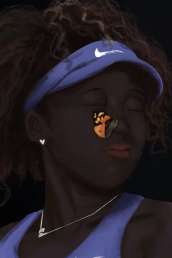
“Fast-forward to 2025. I made my first artwork connected to tennis, and it went viral almost immediately. It was inspired by Naomi Osaka and that famous photograph of her with a butterfly on her face. I simply responded to the image. I loved her expression, her fashion sense, and her attitude.
From there, I started thinking much more seriously about tennis as something I wanted to explore through my work. I became interested in bringing together fashion, tennis and my own artistic language. At that point, everything was moving very quickly inside my head, thinking about the idea and could not let it go. Eventually I simply sat down and started making more paintings. I combined visual elements I had seen, different colours, fragments of poses from Naomi’s game and other references. It became a mixture of several things. I finished that first piece and immediately understood that I needed to continue. I wanted to make more. But I did not want to make random paintings of tennis players. What fascinated me was the movement. There is something in tennis that feels very close to dance. That connection made sense to me because I was already developing work around music, dance floors, romance and movement. So when I began making tennis pieces, I recognised something familiar. The movements felt almost uncalculated. You do not necessarily see the thinking behind them. The body simply moves. It is similar to what happens on a dance floor. You make a gesture, then another, and they flow together. There is rhythm. I do not know how often people talk about tennis in that way, but that is what I see when I watch players. I see choreography. I see dance. And only now am I beginning to realise that both tennis and dance have existed somewhere within my family history and my own experience for a very long time.”
Before tennis entered your work, you had already explored love, life, music, relationships and, above all, Black excellence. Do you see the tennis paintings as a new chapter in your practice, or are they another way of investigating the same human themes that have always interested you?
“I would say they are a continuation of everything I have already been doing. The three major themes guiding my work are life, love and death. Everything else exists within those. They are almost like larger categories containing many smaller subjects. Within life, you have tennis. You have music. You have ordinary routines. You have relationships. You have everything people experience simply by being alive. Within love, you have romance. You have new beginnings. You have intimacy and all the different emotions that come with relationships. And within death, there are questions around the afterlife, other forms of existence, spirituality, celestial energy, higher powers. Those three themes guide almost everything I paint.
Tennis is simply one of the subjects that exists inside life. When I paint, I am often speaking about everyday experience. If you look across my work, you will find people in kitchens. Slow mornings. Self-care. Moments about getting back up after something difficult. Spiritual energy. These are all ordinary aspects of how I live. With the tennis series, I can bring many of those ideas into the same space. I can introduce romance. I can speak about movement. I can talk about life, love, identity and different forms of connection through the game. So I do not really see tennis as something separate from the rest of my practice. It is another language through which I can express what I already see and feel in life.”

What can art communicate about sport that other creative languages perhaps cannot? As an artist, what does tennis allow you to do compositionally that other environments do not? And ultimately, what do you want to express through tennis?
“Tennis allows you to explore softness. There is space within the game for reflection, elegance and a certain kind of calm. Even at the highest level, you can sometimes see players who seem to be genuinely enjoying the craft itself .That is something I find beautiful. Tennis gives you room to improve, but it also gives you room to express personality. And visually, there is so much more to the sport than simply depicting somebody standing on a court hitting a ball. Photography has done an extraordinary job of showing the beauty of tennis.
Photographers have documented the clothing, the gestures, the atmosphere, the players and the courts in incredibly rich ways. But when I began looking more closely at contemporary painting around tennis, I sometimes felt that the representation was narrower. Historically, that was not necessarily the case. If you look at tennis posters and illustrations from the 1970s, 1980s or 1990s, there is so much colour, imagination and graphic experimentation. Even publications like The New Yorker created extraordinary tennis imagery. I want to recover some of that freedom. Because tennis is not only what happens during a match. For somebody who plays, the sport becomes part of an entire identity. It enters the clothes they wear, the objects they keep, the way they spend their weekends. That gives an artist an enormous world to explore. You can paint romance around tennis. You can talk about friendship, intimacy, joy, disappointment. You can create an image that somebody wants in their home not simply because they love tennis, but because it reminds them of something they have felt. That is what interests me and I honestly feel as though I have barely touched the surface.”
Your work already has a very distinctive visual identity. How did you arrive at that language, and how do you continue developing it?
“Discovery requires experimentation. Everything you see in my work now is the result of trying things. I might like a particular colour or texture and ask myself: What happens if I combine this with that? Sometimes I do not know what the result will be until it is already on the canvas. That is how art develops. My style has changed enormously over the years, and I am certain it will continue changing. I like where it is now, but I never want to treat it as something fixed. I could work in a much more realistic or hyperrealistic way, but that would require months on a single painting. That is not necessarily how I want to work. I have too many images and ideas in my head. So I have gradually developed a language that allows me to put those ideas down while still feeling that the work belongs to me. Sometimes the entire painting might be made with only two brushes. Sometimes, limitation can actually create freedom. The important thing is continuing to experiment until something feels right.”
Considering how quickly tennis has expanded within your practice, could it eventually become a complete visual language of its own for you? And are there other subjects or sports you want to explore next?
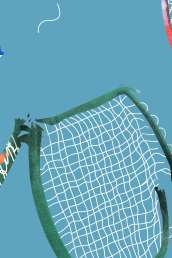
“I never really know exactly where the work is going. I can wake up tomorrow with a completely different idea, and I like having that freedom. But tennis definitely still has much more to give me. There are so many stories around the sport that I have not touched yet. I am currently working on a very large tennis painting, one major, large-scale work. Beyond that, I do not want to define the future too much. What I want people to take from these paintings is something very simple: enjoy yourself. Express yourself. Love tennis. Do not assume there is only one correct way of representing something. And that does not mean tennis has to be represented as permanently happy. If tennis is part of life, then naturally it also contains difficult moments. There are good days and bad days. I made paintings with broken rackets. I have figures sitting alone after a loss, exhausted or close to tears. Because that is part of the game too. It is okay not to have everything figured out. I know that from my own life. But things can change incredibly quickly. So perhaps the message is simply to keep moving. Keep experimenting.”


