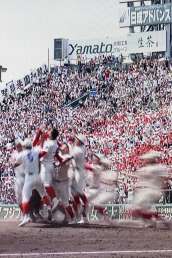
In Japan, during the summer Koshien tournament, baseball becomes the tangible starting point for something far more significant than a mere sporting result. An event that tells the story of dedication, that of hundreds of young people, of respect for traditions, linked to the long love story between baseball and the land of the rising sun. And, above all, of the intense passion with which an entire nation can experience a sporting event. Let us revisit this year’s tournament through the evocative narrative and visual lens of Mauro Puccini
Mauro Puccini has been working in the world of photography for years and, during his summer holidays, he often travels to Japan, where, together with his family, he has the opportunity to immerse himself in the relaxed pace of Japanese daily life. Yet, his gaze had never rested upon baseball, a sport that had never held any particular appeal for him. That changed one sweltering summer afternoon when, turning on the television, Mauro happened to catch a game of the Koshien tournament, and suddenly, everything began to take on a different meaning.
Japan’s National High School Baseball Championship, commonly known as the ‘Summer Koshien,’ is an annual, nationwide high school competition. Considered the most important amateur sporting event in the country, it brings together 49 schools from different Japanese prefectures in a series of knockout matches. A whirlwind of emotions, a rite of passage, a last chance for millions of young Japanese to experience sport in its most all-encompassing form, before adulthood imposes compromises, responsibilities, and divergent trajectories.
Mauro Puccini immediately understood that the uniqueness of this tournament lies as much in the physical effort, in the rush towards a base or in the conquest of an innings, as in the tears of a young fan, in the euphoria of a country absorbed in front of the television screens. In the dialectical tension between what happens on the pitch and what takes place in the stands or on the sofas. Through his photographic investigation, he seeks to convey this dualism in images capable of condensing the kinetic and passionate intensity of an unparalleled competition.






“My wife is Japanese, we have been together for sixteen years and we have a son. Every summer, during his school holidays, we go back to Japan. During the year, I lead a rather hectic life, whereas when I am there I am able to experience everyday life at a slower pace and, paradoxically, one of the things I love most about that time is precisely the possibility of stopping. I think it is a precious space, because it is often there that unexpected thoughts and intuitions begin to emerge.
In Japan, baseball is everywhere. You turn on the television and, almost inevitably, you find a live game or a replay. Of course, people follow the Japanese league, but also the American one, especially now that many Japanese players have become major protagonists in the United States. So I often found myself sitting in the living room with my father-in-law watching baseball. Despite the many years I have spent in Japan, it was a sport I had always struggled enormously to understand. Its rules seemed almost counterintuitive compared with the sports we grew up with in Europe. This year, I finally decided to sit down and try to really understand it. And yet, it still did not particularly excite me. Until one day, when I came home and saw a different kind of game on television. The players were clearly much younger. But above all, their behaviour was different: their reactions, the way they experienced every single moment. I saw boys shouting, crying, exploding with joy or despair. I asked my wife what I was watching. It was Koshien.”


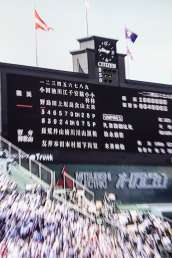
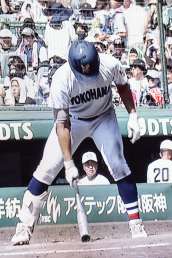
“Koshien is Japan’s national high school baseball championship. But to define it simply as a school tournament is to misunderstand its true significance. For two weeks, it captures the attention of the entire country. The feeling I had was comparable to what we might experience in Italy during a football World Cup when the national team is playing. I sensed it immediately at home, seeing how deeply everyone was involved, but above all through the images. There was something that went far beyond the athletic gesture itself. Within those games, I could see the dream of an entire generation of young people. High school in Japan lasts three years, which means that for many of them there are only three chances to reach that stage. For those in their final year, that game can quite literally be their last opportunity. And it is precisely this awareness that makes everything so intense. In professional sport, I rarely perceive emotion that feels quite so exposed. I am not speaking only about baseball, but about sport in general. Here, the motivation is different. Money, fame and professional success have not yet become the centre of the narrative. What remains is the absolute desire to win. I began following the tournament more and more closely, gradually becoming attached to certain teams.
I think the most fascinating aspect of Koshien is its social and cultural significance. Thousands of schools attempt to qualify, and only 49 teams, representing the country’s different prefectures, reach the final stage. From that point onwards, the format is single elimination: lose one game and everything is over. That makes every match feel like a final. Plus, the majority of these boys will never become professional athletes. After high school, many of them will go on to university, enter the workforce and begin what we might describe as a more ordinary adult life. For this reason, Koshien almost takes on the meaning of one final, immense opportunity for glory within their youth. I find something deeply romantic, and at the same time profoundly dramatic, in all of this.”




“If I had to identify one element of Koshien that, in my eyes, says something broader about Japanese culture, I would think first of all about dedication. The ability to devote oneself completely to something is a quality I strongly associate with Japan. When people decide to do something, they approach it with absolute focus and discipline. You can also see it in the number and quality of Japanese players who are now succeeding at the highest levels of American baseball. At Koshien, that dedication becomes extremely visible. But there is also the respect shown towards the opponent, along with a series of rituals that belong deeply to the culture of the sport. One of the moments that struck me most concerns the teams that are eliminated. After losing, some of the players collect soil from the field and take it with them as a memory. I find that gesture extraordinarily powerful. For me, that too says a great deal about Koshien.”



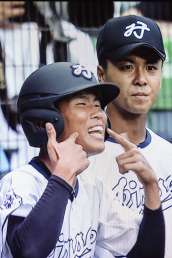
“I have been working professionally in photography for many years now and, inevitably, the way I photograph in a commercial context has often changed depending on the brand. When you work on something personal, all of that disappears. You free yourself from those constraints. You can allow yourself to follow what genuinely interests you. With Koshien, I was in exactly that position. I was completely relaxed, without a brief, without having to come back with any particular kind of image. I could simply observe and react to what I was seeing.
What struck me most was the way the television direction told the story of the games. After a play, the camera would immediately cut to the faces of players or supporters crying or celebrating. They had perfectly understood that the true power of the tournament did not lie only in the sporting action itself, but in the reactions that action generated. So I began working precisely around those transitions. I used slower shutter speeds and tried to capture the moments between a wide shot and a close-up, those fractions of a second in which the images seemed almost to overlap. Bringing together the athletic gesture and the emotional explosion in the stands. That freedom was probably the most interesting part of the entire project.”