


Numbers Game | On Artistic Gymnastics and Human Worth
The geometry of the body and the humanity of movement. Through his cinematic lens, Ilan Lampl explores what lies beyond the measure of athletic performance in the world of artistic gymnastics with Numbers Game
Beyond mere statistics. Beyond the scientific precision of scores and the seemingly incontrovertible order imposed upon physical expression once translated into rankings. Beyond these measures lies a volatile terrain, where human existence converges with, and diverges from sporting expression. A terrain that artistic gymnastics has always possessed the singular ability to reveal, and which Ilan Lampl, a filmmaker with an extensive background in the discipline, has chosen to explore through Numbers Game: a lyrical yet profoundly biographical short film brought to life with the support of Fujifilm UK.
At the heart of his narrative is Matthew McClymont, a gymnast representing Jamaica on the international stage, whose daily existence unfolds between the relentless pursuit of athletic perfection and the practical and emotional care of his sister, who lives with autism, cystic fibrosis and epilepsy. Along this fault line, two strands of life emerge, unfolding to a rhythm as syncopated as it is harmonious. A delicate equilibrium, as artistic gymnastics itself demands, in which the athlete’s instinctive devotion to individual ambition undergoes a profound transformation upon crossing the threshold of home, giving way to an absolute dedication to those he holds dearest.
Together with Ilan Lampl, we retraced the origins of this project, exploring the inspirations and intuitions that shaped Numbers Game. What emerged was a conversation that we have distilled into a single exercise, guided entirely by Lampl’s own reflections and sensibilities.


“I grew up practising artistic gymnastics, a discipline that was part of my life from the age of seven until I was nineteen. Matthew, the protagonist of the documentary, was one of the boys I used to train with. I was fiercely competitive when I was younger, and my dream was to compete at the Olympics. I pursued that ambition relentlessly, dedicating as many as thirty hours a week to gymnastics. Over time, I came to understand how sport, when pursued with such intensity, can both consume you entirely and play a fundamental role in shaping your character. It instills powerful qualities in you: attitude, mentality, discipline, ambition… But when I eventually decided to stop, the sense of failure was so overwhelming that I almost felt embarrassed. I was ashamed of not having achieved something I had desired and pursued with such unwavering dedication. For a long time, I believed that everything in sport ultimately revolved around winning.
It is only now, almost a decade later, that I can look back on that experience from a different perspective and recognise the true value of the journey itself. It is not so much about winning as it is about the person you become in the pursuit of success. That is the central reflection upon which I built Numbers Game. Matthew is an exceptionally accomplished gymnast, but the spotlight in sport often falls on the select few who win the gold medals and reach the absolute pinnacle of their discipline. With Matthew, I wanted to honour the effort of those who devote themselves to their craft with the same intensity and commitment, regardless of whether they achieve the same level of recognition.
Reflecting on my own experience, I am convinced that gymnastics profoundly influenced my understanding of cinema, shaping the way I perceive movement and approach filmmaking. My introduction to the medium came through sport. As a child, I was fascinated by stunts, and my first ambition was to work in that field. I started making videos with my friends while we were doing rather stupid things, like jumping off balconies. Gradually, though, my curiosity began to extend beyond the action itself, towards everything happening behind the camera: editing, framing, the possibility of telling a story through multiple perspectives and different angles… That was how I fell in love with the language of cinema.
Documentary filmmaking, in particular, has become my preferred form of expression. Whenever I travelled, I would take a camera with me and build stories around the experiences I encountered. I love the fact that documentary filmmaking is so deeply rooted in reality. Over time, this approach evolved into a way of observing the world. More recently, I have turned that lens towards the sporting world, developing a series of projects united by a desire to tell the stories of people who are completely absorbed in their respective disciplines, pursuing them with a level of dedication that does not necessarily earn recognition or attention from the wider world. It is a feeling I know intimately, having experienced it myself.
I adopted this same approach in telling Matthew’s story. What struck me most was the particular dichotomy that defines the rhythm of his life. In the gym, he is an athlete engaged in the relentless pursuit of improvement. At home, he is a full-time carer for his sister, who lives with cystic fibrosis, epilepsy and autism. Within the walls of his home, Matthew sets his own needs aside to devote himself entirely to someone else. Yet, despite the difficulties and the demands of reconciling such different responsibilities throughout the day, he has never used his circumstances as an excuse.
We all have the same twenty-four hours in a day, but what makes the difference is how we choose to spend them. It is from this relationship with time that the title Numbers Game emerged. For Matthew, every day is a constant balancing act between his own ambitions and the responsibility of caring for another person. Numbers, after all, also play a fundamental role in sport. Sometimes, a matter of centimetres, a single misplaced step on landing, can make the difference between a gold medal and finishing outside the podium… But there are also numbers that never appear in the rankings: the hours spent training and the countless repetitions performed away from the public gaze, day after day. It is within this dimension that the athlete takes shape, but above all, the human being.


One of the greatest challenges of portraying such a complex life within the confines of a short film was deciding which aspects to bring to the forefront and which to leave in the background. My creative process always begins with the audio edit. Once I have conducted the interviews, I assemble an initial version of the film using the voices alone. This approach allows me not only to establish a narrative structure, but also to distinguish what is essential from what, however meaningful in its own right, is not necessarily indispensable to the story. In Matthew’s case, I deliberately chose not to let his history of injuries dominate the narrative, despite how numerous they had been, because I do not believe they represent the true heart of his story.
From a visual perspective, my firsthand experience in artistic gymnastics naturally proved invaluable during filming. When you have an intimate understanding of a discipline, you can anticipate an athlete’s movements and identify the most compelling camera angles. Having a personal connection to a sport means possessing a kind of grammar of movement, one that allows you to portray athletic gestures with greater awareness and understanding.
The decision to use slow motion came from a desire to explore movement beyond the limits of ordinary perception. Gymnastics is an extraordinarily spectacular discipline, yet everything happens at tremendous speed. Stretching a movement that lasts only a few moments into five or ten seconds allows you to contemplate its technical complexity, revealing an entirely different dimension. I also believe that slow motion has the power to make almost anything fascinating, even the simplest gesture. We are not accustomed to observing the world in this way, and it is precisely this perceptual dissonance that makes it so captivating.
To portray the two dimensions of Matthew’s life, I chose radically different visual approaches. The sequences set in the gym are highly stylised, while those filmed at home follow a more stripped-back approach. The sporting sequences were conceived around a particular conviction: great athletes are forged in the shadows, when nobody is watching. In my mind, this idea took the form of a body capable of radiating light in the darkness, even in the absence of any external point of reference. This reflection became the foundation of the gym sequences’ visual aesthetic, built around the interplay of light and shadow.
The domestic environment, by contrast, demanded an entirely different sensibility. It is a delicate situation, one I felt a profound responsibility to portray with the utmost respect. I chose to maintain an unobtrusive presence, remaining at the edges of the rooms and occasionally filming through mirrors, without interfering with the family’s everyday life. My priority was to allow reality to unfold as authentically as possible. The contrast between these two approaches enabled us to convey a particular glimpse into the complexity of Matthew’s existence.
This attentiveness to the people I portray reflects a fundamental principle of my approach to filmmaking: putting myself in their position and striving to tell their stories with sensitivity and authenticity. Everything rests on trust. Matthew and I already shared a personal connection, but it was essential to continue nurturing that relationship through mutual respect. Because of his numerous injuries, we were only able to film two takes of each exercise, avoiding any additional strain on his body. I believe that respecting those boundaries helped him feel safe. Throughout the editing process, I also maintained an ongoing dialogue with him, showing him every version of the film and listening to his impressions, so that he could recognise himself completely in the story we were telling.
Numbers Game is intended as an ode to the beauty inherent in the very act of striving for something, regardless of the outcome. In sport, the imperative to be the best often leads athletes to place enormous pressure on themselves, sometimes at the expense of the very joy of practising their discipline. I believe that learning to focus on doing the best we can, within the limits of our own abilities, can help relieve some of that pressure. Sporting careers are often fleeting, and it is important to appreciate them while they last. I hope Matthew’s story can inspire people to recognise the value of the opportunities before them. Pursuing an ambition, devoting yourself to something you believe in, is already a victory in itself.”


Exegesis of Surf | Leonardo Fioravanti & Tommaso Geraci
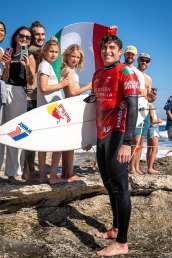
Thanks to K-Way, we had the opportunity to explore the creative symbiosis between Leonardo Fioravanti, a contemporary icon of Italian and international surfing, and Tommaso Geraci, the visual storyteller entrusted with capturing the verses Fioravanti composes upon his board. A relationship extending far beyond professional collaboration.
The board as a prism, through which everything becomes experience, enchantment, expression and, inevitably, narrative.
On one side, Leonardo Fioravanti, one of the discipline’s foremost interpreters. A self-taught artist who, from the shores of Lazio, has carved his way through ocean swells, attaining a status previously unimaginable in the Italian history of this sporting art form. On the other, Tommaso Geraci, the lens through which this pursuit of excellence has acquired, and continues to acquire, tangible form. A succession of aesthetic visions and narrative tableaux, captured barrel after barrel, across the latitudes of the globe.
Athlete and visual biographer. Artist and digital painter. Their synergy unfolds as a shared pursuit of surfing’s fullest stylistic and competitive potential, propelled by an ever-deepening human connection.
Amid the celebrated Atlantic scenery of Peniche, as guests of K-Way for the final and only European stop of the World Surf League, we had the opportunity to engage with both, approaching the board as a prism through which to refract personal histories, the poetics of surfing and an exacting attention to detail. What emerged was a dual stream of consciousness, an undulating compendium of two distinct yet kindred approaches to a shared passion.
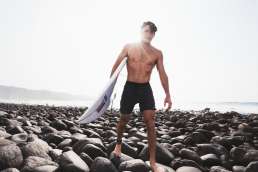




Leonardo Fioravanti
“I believe my personal style is deeply influenced by my Italian identity. Having a recognizable style, something aesthetically distinctive and beautiful, has always been important to me. There are surfers who surf incredibly well, but who aren’t necessarily beautiful to watch… I’ve always tried to develop a way of surfing that goes beyond the score, something that might inspire young boys and girls watching from the beach to want to surf like me. Having a distinctive style means, in a certain sense, being an artist.
There are surfers who have inspired me enormously, even though their competitive careers, strictly speaking, haven’t been particularly spectacular. The way they surf, the way they execute certain moves, remains extraordinary to me. I think, for example, of Andy Irons. The way he moved on a board was simply inimitable. Or Michael Rodrigues, a Brazilian surfer who performs incredible airs. They are sources of inspiration for me. I’ve always tried to draw small elements from different surfers, finding something in each of them that could contribute to shaping my own way of surfing. After all, that’s precisely what happens in art: artists gather impressions and fragments of inspiration, transforming them into something entirely their own.
Attention to detail is essential. Even the details you find in a photograph, something I often discuss with Tommaso, who follows me and documents my journey through images. I don’t think I’m ever one hundred per cent satisfied, because I’m always looking for something more. Experience has taught me that this constant pursuit can also have a negative side, but approached in the right way, it can become a source of strength. You can be happy with what you do, with what you have, and with the person and athlete you’ve become, while still striving for something more. That desire keeps pushing you towards a better version of yourself.
When you’re confronted with a canvas in perpetual motion, like the ocean, instinct becomes paramount. You have to be completely present, entirely focused on what you’re experiencing. To continue the parallel with art, an artist can create something, decide to discard it, and start all over again. Surfing is different. When the right wave comes, it might be your only opportunity. You can’t waste it, and you can’t count on a second chance. You have to put everything into that single instant, concentrating entirely on yourself and what’s happening around you.


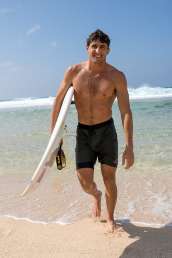

Entering and remaining in a state of flow is something every athlete continually strives for. The flow state is incredibly difficult to explain, because when you reach it, you’re so deeply immersed in your own world that you barely register what’s happening around you. I remember my day in El Salvador (where Fioravanti claimed his first career victory on the WSL Championship Tour, Ed.): everything happened without my having to force anything. I was always in the right rhythm. I wasn’t trying to achieve something at all costs; I was simply experiencing one moment after another. I was in the flow. It’s an incredible sensation, one that’s extremely difficult to find elsewhere. I think the most important thing is not to force it. You have to let it come to you.
Reading the ocean is another essential aspect of surfing. Unfortunately, there’s no book that can tell you exactly how to do it, but that’s part of its beauty: everyone is free to interpret it in their own way. It’s wonderful and frustrating at the same time. You can spend years in the water, learning so much about the currents and how the ocean works, only to find yourself completely out of rhythm during a competition. That’s another reason why I talk about instinct so often. I’m constantly reminding myself to trust it. It means relying on the experience I’ve accumulated over the years, the thousands of hours I’ve spent in the water, the connection I’ve developed with the ocean… I couldn’t tell you exactly why, at a particular moment, I feel I should stay a little further to the left or move slightly to the right. I just feel it. I’ve learned to ‘listen’ to the ocean, to attune myself to it. There’s no exact formula for achieving that connection every single time. If there were, it would all be far too easy.
For me, the ultimate image of that connection is the barrel. What you see from the outside is beautiful, but what you feel when you’re inside is something spectacular. It’s a special moment, almost impossible to describe. It’s just you and the ocean. The very thought of being inside a barrel formed by nature, of experiencing such an extraordinary natural force, is incredible… In that moment, the world stands still. I wish I could give every single person the chance to experience that feeling…


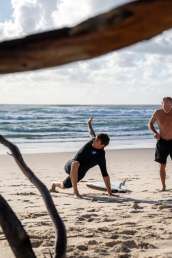

Beyond meditation and the gratitude I feel for this sport, I have to admit that reading has played a major role in helping me take an important step forward in my career. I read a great deal. Sometimes, something you come across in a book is enough to change the way you see sport, or life in general. Reading other athletes’ biographies, watching sports documentaries, listening to interviews: all these experiences have helped me draw connections between different disciplines and find inspiration in other people’s stories.
There are athletes, for example, who consider their sport the only thing that matters in life, something before which everything else loses its meaning. I don’t see it that way. For me, there’s the part of my life I experience when I’m surfing and the part I live outside the water. Those two dimensions coexist perfectly, because I love them both. I want to cherish the moments I spend with my family and friends, just as I want to continue appreciating surfing every single day.
Seeing all the people who came to support me in Peniche, with an incredible number of Italian flags lining the beach, knowing that some of them may have spent a significant portion of what little money they have to be there… I find that truly special, something that transcends sport itself. I appreciate it enormously. I was disappointed that I couldn’t achieve more at this event, for myself, of course, but to a large extent, especially for them. I wish I could have given them more emotions, more beautiful moments for us to share. I feel an immense sense of gratitude.
As I said earlier, seeing young surfers take up the sport because of me is a victory beyond comparison. In Peniche, I met a family of surfers who had decided to name their son Leonardo after me. There’s no victory in the water that could ever compare to that. Seeing a new generation of Italian boys and girls who want to surf like me and embrace the same way of life is another victory in itself. These are things that endure, whose significance extends far beyond any single competition. And, ultimately, beyond surfing itself.”



Tommaso Geraci
“Photography and surfing are two passions that developed alongside each other. For several years, they remained separate. I started surfing in Italy, in the same places as Leonardo, around Santa Marinella. Photography, on the other hand, began out of simple curiosity. After high school, I started studying it largely on my own, taking a few courses along the way, without ever imagining that one day I would become a photographer or filmmaker specialising in surfing.
A few years later, I began exploring whether it might be possible to work as a surf photographer in Italy, only to encounter countless difficulties. I spoke to several professional photographers who, in our country, were mainly working in entirely different fields. Many of them discouraged me. But the desire to give it a try never went away. I kept pursuing it until I came into contact with Roberto D’Amico, one of Leonardo’s closest friends and a prominent surfer from our area. Roberto really appreciated my photographs and encouraged me to develop my filmmaking skills as well. That’s how I found my first small assignments in surfing, working with the Federation and Roberto himself. Eventually, Leonardo asked me to work with him.
Our relationship developed naturally. The connection was personal before it became professional. As I mentioned, we’d already spent some time together and established a certain familiarity. Within a very short period, our bond grew much stronger. Now we travel together, share accommodation, make practically every journey together, and experience almost every moment of competition side by side… When you spend that much time together, the relationship inevitably extends far beyond work.
Leonardo made it clear to me from the beginning that he wasn’t necessarily looking for the most talented photographer or filmmaker in the world. Above all, he wanted someone he could genuinely get along with. In some respects, my work is also quite mechanical: Leonardo uses the images as an actual training tool, to review his movements and analyse what he does in the water… My role is also to support him, make his life easier, and help him approach everything with greater peace of mind. I think having someone who can do that is even more important to him than having someone capable of taking better photographs than anyone else.
Naturally, the fact that I’m a surfer myself, albeit an amateur, helps enormously. It helps when I enter the water to film, but also when I’m working at the computer and selecting particular images. Understanding surfing means understanding its movements, its difficulties, its technical nuances… After all, most of my colleagues who work with other surfers are either surfers themselves or people with a deep passion for the sport. I couldn’t do the same job in snowboarding, for example, because I wouldn’t understand or appreciate its technical and stylistic characteristics in the same way.
What I love most about surfing is the emotion it gives you when you’re in the water. The extraordinary thing is that you can enjoy it regardless of your level. Even as a beginner, every stage of learning can bring immense satisfaction. In other sports, the early stages can be incredibly frustrating. Leonardo, for example, also plays golf. I’ve tried it, but when you’re that inexperienced, it’s difficult even to enjoy yourself. In surfing, on the other hand, you can watch someone who has only just managed to stand up on a board experience a joy comparable to Leonardo’s when he rides through a three-metre barrel…


From a photographic perspective, my eye is naturally drawn to the elements of nature that surround surfing. We work in the ocean, immersed in extraordinary environments, often with access to perspectives that are truly unique. When you film from the water, in a way, you bring the viewer into the ocean with you. If I had to choose one image that perfectly embodies that sensation, I’d think of Tahiti, where the most recent Olympic surfing competitions took place and where one of the WSL events is held.
I spend practically the entire day in the water with Leonardo, swimming alongside him and filming him from privileged vantage points. In those moments, I almost feel as though I’m surfing myself, because I can directly experience the energy of the waves and of Leonardo himself. My favourite opportunities, though, are those rare occasions when we manage to travel outside the competition calendar, with the sole purpose of creating beautiful images. Unfortunately, they don’t happen very often, perhaps once or twice a year… But when they do, it’s wonderful, because we have much greater freedom to decide what to do and how to tell the story.
During competitions, by contrast, our work is inevitably focused on performance. Every day, Leonardo analyses his movements with his coach. I prepare all the footage. When we’re staying in the same house, we review the images together. There are countless details to consider, particularly at his level, where the pursuit of improvement and refinement is constant.
From an aesthetic perspective, too, detail is fundamental. A beautiful surfing image depends greatly on the athlete’s style. Style is something you can work on, but I believe there’s also an innate element to it. According to many surfing enthusiasts, Leonardo has a particularly beautiful style to watch. For me, a surfer needs to be elegant, to convey the impression that what they’re doing requires no effort whatsoever. At the same time, they need to express tremendous power. They have to generate force without revealing the effort behind it. They need to make a significant impact on the wave while remaining deeply connected to it. It’s a combination of qualities that isn’t always easy to decipher.
With all this in mind, Leonardo and I naturally share many reflections on the photographs I take. Since he’s the surfer competing at the highest level in the world, ninety-nine per cent of his comments concern the selection of images according to the technical precision of his movements, something that matters enormously to him. Occasionally, though, he also weighs in on the artistic outcome of an individual composition, and rightly so, because ultimately, it’s his image.


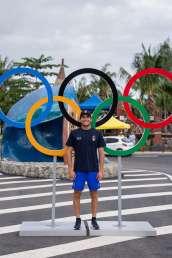
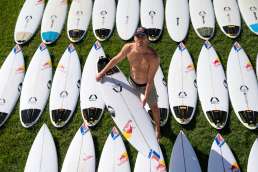
My work also brings me into contact with the world of brands supporting Leonardo. With K-Way, for example, we’ve always had a very positive relationship, above all because of the human connection we’ve established. There’s direct communication and a sense of closeness, strengthened by the fact that it’s an Italian company. They’ve been among Leonardo’s earliest supporters, and that makes an enormous difference. Sometimes, the most complicated part is acting as an intermediary between the demands of brands and media and Leonardo’s sporting commitments. These situations can be difficult to manage, but we always try to do our best. Since performance remains our priority, what I try to do is capture as many moments as possible, then select those that best align with each brand’s needs. During a competition, I can’t freely organise an elaborate photoshoot, so I have to recognise and capture the right images as events unfold.
Another challenge is the need to remain completely flexible. To make myself as available as possible to Leonardo, I can hardly plan my year too far in advance. Things can happen, and have happened before, that completely change our plans for the following months overnight. You can’t anticipate these situations, but you have to be ready to embrace them and manage them as well as possible. You need to be willing to reorganise everything at the last minute, while also accepting that you’ll spend several months of the year away from home.
Then there’s the emotional dimension, which is incredibly intense. The more invested you become in this journey, the closer you grow to Leonardo, and the more personally involved you become in every competition. When things don’t go well, I genuinely suffer too. But I always try to remind myself of something I often say to fans: nobody cares more about the result than the athlete. I understand that people who follow a sport passionately can sometimes be quick to judge or criticise, but they should remember that when an athlete doesn’t achieve the result they were hoping for, nobody feels that disappointment more deeply than they do.
That awareness also helps me navigate those moments. I have to respect what Leonardo is going through after each competition, while also helping him look ahead. Once you’ve analysed a mistake and understood what you can learn from it, you need to reset and focus on what you can do today to avoid repeating it tomorrow. There’s always another competition, another opportunity to improve.


I think Leonardo’s story already has an extraordinary amount to tell. Perhaps all that’s missing is a happy ending. This year, he claimed his first victory at a World Tour event, and that alone, in my opinion, makes his journey remarkable. I’d love to revisit his entire career one day, perhaps when he retires, if only to remind people where it all began.
Today, new generations of Italian surfers have reached an extremely high level and may one day achieve what Leonardo has achieved. But we must remember that Leonardo was born and spent his early years in Italy, developing his talent on our waves. Many of the young surfers who now have the potential to follow in his footsteps spent their childhoods by the ocean. We’d never seen a surfer born and raised in Italy reach the heights Leonardo has reached. I think anyone who truly understands this sport can appreciate just how exceptional that is.
That’s why I try not to think too much about the weight of responsibility that comes with documenting, through images, an athlete of such significance to the history of Italian surfing. I put everything I have into my work, but our team’s primary objective isn’t to create the most beautiful communication or reach the largest possible audience. Of course, those things matter to us too, and we do our best to approach them with care. But Leonardo trains every single day to win, and inevitably, everyone working alongside him comes to share that same mentality.
My greatest satisfaction would be seeing him become WSL World Champion. If greater fame and recognition followed, I’d be incredibly happy for him and proud to have played a part in documenting his journey through my images. But above all, I’d simply love to see him reach heights no one has ever reached before.”

A never ending research I Pierre David
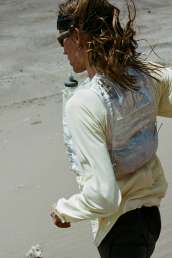
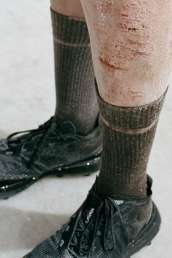
For many, sports consist of nothing more than athletic performance, and the same is for how it is portrayed. For others, however, sports become a system of signs and symbols that generates culture; the driving force behind new narratives. For Pierre David, photographer, filmmaker, and now Head of Image at SATISFY, the world of sports imagery emerges precisely from this exploratory space: a universe that takes shape around the athletic gesture, in what precedes and follows the action, and in the real, shared experience
His interpretation of running does not arise from the conventional vocabulary of the sport. Rather, it is rooted in the rich traditions of skateboarding, surfing, and snowboarding; in underground music; in independent magazines; and in that infinite universe of references through which subcultures have built autonomous identities capable of spreading beyond dominant narratives. Even before he understood the technical workings of a camera, Pierre David had sensed that every sport can create a landscape broader and deeper than the sport itself: a musical genre, a way of dressing, and a way of being together, creating a clearly recognizable community.
It’s from this knowledge that his work takes shape, along with the visual world he is creating with SATISFY, a brand in which running becomes a sociocultural exploration. For him, telling the story of running means going beyond the surface of the act itself, building a narrative around the people, freeing it from athletic repetition, and restoring its anthropological depth.
In this perspective, the creation of an image cannot be separated from the experience itself. It’s a method that preserves the authenticity of skateboarding and transfers it to the context of running: real journeys, weeks spent in remote places, friendships, and roads traveled. Moments when a photo emerges suddenly. A genuine connection with the landscape and with people. Exponentially increasing its ability to convey sincere emotions.


Your work seems to carry traces of different worlds: underground music, surf, skate, fashion, and now running. How did these different cultures shape your visual language?
“For many years, I worked independently as a photographer and film director. More recently, I moved into a full-time role at SATISFY as Head of Image, overseeing everything connected to the brand’s visual language. My roots, however, come from elsewhere: skateboarding, surfing, snowboarding, music, art, subcultures. All of these also live inside the world of SATISFY. That is probably why I have always had such a close connection with Brice, the founder of the brand. We met more than ten years ago, around the time of SATISFY’s second campaign and instantly connected. I have always felt that inside each of these sports, there are different worlds. There are the truly core athletes, and there are the underdogs, the people who don’t always fit into the performance narrative but carry the culture in another way. That is where I have always been more attracted: not only to the athletic gesture itself, but to everything around it, the attitude, the style, the emotion, the pain. The strange mythology of these underground disciplines.
From a photographer’s point of view, I always found it more compelling to look at a skateboarder’s personality, his style, his inspiration, the way he was dressing, the music he was listening and of course the tricks but this was never my first focus point. I always admired the flow more than the execution itself. What interested me was not only the action, but everything before and after it. That, for me, is where the image begins. That is where I connected with SATISFY. It has never been built as a performance brand, around elite athletes or winning stories. It has always been rooted in subculture. We are a premium Trail running brand but we talk about emotion, attitude, real storytelling with an edge. It’s about running and everything that co-exists around and in that world.”
Before running became central to your work, you were deeply connected to surf and skate subcultures. What did those environments teach you about image-making, freedom, and authenticity?
“In the beginning, with running, the challenge was very particular. Running images at first sight can feel meaningless to execute, it’s just about stride, flow, and that’s where I was looking for attitude, for sparks in the act itself and the personality of the guy/girl I was shooting, because there are no tricks involved. It’s all about the environment, the light, and the subject flowing in it. Then I realized I was hooked when, with the brand, through the design of the clothing, our crew, and our storytelling, images were taking life in a different dimension. Surfing and skateboarding offer you something different. First, there are the tricks, which are the core of it. Second, you travel to incredible places, you go to remote islands with a crew for weeks, you shoot beautiful waves underwater, big tubes, airs, reef cuts, blood.… Everything already carries a kind of visual intensity. Running is different. That is where a photographer really has to step outside of his own boundaries. That is why, especially over the last few years, you can see a shift in running photography. A lot of photographers are experimenting, trying to build concepts around it. You can feel that everyone is searching for a way to make the act visually interesting.
For me, what I have always loved most is the emotion of an image, especially when it is connected to a natural environment. That is why it is difficult for me to shoot running on a track, I need the natural element. And that is why I like shooting only analog with running mainly, films add a difficulty to the medium and the beauty of film is beyond everything. That is also one of the reasons I love my job: I want to be in nature. I am not a studio person. All of these sports have always brought me into beautiful locations. Skateboarding, surfing, snowboarding and running are connected, because they all involve one man or one woman inside an environment, trying to move through it, respond to it, and exist within it.”


How and what did you start photographing? And when did sport and its culture become a central subject of your visual exploration?
“For me, photography came from an emotional place. I don’t want to simply say that I came from a difficult background, because that would not be completely true. My surroundings were beautiful: the south of France, the palm trees, the light, the sea. But at the same time, there was something paradoxical in it. A rough emotional environment, a troubled family, love, pain, addiction. All the good and the bad that can exist when you are young. All of that builds up inside you. At some point, when you grow older, it has to come out somehow. Some people turn to drugs, some start a band, some paint, write, or make images. I think many artists share that kind of sensitivity. Photography, for me, became a way to escape reality, but also to face it from a different angle. You are looking at what is in front of you, but through another spectrum. You are somewhere else, but still completely connected to the immediate reality around you.
I started shooting on film, because digital did not exist then in the way it does now. As soon as I saw the first prints, I was amazed. There was something almost magical about that process. When I was young, my father had a very niche French snowboarding brand. I grew up around that world. He would organize snowboard trips, and I was looking at these guys, that whole baggy, early snowboarding aesthetic. There were always tons of magazines at home. I would look through all of them and see ads, sequence shots on film, all these amazing stories of travels. I was always gravitating around my father’s work. He would hire photographers for campaigns, and I could see all the gear, all the process. That is how I was introduced to sport and photography. In a way, that is also the same atmosphere I try to build around SATISFY. We go somewhere for weeks and it feels like a cool hangout group of people. What we do now is not so far from what I experienced as a kid. We spend time in beautiful natural locations, we go for runs, we shoot, we hang out, we have a good time.”
Looking back at your path, do you feel you were always searching for communities that existed slightly outside the mainstream?
“I have always been attracted to the outcast from an artistic and emotional point of view. I was never really drawn to the mass market. Visually, emotionally, I was always more interested in the goth loner sitting at the back of the school, going through something difficult, rather than in the obvious hero. I have always been sensitive to those kinds of profiles, personalities that carry something fragile, strange, or unresolved. The same is true with my references. In cinema, for example, I would naturally go more towards indy and new waves than big time stuff. It’s not a judgment, it’s just where my instinct goes. I think I was always more underground in spirit, even if I didn’t necessarily come from an underground place. I was born in Cannes, the less underground scene you can have in France, the city of the international film festival but also a very particular place. There is a lot of wealth, rich people, big cars, a very posh way of living. Growing up around that, I remember feeling a kind of rejection. As soon as I started seeing punks, skateboarders, indy crews, certain advertisements, strange and disruptive figures, I was immediately fascinated. That is where my eye went.”
Athleta Magazine looks at sport not only as performance, but as a cultural and artistic language. What does sport represent for you as a visual and cultural territory?
“For me, sport has always represented, much like photography, a form of escape from life. Whether you are going through a good or a difficult period, you might feel the need to go out and run, skate or whatever makes you feel better. At the same time, sport was always and is a bridge toward culture, fashion, music. The guy or girl you admired listened to a certain kind of music, dressed in a particular way, drove a particular car. Those people were my heroes when I was young, and I built part of my identity by observing them.”




Coming from surf and skate culture, how did you begin to look at running not simply as a discipline, but as a world with its own codes, rituals, and iconography at SATISFY?
“I think it happened very naturally because we never forced it. We did it for real. That is the fundamental difference. Before SATISFY, I photographed campaigns for several other running brands. Usually, I would receive a brief from an agency, travel to a location for two days, and focus primarily on photographing looks, products, with no meaning. What we have always done at SATISFY is much closer to what I had been doing throughout my life. I love trail running. I never run on the road; I am always outdoors. The garments and colours in SATISFY’s collections have always been so inspiring and they often carry a strong relationship with natural elements. In the end, what we do is simply travel with friends. It is not a frantic one or two day production. We might spend weeks on a road trip through Death Valley. Of course, we are there to shoot a campaign, but we are also genuinely living the experience. That is where images begin to emerge, because the experience is real. When you genuinely travel, you encounter things along the way that you could never have planned to photograph. Of course, this kind of approach is expensive. That is also why we try to work with small crews. We try to produce everything in-house. I find that atmosphere incredibly creative.”
SATISFY has built one of the most recognizable visual identities in contemporary running culture. From your perspective, what makes its aesthetic so distinct?
“SATISFY is not a conventional running brand. For me, it’s a subcultural world in running and outdoors. I am working with inspirations that are fundamentally my own and I actively force myself not to follow what other running brands are doing. I stay away from running as much as I can. I find inspiration in travels, magazines, old movies, music videos, and in every possible form of archival and historical imagery. I am very visual driven. The problem today is that everyone seems to be inspired by the same references. We have always tried to move in a different direction. When everyone else is going one way, or to our way, we instinctively move in the opposite one. That is part of what separates us from other brands.
Today, brands need such an enormous amount of content that photographers themselves can begin to run out of inspiration. There is simply too much material being produced. And, as I said earlier, very little happens when someone runs. A runner is simply running. You have to be good enough to generate new ideas and shift the narrative. We love narrating stories, expressing emotions, and constructing a particular aesthetic. There is of course excellent work being produced by other brands as well, and I have enormous respect for some of it and the talent behind it. We simply have an entirely different point of view. We create our own world, and it needs to remain our own.”
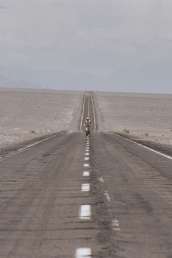



SATISFY’s printed magazine, POSSESSED, feels like an extension of the brand’s inner mythology. What does print allow you to express that digital content cannot?
“For almost eight years, I worked with a publication called Desillusion Magazine, first as a collaborator and later as a partner. It was a European cultural and artistic magazine built around skateboarding, surfing, snowboarding, art and everything surrounding it. I come from print, and that is why the printed objects remain so important to me. The printed magazine offers a form of relief. Images and stories should be printed, because of the texture and materiality they acquire. When you open a book, you also take a break from your work and from the rhythm of the screen. It is entirely different from scrolling through a device searching for inspiration online. A magazine is a tangible object. You can keep it. It possesses value, it can become cult. I feel that one of the problems today is that campaigns, even extraordinary ones, often seem to lose value just after a day. That is why I love POSSESSED. It exists under SATISFY, but we don’t really speak about the brand. Instead, we investigate the strangeness of running and what is happening within this peculiar world, approaching it from a different and much more cultural perspective. Our editor in chief is a goat and truly hilarious. I think print needs to live more fully. It needs to return, and to become increasingly present again. If you want to take a break, get inspired and have a good laugh, read Possessed magazine.”
When you think about the future of running imagery, what would you like to see less of, and what would you like to see more of?
“That is a very difficult question for me because I deliberately avoid looking too closely at the world of running. I genuinely do not know everything that is happening within it, and I am very honest about that. I do not want to look too closely at what everyone else is doing because it can distort my instincts. I actively force myself not to engage with it. For that reason, it is difficult for me to speak on behalf of running imagery as a whole. I can only speak about what I believe in and what we are doing at SATISFY. We are building something so strong that the road I see in front of us is endless.”



Emotional Catalyst | The Koshien Baseball Tournament
In Japan, during the summer Koshien tournament, baseball becomes the tangible starting point for something far more significant than a mere sporting result. An event that tells the story of dedication, that of hundreds of young people, of respect for traditions, linked to the long love story between baseball and the land of the rising sun. And, above all, of the intense passion with which an entire nation can experience a sporting event. Let us revisit this year’s tournament through the evocative narrative and visual lens of Mauro Puccini
Mauro Puccini has been working in the world of photography for years and, during his summer holidays, he often travels to Japan, where, together with his family, he has the opportunity to immerse himself in the relaxed pace of Japanese daily life. Yet, his gaze had never rested upon baseball, a sport that had never held any particular appeal for him. That changed one sweltering summer afternoon when, turning on the television, Mauro happened to catch a game of the Koshien tournament, and suddenly, everything began to take on a different meaning.
Japan’s National High School Baseball Championship, commonly known as the ‘Summer Koshien,’ is an annual, nationwide high school competition. Considered the most important amateur sporting event in the country, it brings together 49 schools from different Japanese prefectures in a series of knockout matches. A whirlwind of emotions, a rite of passage, a last chance for millions of young Japanese to experience sport in its most all-encompassing form, before adulthood imposes compromises, responsibilities, and divergent trajectories.
Mauro Puccini immediately understood that the uniqueness of this tournament lies as much in the physical effort, in the rush towards a base or in the conquest of an innings, as in the tears of a young fan, in the euphoria of a country absorbed in front of the television screens. In the dialectical tension between what happens on the pitch and what takes place in the stands or on the sofas. Through his photographic investigation, he seeks to convey this dualism in images capable of condensing the kinetic and passionate intensity of an unparalleled competition.






“My wife is Japanese, we have been together for sixteen years and we have a son. Every summer, during his school holidays, we go back to Japan. During the year, I lead a rather hectic life, whereas when I am there I am able to experience everyday life at a slower pace and, paradoxically, one of the things I love most about that time is precisely the possibility of stopping. I think it is a precious space, because it is often there that unexpected thoughts and intuitions begin to emerge.
In Japan, baseball is everywhere. You turn on the television and, almost inevitably, you find a live game or a replay. Of course, people follow the Japanese league, but also the American one, especially now that many Japanese players have become major protagonists in the United States. So I often found myself sitting in the living room with my father-in-law watching baseball. Despite the many years I have spent in Japan, it was a sport I had always struggled enormously to understand. Its rules seemed almost counterintuitive compared with the sports we grew up with in Europe. This year, I finally decided to sit down and try to really understand it. And yet, it still did not particularly excite me. Until one day, when I came home and saw a different kind of game on television. The players were clearly much younger. But above all, their behaviour was different: their reactions, the way they experienced every single moment. I saw boys shouting, crying, exploding with joy or despair. I asked my wife what I was watching. It was Koshien.”



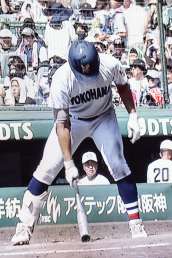
“Koshien is Japan’s national high school baseball championship. But to define it simply as a school tournament is to misunderstand its true significance. For two weeks, it captures the attention of the entire country. The feeling I had was comparable to what we might experience in Italy during a football World Cup when the national team is playing. I sensed it immediately at home, seeing how deeply everyone was involved, but above all through the images. There was something that went far beyond the athletic gesture itself. Within those games, I could see the dream of an entire generation of young people. High school in Japan lasts three years, which means that for many of them there are only three chances to reach that stage. For those in their final year, that game can quite literally be their last opportunity. And it is precisely this awareness that makes everything so intense. In professional sport, I rarely perceive emotion that feels quite so exposed. I am not speaking only about baseball, but about sport in general. Here, the motivation is different. Money, fame and professional success have not yet become the centre of the narrative. What remains is the absolute desire to win. I began following the tournament more and more closely, gradually becoming attached to certain teams.
I think the most fascinating aspect of Koshien is its social and cultural significance. Thousands of schools attempt to qualify, and only 49 teams, representing the country’s different prefectures, reach the final stage. From that point onwards, the format is single elimination: lose one game and everything is over. That makes every match feel like a final. Plus, the majority of these boys will never become professional athletes. After high school, many of them will go on to university, enter the workforce and begin what we might describe as a more ordinary adult life. For this reason, Koshien almost takes on the meaning of one final, immense opportunity for glory within their youth. I find something deeply romantic, and at the same time profoundly dramatic, in all of this.”
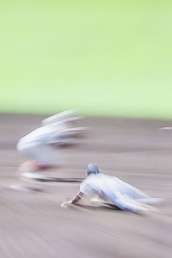


“If I had to identify one element of Koshien that, in my eyes, says something broader about Japanese culture, I would think first of all about dedication. The ability to devote oneself completely to something is a quality I strongly associate with Japan. When people decide to do something, they approach it with absolute focus and discipline. You can also see it in the number and quality of Japanese players who are now succeeding at the highest levels of American baseball. At Koshien, that dedication becomes extremely visible. But there is also the respect shown towards the opponent, along with a series of rituals that belong deeply to the culture of the sport. One of the moments that struck me most concerns the teams that are eliminated. After losing, some of the players collect soil from the field and take it with them as a memory. I find that gesture extraordinarily powerful. For me, that too says a great deal about Koshien.”



“I have been working professionally in photography for many years now and, inevitably, the way I photograph in a commercial context has often changed depending on the brand. When you work on something personal, all of that disappears. You free yourself from those constraints. You can allow yourself to follow what genuinely interests you. With Koshien, I was in exactly that position. I was completely relaxed, without a brief, without having to come back with any particular kind of image. I could simply observe and react to what I was seeing.
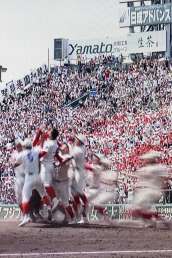
What struck me most was the way the television direction told the story of the games. After a play, the camera would immediately cut to the faces of players or supporters crying or celebrating. They had perfectly understood that the true power of the tournament did not lie only in the sporting action itself, but in the reactions that action generated. So I began working precisely around those transitions. I used slower shutter speeds and tried to capture the moments between a wide shot and a close-up, those fractions of a second in which the images seemed almost to overlap. Bringing together the athletic gesture and the emotional explosion in the stands. That freedom was probably the most interesting part of the entire project.”




New Era, Basecaps are Sport and Culture
Born out of the tradition of the quintessential American sport, today Basecaps are a universal manifesto of identity and pride.
Between sports and fashion there is a connection that goes far beyond aesthetics off the playing field. Between fashion and sports there is a style code inherited from the field that allows each of us to make the values of the game our own. These are values that communicate belonging, loyalty, character and personality, but also madness and obsession. And it is exactly when style becomes the bearer of identity that sport transcends fashion, bypasses trend, and becomes culture.

Right in the culture, first in the American culture and then in the global one too, New Era has reached a unique status compared to other sports brand. This brand has become a pure epitome of the visceral sense of belonging that only sports is capable of conveying. New Era was founded in 1920 by Ehrhardt Koch and today is one of the few brands that has associated its name not only with an accessory, but also with a habit born in the stadiums and developed in the streets: it’s the habit of proving the personal identity and origin.
The concept of sports identity was first externalized in 1845 New York by the Knickerbockers, the world’s first true baseball team whose uniforms combined a woolen pant and a white flannel shirt with a “chip,” the first known example of a basecap; created not only to protect players’ eyesight from the sun, but also, and more importantly, to communicate their connection with the club. Teams such as the New York Mutuals and Brooklyn Excelsiors switched to a merino cap topped with a star motif made by the New York sporting goods company Peck & Snyder. This hat had the two main features of the modern baseball cap: a crown and a visor.

THE COMING OF NEW ERA AND THE 59FIFTY
Between New Era’s founding in 1920 and 1960s, the basecap aesthetic found its consecration. From the first hats to the first deal with the then Cleveland Indians, the Koch family brand began a slow and gradual revolution that reached its peak in 1954 with the launch of the 59Fifty. This revolutionary model introduced a rigid frame for the first time. Its shape was designed to improve the players’ visibility and to keep the team logo above the visor in a frontal position at all times. Ergonomics and aesthetics.

The 59Fifty was first worn by the St. Louis Browns, and it immediately conquered American baseball along with New Era. Nearly all MLB teams soon espoused the design of the brand still owned by the Koch family. The same design that has remained virtually unchanged since 1954, except for two key details. The first coincides with the use of polyester in place of wool, a choice made in 2007 that transformed the 59Fifty into a full-fledged sports and performance garment. The second, dated 1993, was the introduction of the official MLB logo on the side of the basecap, coinciding with the agreement made by the brand with the famous American league. During the following years, New Era created a partnership with the NBA and the NFL too.

FROM SPORTS IMAGERY TO US SUBCULTURES
In New Era’s epic, the sports dimension represents only the beginning of a journey that, at the turn of the new millennium, led the Buffalo-born brand to conquer much more than a place in the sports imagination. Flair, quality, and authenticity soon became the hallmarks of New Era, allowing the brand to transcend the boundaries of cheer to the streets and suburbs of America: the theaters and stages of the new US subcultures. Hip hop first, and pop culture later, give new meaning to basecaps.


N.W.A and Public Enemy. Fat Joe and Change the Rapper. Break dancing. New Era’s 59Fifty becomes a key tool for rappers, musicians, artists and performers to demonstrate pride and belonging. It is a symbol that binds personalities to a city, to a scene. All these elements are shown, in particular, by the photographs of Jonathan Mannion, one of the most important photographers in the hip hop world. Mannion is able to capture the essence of the faces and symbols of hip hop culture like few others.The Cleveland-born photographer and filmmaker has captured some of the most iconic moments in the genre’s collective memory throughout his career. Dr. Dre, Jay Z, Nas, Kendrick Lamar, Lil Wayne and Kanye West all share the 59Fifty. The basecap becomes an inescapable accessory in and out of stadiums.

BE LIKE SPIKE AND CONTEMPORARY FASHION
Spike Lee is undoubtedly the personality who contributes more than anyone else to the image of New Era in fashion culture. Through its collaboration with the well-known director, New Era almost unintentionally discovers the power of its influence beyond 59Fifty and its hats.
From Spike’s mind came the idea, shared directly to then New Era CEO Chris Koch, to revisit the Yankees cap in a scarlet red version. This customization opened the doors of the streetwear world to New Era. Since that time, it is almost impossible to count the collaborations that have featured New Era: from Supreme to Tyler The Creator, Helmut Lang to Takashi Murakami, Fear Of God to Beams.
A connection, with fashion and culture, that leads us today to associate in a spontaneous as much as instant way New Era and the figure of hats, sporting and otherwise, to the world of baseball as to that of rap, music as to fashion. . The interweaving of worlds and imaginaries seemingly so distant has only been and continues to be possible because of the power that the 59Fifty and other New Era hats have gained. Base after base, inning after inning. From the MLB diamonds to the streets all over the world.


Australian, sports aesthetics rhyme with clubbing
Tennis legends, Dutch gabbers, modern techno... A journey through the history of the iconic Italian brand
From the spotlights of the courts to the psychedelic lights of the clubs, sports aesthetics has always represented – at least since the 1980s – a recurring connection between athletic performances and clubbing-related musical subcultures: a common denominator that is still able to combine two distant and seemingly opposite universes, united by the natural instinct of every body: the need to move and follow the rhythm.

A TENNIS AND GABBER KANGAROO
Born at the turn of the last decades of the twentieth century, techno music and its subgenres immediately found in sportswear a unique reference point for the definition of a fashion that was both identity and functionality. A special fashion that managed to reflect the eccentric, alternative and unconventional personality of the 200 BPM lovers.
In this context, Australian, an Italian brand founded in 1956, became a must for an entire cultural movement that turned clubs into its stadiums and music into matches. Tracksuits, polo shirts, bomber jackets and caps were taken away from the sports aesthetic and used into a frenetic, chaotic and unconventional dimension. By the end of the century, garments and accessories initially designed for pro athletes and amateurs on the tennis courts became inextricably bound to the world of Dutch hardcore first and European clubbing later.
In fact, Australian was born as a brand dedicated to and inspired by tennis culture and typical Italian elegance: this vision was shaped by the heritage of its founder, Leandro Gabrielli, who was already active during the first half of the 1900s in the production of sportswear for the ski world and in the creation of haute couture collections, developed in collaboration with young designers such as Armani and Ferrè.
The sports background on the one hand and the fashion passion on the other gave birth to a brand marked from its beginnings by a dual soul, highlighted by the tennis imagery and its legends.


COURTS AND CLUBS
From Paolo Canè to Anders Järryd, there are many faces that elevated the Italian ‘kangaroo’ in tennis culture, but it was in the late 1980s’ that the image of the Milanese brand began to make its way as powerfully, as spontaneously, among the streets and clubs of Rotterdam.
The hardcore music movement was born right in the heart of Holland in the early 1990s, emerging as a clear reinterpretation of house music and its frequencies, which were accelerated, producing a rhythm that was freed from the classical rules of electronic music.
This new genre was influenced to a large extent by the acid and techno house of the 1980s and in particular by Detroit techno, which arrived in Holland during the end of the decade, undergoing experimentation and contamination by Paul Elstak, KC The Funkaholic and several other producers in the scene. Industrial sounds and underground vibes raised the tempo through the bass up to 150-190 BPM: the result was an independent, almost rebellious, reinterpretation of sound, driven by the desire to unleash and create a platform for every individual.
This is why the connection between hardcore subculture and sports imagery turns out to be natural: because it highlights the different, and at the same time similar values and emotions that drives these two social universes.

A CONTEMPORARY HERITAGE
Gabbers became famous for their shaved hair and unisex aesthetic, and found in sportswear the answer to the need for comfort required by their typical dance: the hakken. Australian became then one of the most loved brands of the gabbers, achieving notoriety in clubs, at the Thunderdome – the festivals – and in all hardcore venues.
This boom helped to evolve a special bond between the aesthetics of an entire subculture and the Italian brand. It also shaped the future imagery of techno and its subgenres. Gabber style and culture went beyond the musical scene, becoming a model of representation that inspired multiple fields: from graphic design to modern fashion, which recently seems to have rediscovered the value of this movement.
Thanks to its cultural awareness, Australian recently decided to realease the Archive 2023 collection, a tribute to gabbers and hardcore in general-a collection that the brand describes as “a true dive into the icons of the past.”
The iconic mark left by Australian in the hardcore scene comes back today through oversized silhouettes, full-zip jackets and original designs from the 1990s and 2000s, revisited with a contemporary twist. And it shows, once again, why the future of a legendary brand must be sought and found in its noble, atypical and visionary past.


Credits
Luca Gicomuzzi

LVMH X Paris 2024, French savoir-faire means sport
LVMH's sponsorship of the upcoming Olympics is just the latest leg of a long journey where luxury is synonymous with victory
Victory, like the production of an object, is the result of an inexhaustible repetition of movements. And every athlete, just like a craftsman, is the creator of a continuous succession of actions devoted to triumph. In ‘Artisans of All Victories,’ the concept coined by LVMH that links the luxury group to the sporting imaginary, athletes and artisans share more than just a common role. According to this creative-competitive vision, sportsmen and luxury masters share a flair, a thought and an innate as well as learned talent for creating dreams.
‘The art of creating dreams’ represents the group’s mission in the universe of the XXXIII Olympic Games, the third Parisian chapter after 1900 and 1924. And exactly a century later, the Olympics represent a new and renewed opportunity to exhibit to the world the value and quality of the French capital savoir faire.
The same savoir faire that Luis Vuitton and the entire LVMH group share, and which they’ve decided to sublimate with a unique sponsorship. 150 million euros, three maisons-LV, Dior, and Berluti-as well as Sephora and Chaumet, with the beauty brand being promoted to official partner of the Olympic torchlight run and the historic French jewelry company being chosen to produce the medals.
This sponsorship makes the group and its brands a bridge between fashion and sports, confirming a special connection that is rooted not only in a growing trend, but also in a unity of purpose – artisans and athletes, both engaged in a constant and irrepressible quest for perfection.
The athletes selected by LVMH for Paris 2024 embody the value and spirit of the luxury group, and are summed up by the title ‘artisans of all victories,’ representing the luxury that is synonymous with victory, dreams, perseverance and tenacity. Léon Marchand, Mélanie de Jesus dos Santos, Enzo Lefort, and Pauline Déroulède have become the perfect faces to convey the bond between the French group and the sporting element. They are the ambassadors of a mentality that step by step, leaves everything behind with the sole purpose of pursuing the greatest results.
The same great achievements that Luis Vuitton has been coasting for more than 30 years. Because the brand’s relationship with sports and its symbols has spanned history, marking the most coveted moment for every athlete: reaching a trophy. Football, rugby, sailing, tennis, basketball and Formula 1: V for victory is also V for Vuitton. Trophy trunks made by the French brand have long encapsulated the entire essence of effort, sweat, sacrifice, suffering, joy and recognition that are part of every winner’s journey. And for the brand born in 1884 in Asnières, which is inextricably linked to the experience of travel, celebrating the most iconic moment in sports seems natural.
The Ballon d’Or and the last four football World Cups (2010, 2014, 2018, and 2022) have traveled in an LV-branded trunk, just like two of the last rugby World Cups (2015, 2023) and, since 2020, the Larry O’Brien NBA trophy.
But Luis Vuitton’s history in celebrating sporting triumphs has far more distant origins. Indeed, in 1983 the French brand sponsored the selection regatta between the America’s Cup winning team and its challengers: the Luis Vuitton Cup. The luxury maison has always looked with enthusiasm to the nautical tradition, collaborating with the America’s Cup itself over the years to create the iconic trunk of the world’s oldest international trophy.
The trophy cases handcrafted by the artisans of the Asnières atelier, with a technical and creative effort that can sometimes exceed 400 hours of work, have always been customized according to the type of cup they were intended to contain. One of the most iconic examples is undoubtedly the Davis Cup: in 2019, the trophy was presented at the final round of the men’s tennis World Cup inside a circular trunk covered in the unmistakable Monogram Mocassar canvas and embellished with numerous leather details. Equipped with a giant base, the chest is one of the most iconic testimonies to the Parisian brand’s mastery of enshrining the symbols of sporting success. In tennis, Luis Vuitton has also made the trophy cases for Roland Garros and, more recently, the Australian Open.
The French fashion house’s universal experience also led it to collaborate in the world of motorsport, first with the 24 Hours of Le Mans and then with Formula 1.


In the world of sports, Luis Vuitton’s role is not just tied to the epithet “keeper of victory”. Because in the vision of the maison, as well as in its DNA, the value and importance of travel are ingrained. Even in the sporting element, the exaltation of a journey takes prominence by celebrating that set of stories and moments that go beyond the one component of triumph. Rivalry, strength, style, legend, evolution. In the shots and campaigns of the French brand there is all this and more.
Some tangible examples are Cristiano Ronaldo and Messi who on the eve of their last World Cup play their last and most important chess match, sealing the greatest antagonism of our time, or Carlos Alcaraz who in a marriage of fashion and style exhibits his baggage of equipment and memorabilia crossing the boundaries of tennis, becoming the symbol of evolution and a journey just beginning. From those destined to become legends to those who are already the face of sports epics, such as Lebron James.

Any fusion of sports and luxury is, for Luis Vuitton, an exaltation of style. A style that is not only aesthetic, but also athletic: the savoir faire that every sportsman holds. Like Eileen Gu, freestyle skier who was chosen by the fashion house to tell the imagery of the iconic Luis Vuitton Twist.
LVMH x Paris 2024 marks not only the largest economic commitment to support a sporting event for a company, but also the natural evolution of a relationship that for Luis Vuitton has always represented throughout history an intersection of excellence. A crossover celebrated movement after movement in the Asnières atelier exactly as it is on the playing fields around the world.

A Georgian Myth , Kazbbegi trail with techunter
TECHUNTER takes us to the Kazbegi Mountain Marathon and the Georgian outdoor universe
The TECHUNTER team ventured into the mountains of Georgia, specifically the region around mount Kazbek, to explore its surroundings, history, geography and the legendary Kazbegi Mountain Marathon. Along with runners and friends Jodie and Giuliano, the team took on the 10km and 30km distances of this breathtaking skyrace. They also spent some quality time in the mountains prior to the race and decided to share their experience with us. Enjoy.


Mount Kazbek is a stratovolcano. It consists of many layers (strata) of lava and other material that comes out of a volcano during eruptions, and it usually cools and hardens before spreading too far from its source. This is a reason for the steep profile of such mountains. The summit of the great mountain was first climbed in 1868 by D. W. Freshfield, A. W. Moore, and C. Tucker of the Alpine Club, with the guide François Devouassoud. They were followed by female Russian alpinist Maria Preobrazhenskaya, who made the climb nine times starting in 1900.

The Mountain is situated in the middle of the Greater Caucasus. Standing 5054 meters above sea level, Mount Kazbek is the 6th tallest in the whole Great Caucasus and is the 2nd tallest volcanic-type peak in the Caucasus, outmatched only by the mighty Mount Elbrus. Mount Kazbek is the 5th highest ultra-prominent peak (1.500 m. above its surroundings) in all of Europe and is taller than any other peak in the continent, except the Great Caucasus mountains. It is located to the west of Stepantsminda town (formerly known as Kazbegi) and together with a nearby Gergeti Trinity Church dominates the landscape.


The Georgian name for the mountain is “Mkinvartsveri”, meaning, not directly, “the Glacier Peak” and in a language of local Nakh people – “Molten Mount”.
The mountain finds itself a center for many legends from all around the world. One of the most famous ones is of Prometheus. As the story goes, after giving the fire to mankind, Zeus ordered Prometheus to be chained to Mount Caucasus, where a raven was sent to peck at his liver. It is not confirmed whether Prometheus was chained to Mount Kazbek exactly, as authors refer to a peak in the Caucasus without naming the exact place, yet there is an interesting parallel to Georgian legend, where another god-like being – Amirani, challenged God and after losing the battle was chained to what Georgians call Mkinvartsveri – modern Kazbek.


Within the mountain itself lies probably the most mysterious place in all of Georgia – Betlemi cave. There is a legend among the local peoples, that when Mongols invaded Georgia, young warrior-men rushed with horses to the cave to hide the most important treasures of the country. Willing to keep the secret at all costs, men took their own lives. The cave, closed by an iron gate, would be accessed only by the one of pure heart, when a chain tied to the mountain revealed itself, which granted access to the cave. Another connection to Prometheus. The cave is even related to Abraham’s tent and the Golden fleece, which according to the legend was hidden in Colchis (modern day Georgia). This is where Jason and the Argonauts set out to look for it.


Kazbegi Mountain Marathon is an annual skyrace held in Georgia in September. The marathon is included in the UTMB® World Series Qualifiers, certified by the International Trail Running Association (ITRA) and courses through the Caucasus Mountains in the northern part of the country. The starting and finishing points are in the town of Kazbegi located on the historical military road. The Kazbegi Mountain Marathon is both the largest as well as the first mountain racing event held in the Caucasus.
Over the years the race offered different routes: 4km Fun run (elevation gain 300m), 10km Trail run (e.g. 900m), 15km Skyrace (e.g. 1,300m), 30km Extreme distance (with elevation gain of 2,500m, which requires pre-qualification for each runner).


The marathon is organized by TrailLab and attracts athletes from USA, Germany, England, France, Italy, Japan, Germany, Kazakhstan, Israel, Kenya, the toughest local runners, as well as runners from the immediate neighboring Armenia, Azerbaijan, Turkey and Russia. The breathtaking Extreme route takes the elite participants from the Gergeti village at the 2000m altitude through the stunning Gergeti glacier up to the Bethlemi Hut and weather station at the 3700m of elevation, where mountaineers take refuge before summiting Kazbek itself.
This first and the main accent is going straight from the starting line to the top, which means you’re getting 95% of your altitude gain during the first 10km. If you were fortunate enough to reach the weather station within the cut-off time, a long downhill awaits you from the peak to the valley below. Roughly, the race is like you attempting to climb the Kazbek, at a running pace, and at the base camp you realise you forgot all of your mountaineering equipment and swiftly run back.
The race was a culmination of the TECHUNTER team exploration of the Kazbegi region, and their athletes were fortunate enough to face all of the skyrace’s high-altitude difficulties and successfully finish this adventure. The entire journey was portrayed through Ivan Dzhatiev’s lens.
Text by Gianmarco Pacione
Content creators: Techunter Magazine

Behind the Lights – Tana Wizard
Photography, fashion, streetball. The life of a creative from the Rising Sun
The eye, the wrist, the fingertips move towards the Far East, towards the Rising Sun. In the metropolis where neon lights and cherry trees, centuries-old traditions and hypermodernism merge, there are a series of constantly evolving basketball enclaves.
They are the communities of streetball, of basketball that goes beyond the flavor of the asphalt to become national culture, to marry the fashion world. They are the communities of Tana Wizard: an inspired mind capable of intertwining these parallel tracks, entrusting the Game with its research and its daily commitment.

“I first started playing basketball for fun when I was in elementary school. I wasn’t really into video games, so I used to play various sports outdoors, and basketball was one of them. The more I played, the more hooked I got, but there wasn’t a basketball hoop near my house; so I had to make my own. Re-shaped metal hangers into a circular shape, bunched several of them together, attached it to a wooden board, and then hung it off a telephone pole. My house was on a hill, so it was difficult to practice dribbling in the street. If I fumbled the ball, I had to sprint down the hill to chase it; which actually forced me to get better dribbling. After graduating high school I entered an art school. I didn’t play for the school team, but outside of school I continued to play in 3-on-3 tournaments with my friends. That’s where I met FAR EAST BALLERS, the first Japanese streetball crew, and they invited me to tryout for their team. That’s where I was introduced to streetball, and the beginning of my addiction to this game. Around that same time I first learned of AND 1 MIXTAPE. I started to always keep a ball around with me, even at school. I wanted to spread streetball around Japan, so I also started FREESTYLE dribbling and began performing at big events as well as on TV. My name ‘Wizard’ was given by streetball MC legend, DUKE TANGO, during the multiple AND 1 Japan Games that I played in. Unfortunately, I started suffering a chronic disease and in order to spread the streetball culture even more I started SOMECITY in 2007 with my friends and ballaholic in 2012. By 2013, my chronic disease had gotten worse to the point where I couldn’t play anymore, so that’s when I directed my focus to photography”

The ideals and cornerstones underlying these various projects are portrayed in Tana’s photographs. Like SOMECITY, a transversal confederation of street basketball, which involves and unites all the major Japanese prefectures.
“Japanese streetball did not have an established culture; a big reason for that was because Japan didn’t have an environment for people to play. Parks with basketball hoops were scarce, and most parks wouldn’t even allow kids to play around with a ball. When we started organizing events we had a difficult time getting approval to set up our hoops. So naturally we started to look for places that would allow us to ball, hoop or no hoop, and we would lay our own court. As we went through this, we came up with our style of playing wherever we could; ultimately leading to us to laying a court inside a night club for SOMECITY. After starting SOMECITY, we realized that it wasn’t enough for us to travel around different cities; we needed local people living in those cities to also organize and spread the event. Currently we have over 30 cities running the event, organized by locals, and as a result we have been able to meet many ‘basketball-crazies’ over the years. Internationally we’ve held the event in China, and we’ve also held an international event in Japan called ULTRABALL, where we invited teams from around the world to play games in the middle of Shibuya”

The ballaholic brand lands powerfully not only in the Far East, but also in the Old Continent and beyond the Pacific, in the American cradle of James Naismith. The recent collaborations with ASICS and Kevin Couliau demonstrate this, together with the countless certificates of esteem and the increasing collective interest for a brand that represents much more than just aesthetics.
“Pre-streetball, I never imagined myself wearing baggy shorts that hung below my knees or oversize shirts for playing basketball. This is because Japan has a ‘school-team’ culture, where everyone typically wears similar clothes, and that was all I knew. So once I discovered streetball, I discovered new styles; hooping in the same shorts you walk around with, everybody at the courts having their own style, keeping your uniform on after games, wearing 2 pairs of short on top of each other, cutting the sleeves of T-shirts, wearing that cut portion of the T sleeve on your head. Even saw someone triple layering socks in NY. Also, this was the first time I learned about folding shorts at the waist. Back then, most sports shops didn’t sell basketball shorts that had pockets, because there was a hard line between sports and daily life. I was drawn to the streetball style of merging the two worlds. So our concept at ballaholic is clothes that you can wear for daily life as well as hooping, which is why our shorts have pockets. A big turning point for me was when I was diagnosed with my chronic disease, and that is when I transferred all of my energy and passion that I had for playing basketball, to ballaholic. The more time I put in for creating, the better my work got, the more people enjoyed the clothes, which kept me motivated to the point where I didn’t have time to stop. I also learned about photography during that process, and I think it was fortunate that I learned how to use a camera; I found a new medium to express my thoughts and creativity”


A community with a double soul, made of sweat and playground, of urban contexts and creativity. A community that prefers terms such as ideology and diffusion to profit and capitalism.
“SOMECITY is an event to spread streetball, and to build that streetball culture within each city. ballaholic acts as sponsors for these events by preparing the jerseys. ballaholic is a brand and an ideology. We want people of all ages, gender, ethnicity to enjoy playing basketball. SOMECITY is an event that embraces that ideology. When we ask ourselves “what is streetball?” our answer is “streetball is the ultimate level of play”; “Play” is the state of mind where you are completely immersed into what you are doing. You can’t see what’s going around you. And not because of external motives, simply because you enjoy it. We want everyone who likes the game of basketball, whether they currently play or not, to incorporate basketball into their daily lives. Now we’ve finally settled down from the ASICS collab, so now we’re directing our focus on ballaholic TOKYO’s (our shop) 4 year anniversary as well as a collaboration project with Kevin Couliau and Asphalt Chronicles. We are also in the testing phase of starting a service of building basketball courts with ballaholic designs for private homes; we are planning to launch some time this year. Due to COVID, events are either being cancelled or limited (no audiences), parks are being shut down, and it’s pretty boring now; but we’re making the best of the situation and doing things that we’re only able to do now! We want to continue doing things that excite us, including spreading globally”
Credits

Youth in the Mediterranean: The Rowers
Maturing in the water, not only as athletes, thanks to the right leader
Glauco Canalis’ reportage has the flavor of fatigue and personal growth. It’s a photographic journey on the threshold of the Mediterranean sea: on the waves painted by vascular arms, by a coach-mentor and by teenagers looking for a reason to improve as athletes, as men. Good vision.


This story is an extension of my ongoing research on youth in the Mediterranean. This time the focus is on the rowers: a tribe of blossoming teenagers building their bodies on land and shaping their minds in the sea waters.


The coach, Diego, is one of a kind. A Pirate-like character, long hair and narrow goatee, aka “il Dragone”. His methods are spartan but always uplifting and encouraging. He’s more interested in the content of his practices than in the form of them. He managed to raise ferocious athletes who gained gold medals nationally and internationally.


This photographic series aims to highlight the work dynamics within a team, but also the friendship and connection created by the group, by these young people, in order to achieve a goal that goes beyond the simple result of the competition: the construction of the various personality, of conscious men. A construction based on individual effort and mutual trust.
This story wants to celebrate the beauty of human maturity and the importance of having good leaders in a crucial and delicate moment such as adolescence.


Credits
Ph & Text by Glauco Canalis
IG @glaucocanalis
glaucocanalis.com
Creative Direction Giuliana Minaldi