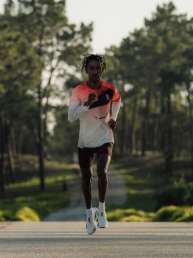
Thanks to adidas we had the chance to delve into the singular run of Inma Zanoguera, a runner, writer, ex-basketball player and PhD graduate starring in the latest adidas Adizero Evo SL campaign
An Icon brand, a fast-paced trainer, a rare pinnacle object whose unique design has begun to write its own mythology in running and the culture that spills out from it. In this lineage, ‘fast’ is not merely a pace you hit on a watch. It’s a way of moving through the world: alert, devotional, a little audacious — a mindset that asks you to believe, for a handful of kilometers, that your life can be lighter than your thoughts.
And Inma Zanoguera, a young woman who makes speed feel less like performance and more like research. Born in Mallorca and adopted with her siblings at the age of two, she talks about sport as identity, as a continuous search and discovery of oneself, never fixed, always in motion. Not only a runner and model, but also writer, former professional basketball player, and PhD graduate. A woman with more than one center of gravity, held together by an almost romantic fidelity to becoming.
In this conversation, Inma offers us something more cultured, more truthful about searching for origins and discovering that what we call home is often a moving thing — found in communities, in the tenderness of shared effort. Running, for her, becomes a kind of language for that elusive rootedness — a way to feel held without being named. Because the real legacy is not the rhythm. Perhaps it is the way we choose to show-up for ourselves, lace by lace.


You were born in Majorca and adopted by a Spanish family with your sister and brother at the age of two. How has the journey of learning about your origins shaped the way you think about identity and belonging today? And what role did sport play in your personal growth?
“My sense of belonging has been completely transformed since I began a conscious search for my origins. Perhaps the most accurate way to describe this shift is going from wanting to find ‘it’ to realizing it’s a process. I began with the thought that identity/belonging had a stable form somewhere out there, but with time I realized it’s more of an exploration, something I’ll never feel completely settled in. I’m always searching, and I find pockets of immense resonance in communities, in people, and in fleeting moments. The beauty, I think, is in realizing that actually it’s the dynamism and effervescence of our identities that fuels the fire of our love for the world and for each other. This is not as easy to accept as a ‘’label’, or some name by which I may come to understand myself like ‘a runner’ or ‘a Muslim.’ These labels may not be untrue but they will never satisfy my need to know myself fully, so my reassurance in who I am has to be rooted somewhere else. I’m not sure how to give words to this, but when I’m running, I can trust this more elusive form of rootedness, that’s a kind of belonging I think.”
You’re a runner, writer, surfer, ex-basketball player and PhD student — what do you wish people understood about living with more than one “center”?
“That we all do, regardless of the forms our lives may take on any given moment. I derive immense amounts of purpose from dedicating different parts of myself and different hours of my days to different endeavors, precisely because they balance each other out. I think the reason this works is because it mimics the multifaceted truth about who we are intrinsically. I find myself incredibly lucky to be able to foster all these parts of me, but I think it’s possible for everyone, or at least for the majority of people, to do the same, even if it’s in very small ways.”
Basketball was your world for 15 years. What did that sport give you — and what did it quietly take from you?
“If basketball took something from me, it was the naively self-assured way with which I had come to understand my identity and my purpose. After I quit basketball, my entire world had to be built anew. So much of why and how that had to happen is still mysterious to me, but what I know is that the process I undertook when I left basketball gave me the opportunity to question everything, and I think it was the same thick skin I had grown as a professional athlete that then gave me the courage to delve into that questioning fully, trusting that I could endure whatever was on the other side.”
You’ve spoken about quitting basketball even after going pro. How did you know it was time, and what did you have to grieve in that decision?
“I didn’t know, actually. I simply didn’t have the will to keep going, physically and mentally, so I quit. But there was little in that decision that I could have confidently said I knew for sure was right for me. What I kept coming back to was, ‘if I want to come back, basketball will be there to receive me.’ I never came back, and somehow I still feel very much on that same path with running. The path of growth, awe, and world-exploring possibilities—all of that was first nurtured on the basketball court for me.”

Team sports can offer belonging. When you left, what did you miss most: the structure, the people, or the shared mission compared to a “solo” sport like running?
“The funny thing I have learned is that the dichotomy of individual and team sports is actually way less fixed than we tend to think. Sports make me feel connected to others in ways no other endeavor can, and that’s also true for me as a runner, and is also true in relation to the communities that I feel I’m a part of even if they are remote from me. Something I experience often on a challenging trail, even when I’m running alone, is a feeling of encouragement from acknowledging the hundreds of others who have suffered with the same anticipation and excitement climbing the same mountain. I’m stepping on their steps, literally. The same can be said for a marathon, on KM 40, where everyone who’s experienced that threshold is suddenly a sister on the path. For a moment I feel I’m ‘together’ with these remote fellow runners. Being part of a team is definitely a magical experience—the shared goal, as you said, the same devotion in a communal setting. But even as part of a team sometimes feelings of isolation can arise if people are not on the same page. So I guess I’m learning that our definitions of community and support can be expanded and enriched, and have a lot more to do with intention than they do with just being on the same roster.”
You’ve called running a “second chance at being an athlete.” What makes this chapter more suitable — and what’s the challenge within that?
“For me, running is a chance at healing my relationship to performance and competitiveness. I started playing basketball at the elite level at a very early age, and I didn’t always have the mental tools to maintain a separation between my performance and my sense of worth. I will always be the kind of athlete for whom the pursuit of hard things holds the purest form of joy, fun, and meaning, so even as a more mature athlete I am still very much a competitor, but it looks different now. Part of it is simply being older and wiser. But there’s also more curiosity now, and a genuine sense of awe for the body’s capacity to endure. Running gives me a chance to explore these things. I find the path of performance, endurance, and adventure awe-inspiring, and that helps me find a balance between competition, gratitude, and fun.”
Do you feel like you run toward something, away from something, or with something?
“I run with something. My running practice has helped me cultivate relationality, as a general principle. Each run offers an opportunity to think more intentionally about how I relate to so many things: my body, the air, the topography of a city or terrain, my ancestors, my existential questions… So each run I become a different person as I relate to these things differently. My last run was rocky and wet, and you could say I ran with every instance in the past that has given my body the muscle memory to know how to navigate that.”
You’ve described your running community as a big part of your life. What kind of belonging does running offer you?
“I mentioned earlier the word devotion. Everyone whose life is devoted to this sport, especially sub-elite runners, I feel I’m in contact with, even if I have never met them. I am certainly not the first one to say it, but you could call that devotional belonging, or congregational belonging where the runs we have together, and races you share with thousands of strangers, are the places where we convene to share our devotion for running.”

What do you think makes a running scene truly inclusive — beyond the optics?
“The basic human skill of taking everyone in as they are, giving everyone the chance to feel their vibe in a space. This can only happen if we’re all comfortable in our ability to be our authentic selves, and, in turn, welcome everyone as themselves. I truly think that’s at the root of it all. I think everything else we’re doing, with better or worse results, and barring some cases, comes from the right intention and we simply need to do more of it, learning from mistakes. At the same time, every runner needs to tune in with themselves and get a sense for what kind of community they feel they can thrive in. Don’t follow the hype and truly let yourself imagine what the ideal running space would look like, feel like, and offer to you. A varied demand from different runners’ needs will shape the space into a more diverse one. What this would mean though is that brands would need to diversify the portfolio of who they support, and I think having a balance of exclusive and inclusive running sub-communities would be very helpful in this regard.”
Your PhD is about understanding the world and what it means to be human — and how sport intersects with sociopolitical life. How does that research change the way you experience running culture?
“The experience I have had writing a PhD dissertation has solidified my intuition that my purpose will always involve being a student of life, regardless of what I do. If I’m in a running context, I want to know everything that’s been written and thought about running, society, and culture—that’s just the way my curiosities are set up. For my research I’m exploring how women’s bodies are turned into aesthetic objects that serve a larger project of national identity, specifically with dancers. As a runner and model, immersed in so many dynamics of brand marketing, personal aspirations, and the energetic creative space that running lives in right now, my experience as a researcher gives me perspective as to how social trends influence us and hopefully, how to make the most of that.”
Does academic inquiry ever clash with the simplicity of just running? Or does it deepen it?
“At its core, academic inquiry is a means to the end of simplifying some research question that is only a question because its complexities haven’t yet been organized. Similarly for running—I think both running and academic inquiry are at their best when they are at their simplest. Maybe I’m exceptionally talented at complicating things, but even running can sometimes feel convoluted, so each of these researches challenge my ability to tap into simplicity. When I let go and let flow, both running and writing come out of me with ease, in their purest form.”

You’re part of the adidas SL SS26 campaign. What feeling do you hope people feel when they watch the video — beyond performance?
“That freedom is within reach, always. That it’s a state that lives parallel to our automated modes of worrying and overthinking, waiting for us to cross the threshold. Lace up your shoes, surrender your will to the run, and show yourself that you’re worthy of the most ecstatic, soul-lifting experiences, in this case running, every single second of your life.”
When you put on a shoe, like the new adidas EVO SL, what do you pay attention to first: comfort, responsiveness, confidence, or something you can’t quite name?
“I was quite the devoted sneakerhead for much of my teenage years. Maybe because I grew up as a basketball player in the early years of the internet, where the imagery and iconography of what was cool in sports came to me in the form of shoe drops, crazy designs, dunk contests, brand deals, etc. Then a few months later maybe I could convince my mom to buy me a pair of those new shoes I saw during NBA All Star Weekend. I was into that stuff a lot so maybe as a result of that, putting on a new shoe always comes with an unnamable feeling of magic waiting to happen. It’s the look, the feel, the smell. Best feeling ever!”
What does “alignment” look like for you right now between running, research, relationships, and rest?
“Practicing gratitude. I think of alignment as a state where what we do rhymes with the purposes and values we want for our lives. That’s a very tall order, and, at least for me, not always reachable. But being grateful for the opportunities, the people, and the resources that I have in my life is the only way I know to at least try to get closer to alignment.”
What are you hoping your next chapter teaches you about who you are?
“I am actually bracing myself for 2026, in the best possible way. I have completed my doctoral studies; I will also finally be established in a new city where I’ve only recently moved; and most of all, I know it will be a time of many transitions where I will be challenged to continue to show up for my dreams and goals. In so many ways these next few months will challenge me to be intentional in my relationships and decisions, and I hope to learn more about who I truly am through how I show up for others while embarking on such life-changing transitions.”