


There are careers that move in straight lines and then there are lives that unfold like a trail run: unexpected events, changes of direction, until the road finally gets clear. That’s the path of Mac Scott
What follows is the journey of a filmmaker who decided to get closer to movement, drawn to intimacy and the visceral reality of sport, without trying to define what it feels like to play, but bringing us close enough to be able to feel it.


An Intimate language
“It is a privilege to film individuals’ lives and disciplines, watching someone express themselves through movement is beautiful. It’s a universal language and you can quickly break down barriers through capturing someone’s passion.
I’ve found that after spending time with athletes and being immersed in their individual disciplines they are open and willing to explain why they’re doing what they’re doing – and most of the time, that ‘why’ is rooted in something very personal and meaningful. That’s what inspires me, I’m drawn to the deeper meanings. I think that comes from having gone through some heavy experiences myself and a desire to express myself in my own way. The camera becomes a way to step into other people’s lives and I feel very lucky to be able to do that.
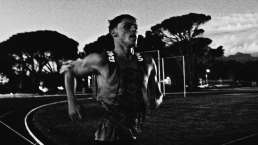
I do think there’s an intimacy to the way I shoot, because you’re literally stepping into someone’s personal space. I always come back to the Robert Capa quote I read years ago: ‘If your photos aren’t good enough, you’re not close enough.’ Crossing that boundary line is something I’m drawn to. You’re fully inside the athlete’s bubble, sharing the same space, the same air. When you’re filming boxing, running, wrestling, people pushing their limits, there’s something very visceral about that. I have to be completely present, in the moment with them, second-guessing their movements, adjusting as they shift. It’s like a dance.”


Searching for the right way to express yourself
“I’ve always been surrounded by art. I come from a creative family from Penzance, Cornwall, a seaside town in the southwest of England, and both my parents were always very creative. My mum ran a small gallery, so I grew up surrounded by art and my dad is a painter and sculptor.
It made sense that I would then go on to study art at university. I was fascinated by photography and collage – layering, cutting, reassembling images out of old found photographs. It’s only recently that I’ve realised how much that obsession with imagery and collage has impacted my filmmaking and editing. I’d take a photograph that was originally made for one purpose and completely change the meaning, trying to build a new piece of work out of it.
When I finished university in London I had no money. I had started working in a restaurant in Peckham, washing dishes to get by. Slowly I started edging my way into the kitchen. It was an addictive atmosphere – intense, high energy – and I ended up pursuing it. I was completely inspired by the kitchen and by becoming a chef for a long time. It was satisfying to get good at something that wasn’t art and it was motivating to be constantly learning all the time. It gave me a solid foundation in discipline and hard work – something I never really had at art college, where everything is loose and free and there isn’t much structure.
Working in kitchens can be brutal; you have to go all in, it’s all consuming. But over these years working in kitchens, my mum’s health had been declining. I had a very strong feeling that if I stayed in the job, that something might happen to her, and I’d be in the kitchen, mid service, ultimately cooking someone’s dinner. I made the hard decision to step away from the kitchen and to move back to Cornwall to be close to her and my dad for a while. Sadly, she passed away two months later, but I’m incredibly grateful I made that decision when I did.”


Finding Sports
“After my mum passed away, this is when, for the first time really, I got into sport. It wasn’t something I had grown up with. My parents were never sporty at all, and as a kid there had never been any competitive sport, nothing structured. Now sport / movement was becoming a kind of crutch for me – a support that helped me process everything that had happened with my mum and everything that was going on in my life. For my mental health, it was incredibly helpful.
After sometime I found myself back in London, I started working in the film industry, in the art department, which was again a huge learning curve. It was motivating to be progressing again in a new field. It opened my eyes to working on big sets and productions, and unlimitedly inspired me to want to make film work for myself.
I already knew about UVU at this time, I had been following the brand and saw Adi (founder of UVU) – had shared something on Instagram saying he was looking for someone to shoot him on the track on 16mm film. I’d never shot 16mm. I’d barely shot motion, and I’d certainly never filmed sports properly. But I reached out anyway. We started talking and pretty quickly realised we had very similar tastes in film and references. We both felt there was a huge gap when it came to shooting sports in a more poetic way.
At a very low level in terms of ability, I was having a huge internal experience with sport at that time. Adi, on the other hand, has had a completely different relationship to sport. He’d done it his entire life and at a professional level. We realised we’d met at this perfect juncture: I’d grown up deeply embedded in creativity and had only recently found sport; Adi had come from this intense sporting background and had been expressing himself creatively in more recent years. Adi took me on and gave me a huge amount of trust based purely on a shared taste level, a shared instinct about how we felt this world should look and feel. I am extremely grateful to Adi for believing in me.”


A different approach
“I’ve always approached things in a really naïve way. I was naïve about this world I was stepping into, the machinery of brand itself. I was coming at it from a very artistic, almost outsider perspective. But I’ve always thought that being naïve can be a good thing. It means you’re free to form your own opinions about what’s happening, about what you find visually interesting.
What intrigued me from the very beginning, shooting Adi and the guys, was that at that stage UVU was basically just a group of friends, and it still is. I was aware I was entering a friendship group as a complete outsider. I didn’t know anyone, and I didn’t want to impose myself too much at the start. As time went on, we all became closer, and I was able to break down the barrier with the camera.
I stayed open to whatever I personally found interesting. A shaft of light coming through a tree can be as important to me as whatever was happening with the boys training. I think those abstract details can hold just as much weight when trying to tell a story. When shooting sports, you can end up with a huge amount of footage. A lot of it is pure repetition, running for instance is repetitive by nature, what I’m really looking for are the in-between moments. The beats between, a look, a gesture, a shift in body language. All these little micro-moments are what actually become important for the storytelling.
With sport, you’re trying to visualise something that’s hard to articulate: what people go through emotionally, the sacrifice, their motivations, why an individual pushes themselves in the way they do. I don’t actually want to ‘succeed’ in fully explaining it, because some of that mystery is the point. I just want to get close enough.”


