


A new running chapter - On OAC Sprint team
Invited by On to Los Angeles for the launch of the new OAC Sprint Team, we met the athletes who make up the core group of this new project: Benjamin Azamati, Max Thomas, Johnny Brackins, and Samirah Moody. Through their firsthand testimonies, we get a close-up look at On’s entry into one of the most iconic, high-performance, and culturally significant areas of running: sprinting
“I think everybody has the same common goal: trying to create a team, trying to be on the biggest stage, trying to be on the podium.”
It’s perhaps from this statement, made by coach John Bolton, that we must begin to truly understand the meaning of On’s new OAC Sprint Team. In sprinting, more than in any other track and field discipline, everything historically happens in a few solitary, condensed seconds, yet the journey toward those few meters can be undertaken together, to grow both as athletes and as teammates.
Through the words of the members of the new OAC Sprint Team by On, a shared vision emerges: sprinting as an individual act that nonetheless stems from a shared ecosystem, and performance as the result of a human process rather than a purely technical pursuit. At this crossroads, the Swiss brand appears as an environment capable of supporting ambition, personality, mental health, professional growth, and personal narratives. A group that doesn’t just want to race toward the next Olympics, but to help define a new culture of speed: one that is more collective and mindful.


On built the first OAC team around a long-term vision, helping athletes grow into world-class performers over time. What does it mean to you to be part of this new OAC Sprint Team from the very beginning?
Max Thomas: “It’s been super cool just going through the process. This is my first year as a professional athlete, but it’s also the first time On is really working with sprinters in this way. So I think it is about growing together. And I think that is dope, because we are not really going through any kind of middle ground. The goal is simply to be the best. That is the goal for the brand, and that is the goal for me as well. It’s the goal for the whole group. For us to jump right into it, to shoot for the stars and aim to be the best, has been such a cool process. And I think anybody who decides to come on board with us is going to be part of something special.”
Johnny Brackins: “I think being part of something from the start makes you more connected to the brand, the team, more connected to the idea and to the outcome. Ultimately, it’s one thing to be immersed in something that is already established, but to be part of establishing something from the beginning is a completely different feeling. I feel blessed, and I’m excited to be part of the journey. I’m excited that my name is attached to something that is going to become so great.”
Samirah Moody: “It feels like being a founding member. First and foremost, I feel very honored that they trust me to help carry out their vision, which is to be at the top of the sprinting world. That’s number one. And then, number two, I really want to bring my opinion and my level of expertise to the table, to help them bring that vision to life. That happens when we get opportunities to collaborate on products, give feedback, or even take part in events like this. It’s important to be all in and to help when possible. That’s the best way I feel I can pay it forward: by helping them create what they are trying to build.”
Benjamin Azamati: “I think it’s great. It’s exciting, because we are not stepping into something that has already been established. We are helping create it. And I believe that comes with responsibility. Years from now, people will look back at the foundation of the OAC Sprint group and see what this group represented. To be part of the first generation means that whatever standard we set truly matters.”
This project feels like more than an athletics team: it feels like the beginning of a new sprinting culture within On. What kind of legacy would you like this group to build?
Max Thomas: “I can’t speak for my teammates, but for myself, I want to be at the top of the sprinting game. I think people are going to appreciate our personalities. I have a pretty big personality, but I also feel like I’m serious when I need to be and humble when I need to be. What I want to leave behind is an environment and a legacy that shows you can be the best and still have fun. You can be serious and still have fun. You can strive for your goals and still have fun. The goal is to be the best and have a good time doing it.”
Johnny Brackins: “I think I want this group to build a legacy around taking a chance. All of us took a chance on the project, because sprinting and hurdling had not previously been part of the brand, and now we are part of that growth. So I think taking that chance is, in itself, a message. It shows that it’s okay to take risks, and it’s okay to trust something that is not fully in front of you yet. That is what I would say.”
Samirah Moody: “I think sprinting specifically, but track and field as a whole, is very individualistic. Sprinting has a reputation for having big egos and very big confidence, and I think that is amazing to bring to the table when there’s also a common goal. Having a group where everyone is so dominant, where everyone has a big personality and a little bit of confidence, a little bit of swag, allows something really beautiful to emerge: a team atmosphere built around one shared direction. That’s what I think On is trying to bring to the sprint world: this group coming together to achieve different things in their respective events. I am excited for what that means as we expand and bring more people into the fold.”
Benjamin Azamati: “I want this group to be respected for its consistency and discipline. Of course, winning medals and running fast matter. But when people see this group, I want them to see professionalism, unity, competitiveness, and personality. That is basically what I want people to see whenever they look at us. I have had experiences with different systems and different competitions like the Olympics, the World Championships, but I’m not the loudest in the group, I try to lead by example. These guys look up to me for advice and things like that. I try to be the person who gives them whatever I can from the experience I have had. I try to advise them through the things they may find difficult. You have to set goals for what you want to achieve personally, and also for what you want to achieve with the others. That is something I am good at doing: setting goals on the personal side, while also setting goals for what we want to achieve as a group.”


Sprinting is often seen as an individual act, but being part of a team can reshape the way an athlete trains, thinks, and belongs. How important is the collective environment in a sport where, on race day, you ultimately run alone?
Max Thomas: “In training, we are constantly comparing, constantly seeing where we are in relation to the rest of the team. Being able to work with guys like Ben, Johnny and all the team is definitely important. Johnny is a hurdler, but he pretty much runs faster than me in practice all the time. I know that if I’m where I need to be in practice with those guys, then on meet day I’m going to be straight, just because of the level of competition we have every day in training.”
Johnny Brackins: “I think training with others prepares you better for your race. Training by yourself is very mental, and I think you can achieve great things on your own. But having competitors and training partners who are at the same level as you, or even better than you, pushes you to become better every day. In a group like this, where all of us are pushing each other day by day and through every workout, we have no choice but to grow. Then, when it’s time to go to a track meet, where you may very well be alone, or where it’s only you against the clock, you don’t crack under pressure. You are not afraid to race others, because you race every day in practice. You are prepared, and you trust yourself.”
Samirah Moody: “I think it’s important because it allows you to actually rely on other people. Yes, it’s your name on the teleprompter. It’s you and your lane on race day. But the preparation is not happening alone. And even the result, the celebration, is not happening alone. Now I have people to rely on when we travel. It’s in every little thing. You don’t have to do everything by yourself. We are experiencing a new chapter together. It builds a lot of camaraderie, and I think that is really what we are trying to achieve.”
Benjamin Azamati: “Sprinting might look individual, especially on race day, but I believe the environment in which you train affects everything. The people you train with shape how confident you become, and that usually translates into race day. I find confidence in the way I train, in how ready I feel, and in the people around me. I am very fortunate to have these guys around, because they are very competitive. That gets me ready, and it pushes me toward excellence each and every day. I believe the environment is really going to shape us moving forward and going into competitions.”
What does it mean to be supported by a brand like On: a company that has built its identity around innovation, design, and a different way of imagining running?
Max Thomas: “I think it perfectly aligns with me. I want to be the best, but I want to do it my way. And I think On supports that. The results have shown it. I want to be the best in my own way, and On wants to be the best in its own way. Right now, On’s way is my way, and my way is On’s way. I think it’s a perfect combination.”
Johnny Brackins: “It feels great to be supported by a brand that stands for those things, especially innovation. Being innovative, being open to changing things and to new ideas was something I looked for in a company before anything else. I think the fact that On is so diverse, and that there is so much variety, so many choices and options within the sport of running is really important. Having a variety of selections, from shoes to clothing, and everything that can make you comfortable, help with injury prevention, and support you even off the track, is amazing.”
Samirah Moody: “I enjoy it because I feel like they are invested in every aspect of me, not just in me as an athlete. We have had personal branding workshops. We have people coming in to help us with our lives. They have apps with mental health professionals, and people who help you understand how to invest and what to do with your money. They are invested in you succeeding as a person, and that makes the track part a lot easier, because you are not struggling in all the other aspects of your life. Sometimes people think that, as an athlete, you are completely separate from the person, but you genuinely are not. Things tend to bleed over and through. So it’s nice that they understand that, and that they are able to see the whole picture.”
Benjamin Azamati: “On looks beyond performance. They pay real attention to innovation, and to be supported by them is great. Recently, we have had sessions through the Athlete Compass around personal branding, one-on-one career coaching, and long-term career planning. I think that is very, very good, and honestly, I think it’s something many athletes lack. For On, to be able to do this for its athletes is going to go a long way for us, and we are very appreciative of it.”


Los Angeles has a strong cultural history around performance, image, speed, and reinvention. What does it mean to begin this journey here, also thinking about LA28?
Max Thomas: “I grew up around five minutes from the Coliseum. I passed it every day going to school. I grew up a UCLA fan, but I ended up going to USC. I never thought that would happen, when I entered It was surreal. I had always been so close to it, but I never imagined I was actually going to belong there. And now, being able to turn professional with the next Games happening out here, I think it is going to be dope for me personally. It looks like a perfect cinema story: a kid who grew up here, went to the local powerhouse school, turned pro, and then competes in the Games in his hometown. I just can’t wait to see how it plays out. I have full confidence in myself. I have no doubt that I’m going to be there and that I’m going to be successful. I just can’t wait to see how it all takes shape, while falling in love with the process. Right now it is 2026, and the Olympics are two years away. I’m just trying to do the best I can, day in and day out, to be able to get there.”
Johnny Brackins: “I think, for the majority of the group, we went to college in LA, and now we are training professionally in LA. The Olympics being here, it’s very personal for us. It’s our ultimate goal to be able to represent On and represent our nation on the big stage at LA28. Training here, growing here, and becoming our best selves here gives us that advantage. It gives us the opportunity to prepare for the Olympics more than anyone. It means the world.”
Samirah Moody: “I think it’s nice because, speaking for myself, I am from Boston, but I’m building a new home in LA. The amount of pride, and I guess also the pressure, that I feel when I go back home to do things for that city and for that home is something I’m beginning to feel for LA as well. As we move toward the Olympics, it creates a different level of appreciation for the place where you are competing, for the fans, and for the people. I’m just glad that I get to build a home in the place where I am going to compete. There is also the opportunity aspect of it. As we get closer and closer, brands and different avenues are flowing into this city, along with resources. Being here and being able to be part of that process, whether by giving or receiving, is very exciting.”
Benjamin Azamati: “The whole purpose of this OAC group is really focused on the LA Olympics. Having the opportunity to train here, to get accustomed to the weather, the food, the culture, and everything around it, is going to go a long way for us. Our minds are set on being able to compete with the best in the world when LA 2028 comes. That is the reason why we have this sprint group. It’s almost like being at home and having someone from somewhere else come in to take medals away from you — and we don’t want that to happen. So we are very focused on making sure we train really, really hard, so that we are able to win medals at LA 2028.”
Every sprinter carries a different relationship with pressure. Some use it as fuel, others try to silence it. How do you personally deal with expectation, especially now that you are part of such an ambitious project?
Max Thomas: “I would say I’m at my best when the lights come on. Pressure makes diamonds, and that is how I have always felt. When I feel pressure, it means something big is coming. It means it is time for me to be at my best. It’s the stakes that drive those crazy performances and those crazy times. I can speak about being in Botswana this past week. It was so loud in the stadium, and I was just like: it’s go time. I’m ready. It’s an amazing feeling. It’s hard to come down from. I’m someone who lives for the pressure. You get to those moments and often people are scared. But for me, this is the whole point of what I’m doing. So why be scared now? Now it is time to be at my best.”
Johnny Brackins: “Ultimately, I just don’t feed expectation. I think expectation is connected to pressure. And if you allow pressure to really penetrate your thoughts, you are only going to harm yourself. There is always someone, something, or even your sponsors that wants you to do well. But I don’t go into any race or any training session thinking about that pressure. I think about my goals. About being determined, trusting myself, trusting my coaches, and knowing that everything will come together. Ultimately, it’s about not letting pressure take over me. It’s about taking control of the situation, rather than letting the situation take control of me.”
Samirah Moody: “I think it’s a balance. When you are at the top of your game, for me personally, I like to invite the pressure, because that is where I get the best version of myself. But there are definitely times when the pressure feels all-consuming, because you are trying to do something when you might not be there yet, or it’s a risk, or you’re coming back from injury, or whatever the situation may be. Those are the moments when it’s best to block things out and really focus on yourself. I have obviously done something right to get here, so it’s about honing in on what I have done right, what I am capable of, and who I am in that moment, in order to produce the best possible outcome, even when I am not feeling my best.”
Benjamin Azamati: “I always say that pressure is a privilege. Once you are performing really well, there are a lot of expectations, and that means you are doing something people want you to do. The way I see pressure is that people expect me to do better. So when I go onto the track and there is pressure, I take it as a way for me to perform better, because there are people out there looking for me to run well and run fast.”


In contemporary sport, athletes are no longer only performers: they are also cultural figures and storytellers. What do you think about the image you project, both on and off the track?
Max Thomas: “I try to be the same person when I’m not on the track, but it’s hard because when I come out here, I feel like I’m in a completely different space. I’m in a completely different mindset. I definitely think Max on the track is way more me than Max in my daily life. I think I’m getting better at being myself when I’m not at the track, and I definitely care about it. I think bringing sprinting into the brand shows the kind of move On is trying to make for the culture.”
Johnny Brackins: “For me, I’m just unapologetically myself. I express myself and present myself in the way I want to. I like to show my creativity. I like to show expression through accessories, through the way I vocalize, and through the way I present myself. On and off the track, I think I’m a very similar person. I communicate my ideas, my thoughts, and my perspective very clearly. I just hope to influence other athletes like myself, or other people like myself — not necessarily only athletes — to always be themselves and be true. That’s one thing I live by. It’s about being myself and being true to everything I believe in and everything I am passionate about. As a jumper and a hurdler, you have to be instinctive, because a race can go any way at any time. It rarely goes exactly how you practiced it. So I think instinctiveness is key for me. Technique is something you always analyze, and I definitely always look at my technique. But for me, instinctiveness matters even more. The creativity part is just who I am in general. I see myself as a creative person overall. On the track and off the track, I try to represent creativity as much as I can. Hurdling is an art in itself. It’s very difficult. It takes a lot of studying. It takes a lot of failure.”
Samirah Moody: “I try to be as authentic as I can be, both on and off the track. I would say the two personalities are very similar. Obviously, on the track, I bring a little more intensity. I think my goal, with both sides of myself, is to continue to be relatable and grounded in who I was and who I am becoming, and to understand that those two things really play off each other. I do want everyone to think ‘I can also do it’. I don’t really want to be put on a pedestal. I feel fueled by the idea that my personal story can inspire, but also be relatable and real, whether things are going great or not. Hopefully, that gives other people the space to be vulnerable and to share what they are going through as well, so that it becomes more of a community where people help each other and build things together.”
Benjamin Azamati: “I think athletes need infrastructure to communicate, not just contracts. And I think On is doing that for us, giving us platforms where we can tell our own stories outside of competition. That is going to be special for us as athletes. Now more than ever, athletes have an identity beyond competition. Having a brand like On that is able to help us tell our own stories outside of track is going to empower this project a lot. It’s going to help us with our personal growth.”
What part of your story do you hope people see through your running, beyond results, medals, or times?
Max Thomas: “I really want people to see that I have been able to succeed in my hometown. I want people to know that I could have gone anywhere. At every point of the journey, I stayed here and I found success. I want people to see that I’m a really hard worker. I wouldn’t compete if I didn’t think I could win. That is what I go out there to do. That is what I come out here to do. That is what I come to practice to do. A lot of people don’t really see that, but I train to win. I compete to win. USC taught me so much about mental resilience. Being a student-athlete at a top university is very difficult. But I learned very quickly — and this is something my dad taught me as well — that you just have to succeed regardless of the situation. I don’t want to look back and say: I did not succeed because of this, I did not succeed because of that, or it was too hard. I don’t want any of that. If it’s hard, all right. I have to suck it up. I would definitely say it taught me that I’m trying to succeed no matter what.”
Johnny Brackins: “I hope people see someone who has overcome a lot of adversity, and who is thriving in a world that is often against him. I hope to influence people and show them that you can strive for greatness regardless of your situation, regardless of your circumstances, and regardless of any shortcomings you may have. You can still achieve what you want to achieve. I hope people see that through what I do.”
Samirah Moody: “I want people to come along for the journey. That’s why I try to be authentic. I always say that the average person can relate to a lot of the so-called failures. Failure can be losing, falling short, or whatever it may be. Most people can relate to that more than to the winning part. Winning is something that only one percent of the world can really understand: the feeling of winning a gold medal, winning at the Olympics. So although I do want to achieve those things, when I do, I want everyone else to have come along with me through the process of getting there. A process that wasn’t always high, not always great. That way, it becomes a better and more real celebration with the people who were there with you. That is my goal: to build more of a community. As a Black woman, I would like all young girls to really understand that femininity is not necessarily defined by how your body looks or by what you choose to put on. It’s embedded in your energy, if that’s something you aspire to embody. Being on the track, I lift, I train with men all the time. My body reflects that, but I don’t think it makes me any less feminine. I want other young women to understand that too: to try their best, to play sports, and not to feel limited by trying to look a certain way or be portrayed in a certain way. Because that is more of a personal choice, something embedded within yourself.”
Benjamin Azamati: “I want people to see resilience and consistency. I believe my journey is not only about talent, but about the hard work and the discipline that I have put into it. I want people to understand that before these elite performances, before everything we are doing now, we had to put in the hard work. We had to do all of that before the spotlight came, behind everything we put into becoming who we are in track and field. Sprinting was not one of the biggest sports in Ghana. It used to be, and still is, football. But now people are becoming really interested in running.”


Game Changers - Uppervoid
As contemporary outdoor sports continue to evolve, so too does the way it approaches nature. Performance still matters, but it’s no longer the only lens through which movement is understood. It is precisely within this shift that Upperrvoid emerges
The outdoor experience has become more layered, more psychological, more focused on the relationship between body, environment, and identity. It’s no longer only about pushing through the elements, but also about how we choose to inhabit them. About what it means to enter a landscape not in opposition to it, but in dialogue with it.
Founded in 2021, Uppervoid brand is part of a new generation of outdoor labels rethinking not only how technical products are designed, but what they symbolise. Its vision begins with performance, but refuses to stop there. The garments are conceived to function in real environments, with the rigor and responsibility that technical outdoor demands, yet they also carry another ambition: to propose a different design of exploration— more attuned to comfort, contemplation, and inner experience.
In conversation with founder Vis Bi, what emerges is more than the story of a brand. It’s a reflection on how outdoor culture itself is changing—becoming more plural, more self-aware, and perhaps, more human.


Going back to the beginning, how did the idea of Uppervoid take shape? What was the initial vision behind the brand?
“We started in 2021, and the vision was actually quite simple, built around two main ideas. At that time—before the whole gorpcore wave really took off—I felt that functional outdoor gear was, in a way, aesthetically lacking. It was either overly bright or reduced to black and white. There was very little cultural dimension to it. In running and sportswear, brands like Satisfy, Soar or District Vision had already begun to reshape the landscape, bringing a more contemporary sensibility to performance. But in technical outdoor, that shift hadn’t really happened yet. Part of the reason is that outdoor products are more complex to design and produce. In running, much of the innovation sits in the fabric. In technical outdoor, craftsmanship plays a much bigger role.
At the same time, we were observing a new type of user emerging. People who are psychologically drawn to extreme environments, but not necessarily interested in approaching them through physical hardship. I experienced this personally in Nepal. I originally planned to hike the Annapurna circuit, but after the first day I realised I didn’t enjoy that kind of experience. So I took a helicopter to base camp instead. And I realised there are many people like that. A different way of engaging with nature.
The idea behind Uppervoid was to create products that are as technically capable as heritage outdoor brands, but with a different narrative. Less about conquering nature, more about a psychological and spiritual relationship with it. This also reflects a broader cultural shift. We’ve moved away from the ‘just do it’ mentality, where discomfort was part of achievement. Today, people are more aware of mental wellbeing. They don’t necessarily want to suffer to reach a destination. There are other ways—more balanced, more considered, even more aesthetic ways—to engage with the outdoors. That’s where the brand was born.”
On a personal level, what has been your relationship with the outdoors? How did your own experience shape the way you approach the brand?
“I grew up in Vancouver, which is naturally an outdoor-oriented city. Access to nature was immediate and easy. You could snowboard in the morning, hike down, and be at the beach in the afternoon—all within short distances. So I was introduced to the outdoors from a very young age, but in a way that didn’t feel extreme or inaccessible. It was always something integrated into daily life. At the same time, I realised over the years that I’m not an endurance-driven person. I’m more drawn to short, intense experiences—moments of adrenaline rather than long-duration effort. I enjoy snowboarding, climbing, skydiving, and riding through the desert, but I don’t gravitate towards long treks. That perspective is reflected in the brand. The way we present the outdoors is aligned with how I personally experience it—not as a test of endurance, but as a series of meaningful, often intense moments within nature.”


Today, sport is not only about performance—it’s also about community and environmental awareness. How does sustainability fit into your vision?
“Our approach to sustainability is slightly different from the conventional narrative. Of course, we use recycled fabrics where possible. But for us, the real focus is longevity. Creating products that last as long as possible.
Coming from a family with a background in clothing manufacturing, I’ve seen how many sustainability claims in the industry are not entirely accurate. Using recycled fabrics doesn’t always significantly reduce environmental impact, especially when you consider processes like dyeing, which is one of the most damaging stages in production. Recycling itself is also more complex than people think. Most garments today are made from blended materials, which are very difficult to recycle properly. True recycling requires single-fiber fabrics, and even then, there are limitations. So our logic is simple: we aim to create the best possible product, using high-quality materials, so that once you buy it, you don’t need to replace it.
At the same time, we continue to research new materials. For example, we’ve developed a copper-based fabric and even patented a way to produce it. But at the moment, the cost is too high to make it viable. Sustainability only works when it’s scalable. It’s not about a few people using better materials—it’s about making those solutions accessible to everyone. Until then, we keep developing.”
One of the most distinctive aspects of Uppervoid is its design language. There is a clear influence of Eastern aesthetics. How does this perspective shape your approach?
“I see our work as a blend between traditional outdoor aesthetics and an Eastern perspective. Historically, most outdoor brands have been Western, rooted in specific geographies and environments. But the outdoor world is much broader than that. Asia, for example, has very different landscapes, climates, and ecosystems. These differences influence design in subtle but important ways. A simple example: we never use yellow in our spring-summer collections, because in many parts of Asia it attracts insects. That’s not something you would necessarily consider in another context.
Climate also plays a major role. In many Asian regions, temperature variation throughout the day is minimal. Summer can stay consistently around 30 degrees, even at night. That changes how you design ventilation, layering, and materials. We’re currently developing a hard shell specifically for summer rain seasons—something that wouldn’t traditionally exist in Western outdoor design, where rain is more associated with colder conditions.
Footwear is another example. In many Asian markets, consumers prefer heavier, high-ankle boots for trekking. In other regions, like Northern Italy, there’s a stronger preference for lighter, low-cut footwear.
All of these factors—environmental, cultural, practical—come together and shape the final product. And that’s what makes the brand feel different. Not intentionally, but as a natural result of approaching the outdoors from another perspective.”


Today, the boundaries between sport, culture, and aesthetics are increasingly fluid. As we often explore in Athleta Magazine, fashion can also be seen as a form of art. Do you think the growing intersection between sportswear and fashion is bringing more people closer to the outdoors?
“We’re actually very careful about that balance. Internally, we don’t really use the word ‘fashion’. We prefer to talk about ‘aesthetics’. Fashion, by nature, is tied to trends. And in recent years, many brands have emerged that are essentially outdoor-inspired fashion. That’s not necessarily a negative thing, but for us, it’s not the same.
The biggest risk we want to avoid is that someone wears our product in a real outdoor environment expecting it to perform, and it doesn’t. In fashion, there are no real physical consequences. In the outdoors, there are. Our products carry a responsibility—they need to keep people safe and comfortable. So we do draw inspiration from fashion, but only in areas that don’t affect performance. Colors, prints—those are open to interpretation. But when it comes to technical elements—pocket placement, zippers, construction—we don’t follow trends. We follow functions.
Every product starts from a very clear question: where will it be used, and for what activity? Then we break that down further. For trekking, it might be based on the number of days. For mountaineering, altitude. For trail running, distance. Within each category, we define different tiers, and for each one, we work closely with athletes to understand what is actually needed. That’s how we build products—through real use cases. Once that foundation is established, then design can come in. But never the other way around.”
You mentioned working closely with athletes to test and refine your products. Are you planning to support some of them with a sponsorship?
“We are actively trying to support athletes, but it’s not always easy. Many of the athletes we would naturally connect with are already sponsored by larger brands. So we’ve shifted our focus towards more grassroots athletes. We look at rankings like UTMB, and we explore regions that are less represented—countries like Georgia or Armenia. Sometimes we find interesting profiles there. It’s an ongoing process. We’re constantly searching, building relationships, and trying to create something meaningful over time.”


Looking ahead, what are the next steps for Upeervoid? How do you see the brand evolving?
“The next phase is about refinement. Over the past few years, we’ve focused a lot on expanding our product range. Now it’s about improving what we’ve already built. Taking those learnings and developing second and third iterations—2.0s, 3.0s—making each product more precise, more functional, more resolved.
At the same time, we want to continue building relationships with athletes, especially at a grassroots level, and strengthen that connection between product and real-world use. We’re also expanding into new markets and sales channels. But in the outdoor sportswear industry, growth is naturally slower than in fashion. It requires time. It requires consistency. You can’t shortcut credibility. So for us, it’s about staying focused. Continuing to believe in what we’re building, and moving forward step by step.”


Shredding Manhattan
The soul of the Lower East Side, captured through Simone Strano’s photographic ritual: a visual inquiry into skate identity and the aesthetics of imperfection in the beating heart of Manhattan
There is an intersection at Monroe and Pike Street where Manhattan sheds its excess, revealing something rawer, more essential. Here, in the Lower East Side, beneath the monumental arches of the Manhattan Bridge, the rhythmic, almost tribal, roar of the B and D subway lines conjures a sense of belonging that transcends verbal language, leaving skateboarding as the only shared grammar.
LES Coleman Skatepark does not challenge the urban fabric; it embraces it. It exists as a natural extension of the city, conforming to its contours. The iron and stone pillars of the bridge cut through the space, casting monumental shadows over granite benches and handrails that precisely echo the vocabulary of New York’s streetscape.
The eye widens across what reads as a concrete manifesto: since 2012, through the vision and redesign of Steve Rodriguez, this site has become a global landmark. A microcosm where the hierarchies of the Big Apple dissolve, undone by a community that has elected the skateboard as its muse, and through it, continuously regenerates itself.
We are granted the privilege of exploring this skate mecca through the lens of Simone Strano, a Neapolitan visual researcher long based in Rome, who has chosen to immerse his gaze in forms that are as urban as they are human. His project spans over a decade: a timeless continuum that narrates, through portraiture, detail, and motion, the essence of a spot and of a movement in constant expansion.
Echoes of this sensibility emerge throughout his own biographical account.


Simone Strano
“My passion for photography began in Naples, the city where I was born and raised, sparked by a gift from my grandfather. At nine years old, for my First Communion, he gave me a compact camera. That ‘mechanical eye’ fascinated me immediately. I started shooting relentlessly: anything, everything. Over time, it became natural to deepen my knowledge, to collect books… Eventually, I left university and moved to Rome, where I attended a professional photography course. Today, in my daily work as a retoucher, photography remains a space of decompression: an art form that captivates me precisely because it allows me to step away from the digital perfection of commercial work.
During my high school years, I met a guy who skated: something quite rare, especially in Naples. The raw sound of wheels grinding against asphalt struck me deeply. With ups and downs, I began skating as well. Although my time on the board has gradually diminished due to back issues, my affinity with street culture—the music, the style, the sense of belonging that skateboarding has always embodied—has never left me.
This project was born over ten years ago from the convergence of these two passions. Its core took shape in 2014 in the Lower East Side, beneath the Manhattan Bridge. I have to admit, arriving at that spot made the contrast with Rome, where I was living at the time, immediately apparent. If Rome’s street surfaces discourage anyone from stepping on a board, in New York skate culture permeates everything. It runs through the veins of the city: you feel it instantly. The board is an essential means of urban transport, whether you’re grocery shopping, commuting to work, or running daily errands.
During those three months, the LES skatepark became home: an urban institution where space and the energy of a heterogeneous community allowed me to photograph in complete freedom. Becoming part of that community as a photographer happened organically. My daily, prolonged presence in the park made me a familiar figure: recognized, accepted. Paradoxically, the strength of such an individual discipline lies in its extraordinary ability to generate collective bonds: skateboarding breaks down every barrier. It is a universal language. No one cares who you are or where you come from: the only thing that matters is a shared passion for the board.
My visual approach initially revolved around portraiture. I would stop skaters for extremely tight shots, shooting wide open: sometimes focusing only on the nose, letting the rest dissolve into blur. I also produced wider portraits, with boards held in the positions each skater preferred. Then I shifted toward details. Coming from commercial still life, I’ve shaped a particular sensitivity to objects and forms. I photographed wheels, tattoos, broken decks, worn-out shoes. Eventually, I moved into action, using slow shutter speeds to capture motion: approaching photography, in a way, with the same instinctive process that guides skateboarding.
As I mentioned, skateboarding offers a way of observing reality through a different lens, one that has inevitably influenced my artistic approach. Much of what attracts me comes from the underground, standing in stark contrast to my professional work, where everything must be polished and perfect. When shooting personal projects like this, my instinct moves in the opposite direction. In New York, I tried to transfer the inherent roughness of skateboarding into the images: seeking a ‘dirty’ aesthetic composed of grain, motion blur, and defocus. Above all, the goal was to produce images that feel authentic.
After those initial three months, I returned to the LES skatepark other times. More than a decade after the project’s inception, while curating the final gallery, I also adapted the work to reflect the evolution of my taste. I chose to unify the project through black and white: a decision that removes the images from any precise temporal context, creating a timeless continuum. Ultimately, I know that if I returned to LES today, I would still find skaters embodying the same spirit, the same style. I revisited the material in a physical, tangible way: printing, tearing, writing on, recomposing, and rescanning the images to strip away digital perfection in favor of a more raw, analog approach.
Now, seeing this journey, developed over such an extended period, take shape as an editorial publication is deeply rewarding. It’s moving to be able to tell the story of such an iconic spot in New York’s skate scene through my lens.”


Tennis in a new dress - Magda Linette
Through the images of Ola Bodnaruś and words of Magda Linette, tennis reveals itself not only as competition, but as a cultural space where style is not just decoration, but an extension of self
‘Dress shabbily and they remember the dress; dress impeccably and they remember the woman,’ Coco Chanel. In tennis, perhaps more than in any other sport, this idea finds one of its most compelling expressions. Because inside the court, style exists inside of performance—it moves with it, breathes with it.
The image of a player is never just constructed by strokes and results, but by the subtle harmony between body, movement, and what that body chooses to carry onto the court. In this space, clothing is never neutral. It becomes a language. An assertion of presence in a moment defined by exposure—where every gesture is observed and emotion amplified. Under those conditions, what one wears can become a form of grounding. A structure. A way of inhabiting the moment with more control.
As we delve into the life of this WTA tennis player who straddles the worlds of sports and fashion and whose journey defies the immediacy often demanded by modern sports, unfolding instead with a deeply personal sense of identity, tennis has proven to be not only a lifestyle but also a door to a different path.


You come from Poland, a country marked by resilience and endurance. Looking back at your childhood, what kind of atmosphere shaped you—both as an athlete and as a person?
“I’m from Poland, and my father was actually a tennis coach, so I was introduced to the sport very early. At the same time, he stepped back from coaching me quite early as well, because he didn’t want tennis to interfere too much with our relationship as father and daughter. In many ways, it wasn’t an easy path from the start. We were not a wealthy family. We struggled financially quite a lot, so tennis was probably not the most logical choice. It’s an expensive sport, and it asks a lot from a family. But at that time—and I think this is something that is slowly disappearing, especially in Poland—there were still clubs funded by the city or by the government. That kind of structure gave players like me a chance. I think I was one of the last generations to really benefit from that system. You could represent your club, play certain tournaments, receive some support, and still have access to opportunities that today are becoming harder and harder to reach. Now there are more private clubs, and everything is getting much more expensive.
Once I started growing up and wanted to compete outside Poland, across Europe, that support was no longer enough. At that point, I needed private sponsors, and everything became much more uncertain. If I’m honest, the word that comes to mind is desperation. That feeling drove me through a lot. Through difficult conditions, through moments when results didn’t come, through situations that were far from ideal. It was this constant need to push through, to find a way forward, to create something better—not only for myself, but for my family too. There was never really a plan B. It was this or nothing. Everyone around me was making sacrifices. Even my sister’s life, in many ways, was shaped by my tennis. Whatever money we had went into my career. There was pressure. A lot of pressure. But there was also this strange, unwavering belief within my family that it was worth it.
That’s what I remember most: that sense of belief, even in very hard conditions. Training all winter in freezing bubbles, leaving home before sunrise, coming back late at night after school, practice, gym, physio, homework. It was exhausting. But underneath all of it, there was this shared feeling that maybe tennis could open the door to a different future.”


When you were young, what did tennis represent to you? A dream, a discipline, or a way to change your life?
“I think it was all of those things at once. There are very few professions that can completely change your financial reality in such a short amount of time, especially for women. Tennis is still one of the best-paid female sports in the world, and if you are good enough, things can happen quickly. In other careers—if you want to become a doctor or a lawyer, for example—it can take fifteen years before you reach that kind of stability. In tennis, it can happen in two, three, four years.
Of course, that’s only if things go well. If they don’t, it can take much longer. And in that sense, it is a gamble. An injury can stop everything. A wrong decision about your team, the wrong environment, not enough funding—so many things can go wrong. There are so many players trying to make it, including many who come from much better conditions than I did, with more support, more money, more structure. So of course you ask yourself: why would it work for me? But that’s exactly why I keep coming back to that idea of belief. Somehow, everyone around me believed it would work out. Not in a naive way, but with a kind of stubborn faith. And when you grow up inside that kind of atmosphere, it becomes part of you.”
Do you feel that belief—that kind of grit shaped by where you come from—is still something you carry with you when you walk onto the court today?
“I think it’s something many of us from this part of the world share. There is a certain mentality that comes from that background, and I think you can feel it in a lot of players from Eastern Europe. We can be emotional, yes. Sometimes maybe more emotional than others. But we also have this instinct to do absolutely everything we can to win. Even if things are difficult. Even if we are not feeling our best. Even if the conditions are against us. There is this sense that, somehow, you still have to find a way. And I think that comes from being used to adversity. When you grow up with things not always going your way, you learn to operate inside that discomfort. In some strange way, it can even become motivating. When conditions are difficult, when something is not working, instead of feeling defeated by it, you almost feel activated by it. That mindset can help you, and sometimes it can work against you too. But for me, it has definitely stayed. I still carry that feeling that no matter what kind of day I’m having, I have to find a solution.”
In sport, people often celebrate prodigies and sudden breakthroughs. Your story feels different—more patient, more layered, maybe more human. You entered the top 100 later than many expected, and reached your first Grand Slam semifinal after turning 30. What did all those years teach you?
“One thing they teach you is that in every industry, people are always trying to sell the dream. That’s why everyone wants to talk about the young player who rises quickly, the teenager who suddenly breaks through, the story that feels cinematic and immediate. That’s what attracts attention. That’s what excites parents, sponsors, and the market. At the end of the day, sport is also a business, and that is part of how it works.
What doesn’t sound as attractive is the truth that for many players it takes six, seven, eight very hard years of grinding without money, without certainty, without guarantees. That version is much less appealing. For a long time, longevity wasn’t part of the conversation either. Players used to retire younger. Very few were still competing seriously after thirty. Then people like Serena began to shift that narrative. They showed that a career could be longer, that it could evolve, that you could even come back from experiences people once thought would end a career entirely. That idea is still relatively new. I think people are only now beginning to understand the value of longevity—not just emotionally, but professionally. A long career can also be a great investment. It can create something meaningful over time. But of course, the dream will always be more seductive. That’s what people want to see in films, in headlines, in sport. And I understand that. Still, sport has a brutal honesty to it. In the end, you defend your place with your performance. That part, at least, will always remain fair.”


Do you think arriving at the top later allowed you to develop a deeper relationship with tennis—something more meaningful?
“For most of my career—really for most of my life on tour—my biggest worry was money. How am I going to afford the next tournament? How am I going to build the best team I can? How am I going to keep going? That pressure was constant. When I made the semifinal and reached No. 19 in the world, that was also the moment when the financial side finally gave me some breathing room. For the first time in maybe twelve or fifteen years, I felt calm and I realised how much mental space had been occupied, for so long, simply by survival. In that sense, I do wish it had happened earlier. Not because I’m not grateful—it meant everything to me, and I know very well how few players ever get to experience something like that. But if I could have had that peace of mind sooner, maybe I would have had more time to focus purely on improvement. Not on surviving, not on figuring out how to keep going, but simply on how to become better. I’m deeply grateful it happened at all. But if I could choose, of course I would have chosen to arrive there earlier.”
At Athleta, we’re interested in sport not only as performance, but as a cultural language. For you, what does tennis represent beyond competition?
“Tennis is my way of life. It’s not something that begins when you step onto the court and ends when practice is over. At this level, you live inside it completely. The sport is so competitive that if even one part of your life is not aligned with what you’re trying to do, you immediately feel behind. Everyone else is giving everything to it too.
And beyond that, there is so much more involved than people realise. Tennis is not only about hitting the ball. It’s flights, hotels, practice schedules, staff, taxes, logistics, surfaces, balls, time zones, transportation, planning. You are responsible for everything. Unless you can afford to pay someone to handle those things for you, it all stays on your shoulders. That’s what makes tennis so different from many team sports. In a team environment, a lot of the structure is already there. In tennis, you have to build your own system constantly, week after week, city after city. The season runs almost all year, and you can compete nearly every week in different parts of the world. Every tournament brings different conditions, different adjustments, different demands. And then on top of all that, you also need emotional support. You need to decide who travels with you, who helps you, how to make it all work not only professionally but personally too. I think that complexity is something people often don’t see. Tennis is not just a sport you play. It becomes your entire life.”


When you step onto a tennis court, do you ever think about the game in aesthetic terms—lines, rhythm, spacing, choreography—almost as if it were something artistic?
“To be honest, what I noticed first was the outfits. I’ve always loved that tennis gives you room for individuality. I think I would hate a sport where everyone had to wear exactly the same thing, in exactly the same way, with no freedom at all. That would drive me crazy. So in that sense, I’m very glad I ended up in tennis.
Sport is such an exposed space. You’re sweating, you’re tired, you’re frustrated—you’re not exactly in your most polished state. And yet somehow, in tennis, you can still hold onto a sense of style. You can still express something through what you wear, and I’ve always loved that. I’ve always cared about clothes. I love fashion. So that was my first entry point into the aesthetic side of tennis— the visual identity of being inside that space.
Only later I begin to notice the other elements more clearly: the lines, the colours of different surfaces, the way certain tournaments create an atmosphere, the way a court can become a kind of stage. I think maybe I didn’t notice it before because I grew up in harsher environments—cold indoor courts, winter bubbles, places that were functional rather than beautiful. But once you start travelling more, once you see different settings and different tournaments, you really begin to understand that tennis can be visually striking in so many ways. And I like that now there is a growing interest in seeing tennis—and sport more broadly—from a different angle. Not only through performance, but through image, mood, atmosphere, and culture.”
Tennis and fashion have long been intertwined. What does fashion mean to you personally, outside the court, as a young woman?
“For me, fashion has always been connected to confidence. I’ve never been the most confident person. I’ve never really felt fully comfortable with the way I look, and for a long time I always wanted to change something about myself. But fashion gives you a way to work with that feeling. It gives you a way to shape how you present yourself, to play, to transform, to create something that makes you feel better. Clothes can change your energy and how you move through the day.
I also think fashion gives space to a kind of creativity. I don’t paint, I don’t sing, I don’t really have those more traditional artistic skills. But I do feel like I have some artistic instinct in me, and fashion gives me a way to express that. It’s one of the first forms of self-expression available to you. Especially as a woman, I think clothing can become a very immediate language. And what I love about it is that it’s completely yours. You decide. You can do what you want with it. That freedom is what makes it so powerful to me.”


While on court, do clothes change the way you inhabit a match? Can what a player wears shape her confidence?
“When I wear something I truly like, something that feels right on me, I immediately feel better. There’s a noticeable shift. And on the other hand, if I’m not completely comfortable with what I’m wearing, I feel it straight away. It’s distracting. It takes something away.
There’s definitely a sense of pride in it too. As an athlete, especially when you have contracts, you don’t always have full control over what you wear. So when you do get that freedom, it matters, it affects confidence—completely. You step onto the court in front of thousands of people, and at the same time you know there are many more watching on TV, sometimes for hours. It’s a very exposed space. You’re tired, you’re sweating, you’re not exactly in your best-looking moment. Clothing doesn’t hide that, but it gives you a kind of foundation. A sense that at least one part is taken care of. That you feel good in your skin. And when that part is settled, you can let go of it and focus fully on your performance.”
In a sport built on repetition and discipline, does fashion allow you to express something more personal?
“I think it’s very personal. Everyone finds their own way of expressing that. For me, it’s my necklace. That’s something I really care about. It has two sides—one that captures the day, and one the night. I spent a long time looking for it, more than a year. I didn’t want just any object. I wanted something with a story. I remember going into a store in New York and asking if they had something meaningful, something that carried a certain energy. And they showed me this talisman. From that moment, it felt right. I don’t change it often. I can wear the same piece for years. It becomes part of me.
On the court, it represents something deeper. There is always what you show, and then there is what you carry inside. I feel like that small object connects those two layers. For some players it might be a ritual—how they tie their hair, how they wear a bandana. For me, it’s that.”


What kind of idea of femininity, strength, or identity do you hope to convey and carry with you, beyond your tennis abilities?
“I think for me it’s important not to be defined only as a tennis player. Of course, tennis is my life right now, but I also want to build something beyond it. I’ve already completed my bachelor’s degree. I want to make sure that when tennis ends, there are other paths open. At the same time, I try to express who I am in the present. Fashion is part of that. It’s one of the ways I can show something more personal, something that goes beyond the court.
In a way, it’s similar to tennis itself. You’re playing a match, and you never fully know how it’s going to unfold. The only thing you can control is your readiness. You prepare, you stay open, and when an opportunity appears, you have to be able to recognise it—and take it. That’s how I see things right now. I don’t know exactly what will come next, but I’m trying to be ready for it.”
Beyond rankings, titles, and milestones—what do you hope your journey will represent for younger players, in Poland or elsewhere?
“I think the most important message is that there isn’t just one ‘right’ story. We are used to hearing about the dream trajectory—the young player who rises quickly, who achieves everything early. But that’s not the only way. And just because your path takes longer, it doesn’t mean it’s the wrong one. My journey has been slower, more gradual. And for a long time, maybe it didn’t fit the narrative people expect. But that doesn’t make it less valuable.
I hope that players, but also coaches and parents, can see that there are different timelines, different paths, different rhythms. And that those more human, less linear journeys are just as valid. Not everything has to happen immediately to be meaningful.”


Credits
Photographer & Art Director: Ola Bodnarus
Stylist: Joanna Opinska
Make-Up: Cincior
Hair: Kateryna Yefremova
Lighting Assistant: Konrad Pardo
Photographer Assistant: Aleksandra „oliksy” Kalinowska
Stylist Assistant: Iza Gromko
Production Support: Aleksandra Teresa Grzymska
Photographer’s Agent: Nina Michalewska / nmgmt
special thanks to: Kuba Partyka (video & music) / Charlotte Bistro / Marcello Warszawa / Ośrodek Rozbrat – Warsaw / Agrykola Tennis Club – Warsaw
Editor: Filippo Libenzi

Field Rituals | A Grammar of the Beautiful Game
The editorial project, shaped by the visual direction of Faramarz Gosheh and the styling of Robyn Agulhas, allows us, on the one hand, to delve into the cultural and aesthetic texture of the Beautiful Game; on the other, to step into the biography of the eye behind this production: a creative trajectory in which football assumes a structural and lyrical role
“Some people believe football is a matter of life and death. I assure you it is much more serious than that,” once declared Liverpool’s legendary manager Bill Shankly. Known as ‘The Saint,’ Shankly recognized in the world’s most universal sport a force capable not only of shaping individual lives, but of marking the rhythm of entire communities and nations: elevating itself to a cultural phenomenon of primary importance, far from incidental.
Whether aesthetic, let alone artistic, considerations were part of the Scottish icon’s reflections remains unknown. Yet, in listening to Faramarz Gosheh, the connection feels almost inevitable: between the absolute centrality of football—its rituals, its details—and a sense of beauty, sometimes overt, sometimes latent, that has intrinsically defined it since its origins. A beauty that, in turn, shapes the lives of those who fall in love with the game.
‘Field Rituals’ stands as a manifesto of this rare and extraordinary power. A series of sensory compositions suspended beyond time and space, finding their fullest meaning within the personal history of their Swedish creator: a story we set out to uncover.


Let’s start from the relationship you’ve built over time with aesthetics, visual storytelling, and football: how did these elements come together as you were growing up?
“I think it starts at home. My mother is both an artist and a nurse, and there were always paintings around: acrylics, watercolors, quite abstract and often political. At the time, I didn’t fully understand them, but looking back, I can see how they shaped me. I grew up surrounded by texture, by images, by this sense that making something was part of everyday life. She never pushed me in any particular direction, but that environment made me feel that a creative path was possible. As a kid, I was drawn to architecture and design: I remember sketching football boots, imagining how I would design a Nike shoe. I’ve always been a dreamer. For a long time, though, my main dream was to become a professional football player. Around sixteen or seventeen, I realized how difficult that would be, especially in Europe. Still, I kept playing. I progressed through the system in Sweden, playing for Örgryte IS from youth teams to the junior squad, then reserves, and eventually the first team. I played semi-professionally for a couple of years, moving between the second and third divisions. Interestingly, the club has since reached the first division, which I’m really happy about.”
What role did football play in shaping you, not only as a player but as a person?
“It had a fundamental impact. First of all, it taught me how to function within a group. You learn very quickly that you’re not the superstar: you can’t be. You rely on others, and they rely on you. That understanding translates directly into filmmaking and photography. You need a team to make anything meaningful happen. It also instilled discipline. Training several times a week, taking care of your body, eating well, sleeping properly… those habits stay with you. As a freelancer, that structure is incredibly useful. I often think about my work in terms of a ‘season’: how I prepare, what I want to focus on, how I sustain myself during busy periods, and then how I reset afterward. Football also exposed me to different environments. Traveling for away games, seeing small towns and unfamiliar parts of Sweden definitely broadened my perspective. Thanks to football, I had the chance to meet people from different backgrounds, different cultures, even within the same country. That stays with you.”


Given your natural visual sensitivity, did you ever perceive football, during your playing years, as an aesthetic or creative source?
“Not consciously at the time. Back then, it was more about development and competition. But in retrospect, I can see how certain visual elements stayed with me. The colors of the kits, the way players wore their socks, how they tucked in their shirts… those details were always there, even if I wasn’t thinking about them as ‘aesthetic’ in a formal sense. Now, they come back as a kind of visual memory, almost like texture. There’s something very beautiful about that, but I think I only fully understood it later.”
How did photography, and later directing, enter your life?
“It started very simply. My mother had a DSLR at home, and I picked it up. I began taking photos of my friends, and it quickly became something more than just a hobby. The camera also gave me a way to position myself socially. When you’re young, it can be awkward entering a room, but if you have a camera, you have a purpose. You’re there to observe, to capture something. That felt natural to me. Over time, I became interested in capturing moments as truthfully as possible. But then I realized that sometimes those moments don’t just happen: you have to create them. Especially when working with clients, where you’re asked to evoke a certain lifestyle or feeling that isn’t naturally present. That’s where directing in a broader sense came in. This all developed over several years, while freelancing across different types of work: events, weddings, food, anything I could take on. I didn’t have a formal education, so I relied on curiosity and discipline. I made a lot of mistakes, but I also learned by surrounding myself with people who knew more than I did. At some point, people started telling me, ‘You have a voice.’ That pushed me to think more critically about what I like and why.”
How do you navigate the balance you mentioned between commercial work and artistic expression?
“I’ve never been a purist about it. I don’t see commercial work or fashion as something inherently ‘lesser’ or compromised. Some of the photographers I admire most are able to take a brand and create something deeply artistic: something with a strong narrative or conceptual depth. That’s what I aim for. Ideally, the work lives beyond the campaign itself. It should have its own integrity, its own longevity. At the same time, I maintain a separate space for more independent storytelling: short films, personal projects. But I’m always interested in that intersection between art, commerce, and fashion. I think that’s where a lot of interesting work happens today.”


Let’s talk about Field Rituals. How did this editorial project come about?
“It came at a moment of frustration, to be honest. I had just lost two commercial jobs, and another one had really drained me creatively. I felt disconnected from joy. I remember sitting somewhere and thinking: what do I actually want to make? I realized I love football, but I hadn’t explored it enough in my work. At the same time, I knew I would be traveling to South Africa, where my girlfriend is from. That became an opportunity. I wrote down an idea and started reaching out. I wanted to explore the intersection of football and fashion in a way that felt playful and accessible, not overly heavy. I collaborated with stylist Robyn Agulhas, who brought a deeply personal perspective: her father was a footballer in South Africa, so she had a genuine connection to that world. We approached it without the constraints of a client. It was about making something we genuinely cared about.”
How did the production and the project itself unfold?
“It was very organic. We cast people who were open, who had some connection to football. Not everyone was a player, but there was a shared energy. We had ideas going in, but we also allowed space for spontaneity. Some concepts were discarded on the spot; new ones emerged during the shoot. That kind of freedom is rare when you’re working commercially. When I look back at the images and the film, what stands out is that atmosphere: playful, intuitive, collaborative.”
Was the project driven primarily by an aesthetic approach, or are there deeper thematic layers?
“It was more intuitive than conceptual. I tried not to over-reference or over-research. Instead, I focused on memory: what football felt like when I was a child. That sense of seriousness, especially at a young age, where every small game feels like a Champions League final. The rituals, the intensity, even when the stakes are objectively low. I wanted to bring those textures into an adult context: something slightly nostalgic, but also playful. There are subtle references to 90s football and early 2000s ‘Joga Bonito’ culture, but they’re more like echoes than explicit citations.”


Why did you choose to work with analog?
“There are several reasons. First, there’s the inherent beauty of analog: it’s very difficult to replicate digitally in a convincing way. But beyond aesthetics, it’s about process. Shooting on film forces you to slow down. You become more intentional. You don’t just take endless shots, you wait for the moment that feels right. It also affects how you direct. You have to be clearer about what you want. In this case, we also had a practical opportunity: our cinematographer Reezo Hassan had two rolls of Super 16 film. For both me and him, it felt right to use them, even though it was a personal investment. There’s also something about imperfection. Dust, scratches, light leaks… these are not flaws to me. They’re traces of the human hand. In an era increasingly shaped by AI and generative imagery, analog still carries a certain resistance. It reminds you that someone was physically there, making decisions. In a way, it connects back to my mother’s paintings: the visible brushstrokes, the sense of presence.”
One final, essential point in relation to this editorial project: how do you see the relationship between football and fashion today?
“I find it exciting. Football has traditionally been very uniform, both literally and culturally. But now, especially through social media, we’re seeing players express themselves more openly. What they wear off the pitch, their collaborations with fashion houses… it reflects a growing intersection between these worlds. There’s a kind of hunger for it. I don’t think it’s as developed everywhere, certainly not in Sweden, but globally it’s becoming more visible. For a long time, basketball was ahead in that sense. It had a certain swagger. Just think about Allen Iverson, for example. Football is catching up now, and I think that evolution is really interesting to observe.”


Credits
Director & photographer: Faramarz Gosheh
Stylist: Robyn Agulhas
Cinematographer: Reezo Hassan
1st AC: Paul Painting
Camera Trainee: Mantoa Motlolisi
Best Boy Lighting: Stephen Naki
BTS Photographer: Andile Phewa S
Stylist Assistant: Jason John
MUA & hair: Justine Alexander
Service Production Company: 360films
Service Producer: Mandy Ritchie
Production Coordinator: Sisipho Ngodwane
Set PA: Jabu Goba
Composer & sound mix: Richard Azar
Colorist: Franziska Heinemann
Editor: Faramarz Gosheh
Title Design: Paloma Demanet
Agent / Creative Partner: Andrea Hasselrot
Lab: Cinelab UK
Film: 16mm Kodak VISION3 50D5203/7203
TALENTS:
Emilio Namuhuja
Mukena Kapapa
Mncedisi Masondo
Alex Michelsen
Tosin Okunnu
Malaika Cuambe Jones

The invisible power of Sports - Justin Sorensen
There are values in sport that rarely gets photographed. They doesn’t appear at the finish line, nor in the instant of victory, nor even in defeat. They exists somewhere in between— and it’s often where the deepest meaning of sport resides. For American photographer Justin Sorensen, that is where the work begins
His images do not chase the obvious. They resist the clarity of resolution, the immediacy of celebration, the visual language we’ve come to expect from sports imagery. Instead, they linger. They move toward something less defined—toward the invisible structures that hold an experience together.
Sorensen’s path into photography reflects that same sensibility. It is neither direct nor predetermined, but shaped by movement across disciplines—first through music, studying and performing jazz for over a decade, then through design, immersed in the evolving culture of endurance cycling, and eventually into photography as a way of translating those lived experiences into images. Each phase carries forward a shared language: an attentiveness to what cannot be immediately seen.
It is perhaps in New York—where running culture has grown into a collective, almost underground energy—that his work has found its most natural terrain. Here, sport spills into the city. It occupies streets, bridges, early mornings and late nights. It becomes less about competition and more about presence, about community, about a shared momentum that moves through bodies and across spaces.


Going back to the beginning, what first sparked the idea of picking up a camera and making photographs? What was the path that led you to becoming the photographer you are today? How did that process unfold?
“My background is a little unconventional. I’ve moved through several creative fields in my life to get to where I am now. I originally studied music in college – jazz, specifically – and after that I played professionally for about twelve years, living in Seattle, San Francisco and New York.
That career began to shift when I moved back to San Francisco and got into clothing design. I was designing clothes for a small cycling brand there, and because it was such a small company, everyone wore multiple hats. I’d always had cameras around me and had used them in different ways throughout my work, but when I joined that brand I really immersed myself in cycling culture. Endurance sports became a huge part of my daily life. The company was constantly on the road, at events, out in the field, participating in and documenting everything happening around this emerging culture, gravel riding, and these huge efforts where people would go out into the middle of nowhere and ride 200 miles. My role there, among other things, became photographer for the brand. I was shooting all the lifestyle work, along with a lot of the narrative, brand-building stories that were naturally emerging out of that world.
I was with them for six years, and then I moved to New York – about five years ago now. When I arrived in New York, I wasn’t exactly sure where I was going to land or what field I was going to fully commit to. It took me about a year and half to understand that freelance photography was what I wanted to pursue. During that period I kept cycling, but New York is really a running city. The running culture here completely absorbed me. I became part of it through the different run clubs that were popping up, through the underground unsanctioned races, by simply being present and photographing what was happening.
There had already been a strong run-club history in New York for around a decade before I arrived, but about four years ago it felt like everything was accelerating. There was so much momentum, and I think I arrived at a really important moment in New York running culture – a moment when a lot of things came together at once. That has completely reshaped the trajectory of my career. Most of my work now lives in running, and that’s true across nearly all of the brands I work with.”
How do you personally see sport through your lens? What is it that really interests you as an artist when you photograph it?
“My perspective on sport, and really my perspective as an artist in general, has always been shaped by an interest in what is invisible. I’m less interested in the finish line and much more interested in the journey – in the poetics of the journey, in the relationship an athlete has with the sport itself.
What intrigues me most is the intangible experience of being in the middle of a very hard effort. That’s what I try to capture with my photography. The quiet moments. The moments that aren’t always visible. Whether it’s a track meet, a marathon, or an ultra race, the event itself is almost less important to me than the relationship to the event. That’s what I’m always searching for. Honestly, that theme has followed me my whole life – even when I was playing music. It’s always been the invisible parts of life that interest me most. Those are the moments that actually construct our lives and give them a foundation, even if we don’t always pay attention to them. We tend to focus on the highlights – this moment, that moment, another big moment – and of course those matter. But what makes those moments possible are all the things in between.
That’s where my attention goes: to the in-between. I think that’s especially compelling in photography, because when I’m able to capture one of those moments, there is more ambiguity in what’s happening. There is more room for interpretation. That’s a constant thread in my work as well: I never want an image to feel finished. I don’t want the story to be fully laid out and explained in a single frame. It’s important to me that whoever looks at the image can bring their own story into it. It shouldn’t feel final. It should always feel in motion.”


Was there always something in sport that drew you in, even before photography? Was sport already something that stayed with you from when you were young, or did that relationship develop later in life?
“I grew up playing all kinds of sports, so my familiarity with games, with play, and with the joy that comes from those experiences definitely comes from childhood. But if I go a little deeper than that, I think I’ve always just been fascinated by watching people move their bodies. Even as a child, I think I saw it as a kind of expression. Yes, of course, you’re playing a game. Yes, you’re trying to win. But I think what I loved most was the act of doing it – the act of moving. That’s what appealed to me from the beginning. As I got older, what became especially interesting was movement and repetition in endurance sports: what happens to the body, what happens to the mind, what happens across a long effort.
For me it has always been movement-focused. Whether I was playing or watching, I was just entranced by it. I couldn’t take my eyes off it. That’s still what draws me in now – I’m deeply curious about the way people move their bodies. I’m interested in all different kinds of bodies, moving in all different ways. I think that’s kind of amazing. So for me it’s never really been about spectacle. It’s about experience – and about everything connected to sport, especially the more introspective parts of it.”
Moving to New York – a city where sport is central, historically and culturally – was there a specific team, group of people, or group of athletes that gave you the inspiration to start photographing the scene there and to look at movement differently?
“What I really fell in love with in the New York running community was the slightly subversive act of taking over the streets. Runners – pedestrians in general, really – kind of run this city, no pun intended. There are so many people walking and running here that they actually dictate the movement of the city. Watching run clubs, and especially some of the unsanctioned races, and witnessing these huge masses of people come together and then race straight through Manhattan – it was exciting, it was beautiful, it was an energy I had never seen before. That’s what really hooked me: seeing people’s passion for running, their passion for living in New York, and that whole expression of movement that feels like it could only happen here. It feels very specific to this city. I felt very comfortable documenting that kind of community because it has this element of chaos – a little bit wild, a little bit crazy. You have to be a little bit crazy to do it. Being out at 3 a.m. on Broadway on a bike, with traffic coming toward you, photographing runners… You really couldn’t do that anywhere else. This connected to so much of what I already loved about movement and sport. It was a natural fit. I didn’t plan to become part of it in any strategic way – there was a little bit of magic in it. One thing led to another, then the next thing, and suddenly I found myself in a space that felt right. That’s really how my career in New York has unfolded over the past four years. It’s been incredibly rewarding, because there is so much beautiful passion around running right now. It feels like the sky’s the limit in terms of how we can tell stories around this sport.”
You became a runner too?
“I started running when I moved here. I run in Central Park all the time, and it never feels the same twice. There’s something almost unexplainable about running in New York. It makes you feel like you’re part of a much larger movement. There’s this profound energy here – an unspoken web of people, this silent community that I really love. It’s an incredible city to run in. The funny thing is, I never thought I would become a runner. I honestly didn’t really like running growing up. In all the sports I played, it was used as a form of punishment – if you did something wrong, it was run laps. Now it’s become something completely different. It’s such a good space to detach for a while, to recenter. I really value it for that. I ran my first marathon last fall in Berlin. The weather was terrible, it was super hot, but I had an amazing time.”


New York also gave you the opportunity to create the book ‘Traces’. The word itself suggests residue, imprint, evidence – something that happens over and over again and leaves a mark. What kinds of traces were you most interested in, and what did you want to point toward in the book?
“‘Traces’ was a project I worked on last summer and fall for about four months. It focused on sub-elite marathon athletes in New York City – people I would define as living in that grey area between professional and non-professional. They have full-time jobs, but they train like professional athletes. I felt lucky that I could build an entire project around athletes who are that fast and that committed while also working full-time. What interested me most was their love of the sport, because that’s what it takes to live in that world. Some of them have families, some travel constantly for work, and yet they still find time to train at that level. That, to me, is incredible.
Coming from my own perspective, I’m always most interested in the journey, in the training, in the quiet moments. I didn’t really care about the actual marathons they were running, or about documenting race day in any direct way. I wanted to dig into the process. I wanted to go along on a training run and see what happens. It’s in that repetition – in doing the same thing again and again and again – that we build ourselves up to take on these larger challenges. Some people think of repetition as building a callus, as creating a harder surface that protects you from injury. I tend to think of repetition differently. I think of it as a kind of shedding. Not exactly wearing down, but removing layers. Through repetition, through the constant return to effort, we start stripping away things we’ve picked up over time that maybe no longer serve us. And what remains is something more authentic – something closer to who we actually are. Those are the “traces” I was interested in: the residue that gets shed.
You can see it in people’s expressions. You can see it in muscle fatigue. You can see it in those tiny shifts in form that happen as the body starts to reveal itself. But to capture that, you have to stay present through the boring middle section. You can’t just show up for the highlight. You have to stay with the repetition long enough to witness those small, fleeting moments. That’s what I was trying to capture in the whole project: that very brief space inside a workout where something opens up and becomes visible. That was the hope behind ‘Traces’.”


How does your approach shift when you move from long-term, intimate projects to large-scale sporting events—where access is limited and everything unfolds at speed?
“When I’m asked to shoot larger events, especially in contexts where access is restricted, the first thing I do is look at how those events are usually photographed. And then I make a very conscious decision to move in the opposite direction. For me, the perspective has to shift—otherwise, what’s the point?. From there, I try to understand the environment I’m stepping into: the city, the venue, the history of the event itself. I’m always searching for an angle that allows me to reframe what I’m seeing, even within a structure that might feel rigid or predetermined I’ll often begin with a mood board, a loose framework—something that gives me direction. I also know that once I’m inside the environment, everything can change. In fact, it probably will. Having a strong idea going in is important, but I have no problem abandoning it completely if something more interesting emerges in the moment. That way of working goes back to my background in jazz. You have a structure—a harmonic framework—but within that, there’s space to improvise. I think about photography in a similar way, especially in these high-pressure environments. Once I’m in it, it becomes about trusting the process. Trusting everything that has led me there. There’s a kind of creative autopilot that takes over—if that even exists. I’m reacting more than thinking, relying on instinct. The more I try to control it, the worse the work becomes. In those moments, I think of myself almost as another athlete. I’m trying to match their energy, to enter a similar space. The closer I can get to their experience—or at least to what I imagine their experience to be—the more truthful the image becomes. It’s important for me to feel some level of struggle myself. That tension, that effort—it adds something real to the image. In a way, I think of photography as a sport. Matching energy is essential.”
In these environments, do you feel sport can reveal something beyond the physical act—something deeper, even through photography?
“There’s always an objective in sport—winning, scoring, achieving something measurable. That’s part of it. But those outcomes don’t really tell us much about the person experiencing them. What interests me is how people hold themselves within that context. I’m less focused on what is being won and more on what is being revealed. The emotional and personal dimensions of the experience—those are the moments I’m drawn to. Often, it’s what happens just before or just after the defining moment. Right before something is achieved, or immediately after—when the celebration fades, or when the weight of a loss settles in. That’s where something more honest tends to emerge. Those moments say more about who we are. Not just as athletes, but as people. And they also reshape how we understand the sport itself—not in terms of rules or outcomes, but in terms of meaning. That’s where the depth is, for me.”


Looking ahead, are there still unexplored territories—within sport or beyond—that you feel drawn to?
“I’m definitely starting to move beyond running. What interests me is that this way of seeing—this focus on movement, on internal experience—can extend far beyond sport. It’s really about states of flow, about devotion, about how people engage with something they care deeply about. I’ve also done some work with dancers here in New York, and I’d love to explore that further. Movement for its own sake—without the framework of competition—is incredibly powerful. There’s a lot there.
I’m also hoping to spend more time in alpine environments this year. New landscapes, new conditions—just continuing to expand the space in which this work can exist. For me, it’s an ongoing process. I’m not trying to define it too rigidly. I follow what feels interesting, and I let the work evolve from there. Personal work will always be essential—those are the spaces where I can explore freely, without constraints. But what’s exciting right now is that even within commercial work, there’s a growing openness to more narrative-driven storytelling. In some ways, it feels like those two worlds are starting to overlap. And that allows me to approach commissioned projects with the same mindset I bring to my personal work.”


Adidas Adizero Dropset Pro — A new step in Hybrid training
Within the contemporary training ecosystem, hybrid training represents a shift in perspective—a new way of thinking about movement and athletic preparation that transcends the boundaries between disciplines, which have now been permanently redefined. Accompanying the disruptive development of this new training method is the Adizero Dropset Pro, a shoe designed by adidas and launched by Cisalfa Sport to address the complex dynamics of hybrid training, where speed, strength, stability, and adaptability are no longer separate categories but part of a single athletic identity
Over the past year, the growth in participation and relevance of hybrid training has been unparalleled, becoming a true trend in the world of modern training and representing the solution to a new concept of movement. A dimension that, naturally, aligns with the vision at the heart of Cisalfa Sport, where every human being can be an athlete, embracing both athletic transition and absolute specialization. Hybrid training stands as the flagship discipline of this philosophy: for its ability to transition from running to weightlifting, from conditioning to power, from the intensity of running to the precision of lifting weights. In this framework, the hybrid athlete is not defined by a single discipline, but by their ability to move between them: they must be fast, yet also stable. They must be strong, yet also resilient. In constant dialogue between two paradigms once considered polar opposites.
At a time when fitness is increasingly synonymous with cross-training and community, the Adizero Dropset Pro is being introduced to address this diverse complexity, and is now available on Cisalfa Sport. Developed with input from professional athletes, this shoe interprets training as a fluid sequence of different athletic movements and offers a functional solution for tackling them. By combining various technologies developed through adidas’s ongoing research and development, their hybrid nature offers the lightness and responsiveness borrowed from the world of running while providing the stability needed for strength training, creating a solid foundation for those who no longer accept a separation between speed and control.
We had the pleasure of capturing the launch of this shoe through a photographic story created specifically for Cisalfa Sport by adidas, the only retailer presenting the model in an exclusive Italian premiere. A visual narrative conceived with the idea of placing the Adizero Dropset Pro in its natural habitat: that of a Gym 2.0 designed to welcome a new generation of athletes who experience hybrid training as both athletic preparation and a pursuit of total well-being.


Behind the Lights - Mac Scott
There are careers that move in straight lines and then there are lives that unfold like a trail run: unexpected events, changes of direction, until the road finally gets clear. That’s the path of Mac Scott
What follows is the journey of a filmmaker who decided to get closer to movement, drawn to intimacy and the visceral reality of sport, without trying to define what it feels like to play, but bringing us close enough to be able to feel it.


An Intimate language
“It is a privilege to film individuals’ lives and disciplines, watching someone express themselves through movement is beautiful. It’s a universal language and you can quickly break down barriers through capturing someone’s passion.
I’ve found that after spending time with athletes and being immersed in their individual disciplines they are open and willing to explain why they’re doing what they’re doing – and most of the time, that ‘why’ is rooted in something very personal and meaningful. That’s what inspires me, I’m drawn to the deeper meanings. I think that comes from having gone through some heavy experiences myself and a desire to express myself in my own way. The camera becomes a way to step into other people’s lives and I feel very lucky to be able to do that.
I do think there’s an intimacy to the way I shoot, because you’re literally stepping into someone’s personal space. I always come back to the Robert Capa quote I read years ago: ‘If your photos aren’t good enough, you’re not close enough.’ Crossing that boundary line is something I’m drawn to. You’re fully inside the athlete’s bubble, sharing the same space, the same air. When you’re filming boxing, running, wrestling, people pushing their limits, there’s something very visceral about that. I have to be completely present, in the moment with them, second-guessing their movements, adjusting as they shift. It’s like a dance.”


Searching for the right way to express yourself
“I’ve always been surrounded by art. I come from a creative family from Penzance, Cornwall, a seaside town in the southwest of England, and both my parents were always very creative. My mum ran a small gallery, so I grew up surrounded by art and my dad is a painter and sculptor.
It made sense that I would then go on to study art at university. I was fascinated by photography and collage – layering, cutting, reassembling images out of old found photographs. It’s only recently that I’ve realised how much that obsession with imagery and collage has impacted my filmmaking and editing. I’d take a photograph that was originally made for one purpose and completely change the meaning, trying to build a new piece of work out of it.
When I finished university in London I had no money. I had started working in a restaurant in Peckham, washing dishes to get by. Slowly I started edging my way into the kitchen. It was an addictive atmosphere – intense, high energy – and I ended up pursuing it. I was completely inspired by the kitchen and by becoming a chef for a long time. It was satisfying to get good at something that wasn’t art and it was motivating to be constantly learning all the time. It gave me a solid foundation in discipline and hard work – something I never really had at art college, where everything is loose and free and there isn’t much structure.
Working in kitchens can be brutal; you have to go all in, it’s all consuming. But over these years working in kitchens, my mum’s health had been declining. I had a very strong feeling that if I stayed in the job, that something might happen to her, and I’d be in the kitchen, mid service, ultimately cooking someone’s dinner. I made the hard decision to step away from the kitchen and to move back to Cornwall to be close to her and my dad for a while. Sadly, she passed away two months later, but I’m incredibly grateful I made that decision when I did.”


Finding Sports
“After my mum passed away, this is when, for the first time really, I got into sport. It wasn’t something I had grown up with. My parents were never sporty at all, and as a kid there had never been any competitive sport, nothing structured. Now sport / movement was becoming a kind of crutch for me – a support that helped me process everything that had happened with my mum and everything that was going on in my life. For my mental health, it was incredibly helpful.
After sometime I found myself back in London, I started working in the film industry, in the art department, which was again a huge learning curve. It was motivating to be progressing again in a new field. It opened my eyes to working on big sets and productions, and unlimitedly inspired me to want to make film work for myself.
I already knew about UVU at this time, I had been following the brand and saw Adi (founder of UVU) – had shared something on Instagram saying he was looking for someone to shoot him on the track on 16mm film. I’d never shot 16mm. I’d barely shot motion, and I’d certainly never filmed sports properly. But I reached out anyway. We started talking and pretty quickly realised we had very similar tastes in film and references. We both felt there was a huge gap when it came to shooting sports in a more poetic way.
At a very low level in terms of ability, I was having a huge internal experience with sport at that time. Adi, on the other hand, has had a completely different relationship to sport. He’d done it his entire life and at a professional level. We realised we’d met at this perfect juncture: I’d grown up deeply embedded in creativity and had only recently found sport; Adi had come from this intense sporting background and had been expressing himself creatively in more recent years. Adi took me on and gave me a huge amount of trust based purely on a shared taste level, a shared instinct about how we felt this world should look and feel. I am extremely grateful to Adi for believing in me.”

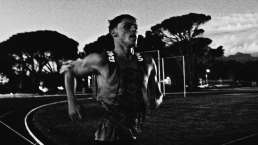

A different approach
“I’ve always approached things in a really naïve way. I was naïve about this world I was stepping into, the machinery of brand itself. I was coming at it from a very artistic, almost outsider perspective. But I’ve always thought that being naïve can be a good thing. It means you’re free to form your own opinions about what’s happening, about what you find visually interesting.
What intrigued me from the very beginning, shooting Adi and the guys, was that at that stage UVU was basically just a group of friends, and it still is. I was aware I was entering a friendship group as a complete outsider. I didn’t know anyone, and I didn’t want to impose myself too much at the start. As time went on, we all became closer, and I was able to break down the barrier with the camera.
I stayed open to whatever I personally found interesting. A shaft of light coming through a tree can be as important to me as whatever was happening with the boys training. I think those abstract details can hold just as much weight when trying to tell a story. When shooting sports, you can end up with a huge amount of footage. A lot of it is pure repetition, running for instance is repetitive by nature, what I’m really looking for are the in-between moments. The beats between, a look, a gesture, a shift in body language. All these little micro-moments are what actually become important for the storytelling.
With sport, you’re trying to visualise something that’s hard to articulate: what people go through emotionally, the sacrifice, their motivations, why an individual pushes themselves in the way they do. I don’t actually want to ‘succeed’ in fully explaining it, because some of that mystery is the point. I just want to get close enough.”


An Eternal Breath | The Internazionali di Roma
Thanks to EA7, we celebrate the Internazionali BNL d’Italia: the cyclical union of Rome and tennis
You can hear them echo. Rallies. Shouts. Aces. Strikes. “Silenzio, per favore.” At times, they land like shouted proverbs, laughing through the streets of Testaccio. Other times, they captivate: like one of those balcony-view sunsets no filmmaker has ever been able to resist. They wade across the Tiber, dart through cobblestones and classical statuary, setting the core of the Eternal City pulsing. These are the frequencies of Roman tennis, at its highest expression: both in meaning and in historical era.
The Internazionali BNL d’Italia are Rome. Rome opening itself to talent from all over the world, as it has always known how to do. In this cyclical and pinnacle event, to the genius of the racket. A sporting hymn to a city that has so profoundly shaped the course of events, the aesthetic canon, and the epic of athletic effort: and that continues to be summoned by this very fusion. Passionate. Enchanting. Not by chance, Eternal.
Alongside EA7, we captured the evocative power of the Foro Italico: the Roman breath that aligns with tennis. The gallery is shaped through the founding lens of Athleta Mag, RiseUp Duo.


The Tennis elegance of Radka Leitmeritz
Radka Leitmeritz did not arrive in tennis through sport photography. She arrived there carrying the eye of fashion, the discipline of art, and the Confidence of someone who had learned that beauty can change the way we look at sports
Her work had moved through magazines, museums, celebrity portraiture and editorial worlds built on control, styling and intention. Then tennis entered her life — first as obsession, then as practice, and finally as a new visual frontier. What she found there was a world full of grace, tension, colors, yet still rarely seen with the sensitivity it deserved.
We spoke with Radka about what happens when a fashion photographer steps onto a tennis court and refuses to leave her background. What emerges is not just a new way of seeing the sport, but a deeper meditation on tennis beauty.


A fashion photographer on the tennis court
“I worked in fashion for most of my life. In Paris, for fifteen years, I was working both in fashion and in art. Then I moved to Los Angeles because I had always loved California and I wanted to explore another side of fashion, start working with Hollywood actors and celebrities. I came to LA and, for a few years, I worked fully in that world, photographing famous people for Vanity Fair, Variety and other magazines. But after some time, I realised that this wasn’t the world I wanted to stay in forever. To be honest, I didn’t really feel happy there. I was looking for something else, something new.
Around that time, I started playing tennis. That was maybe ten years ago, and I became completely obsessed with it. I got so into tennis that at some point I thought about photographing it. I wanted to do something with the tennis world. So I started looking into it, and what I discovered was that, ten years ago, visually there was almost nothing there for me. The aesthetics I knew from fashion and the aesthetics I saw in sport felt so far apart.
That was the beginning. I started exploring this space and, very quickly I began collaborating with Racquet Magazine, which was just about to launch, so in some way we were beginning together. I did a few things with them, and that’s how I got my first credentials for a tennis tournament, here in Indian Wells. I had never seen professional tennis live before. I arrived with a film camera, a Polaroid camera, and a completely different visual mindset. That’s how it started. I began thinking more ambitiously. I wanted to do something more artistic about tennis: to tell the story of such a beautiful sport through a different lens.Through my fashion lens. I wanted to bring beauty to tennis: cinematic aesthetics, film photography, atmosphere — something beyond just the action.
The WTA reached out quite quickly. Then COVID came, and of course everything stopped. We couldn’t really do much. I got stuck in Prague because they wouldn’t let me back into the US. I used my time to work on tennis there in the Czech Republic. What came out was a beautiful coffee-table book dedicated to Czech tennis. I was photographing old tennis clubs, historic courts, and portraits of famous players in ways they had never really been photographed before. We published the book, it’s something I was very proud of.
Then the tennis tour came back, and I continued traveling at my own expense. I built relationships with players. I kept developing a different kind of tennis photography. Over time, brands started to reach out. It took time, but I began doing campaigns and collaborations that allowed me to keep traveling on tour and, in a way, finance the larger project I’m building. Last year I also created a creative studio here in Los Angeles with the focus on female athletes — helping them build their brands, tell their stories through different lenses, not only in tennis but across other sports as well.”


Challengers
“For me, tennis was a completely new world. The first big challenge was that in fashion photography, or in commercial photography, I was used to controlling everything. You create the image. You build the team. You have the vision, and then you execute it. In sport, it’s the opposite. You arrive as an observer. And for me, that was incredibly hard. It’s funny, actually in my mind I still see these athletes as my talent. They are still a little bit like actors inside my own vision. The difference is that I can’t really control them. There are only a few things I can control. And of course, when it comes to live performance, to a match, you cannot control anything.
Working with athletes off the court is easy, in comparison. Feels familiar. It’s similar to working with models or actors. But when it came to actual tennis performance — sports photography itself — I think it took me many years. I was shooting matches because I had access, and because I loved tennis, but if I’m honest, at first I was often sitting courtside watching more than photographing. I was frustrated that I couldn’t stand anywhere different from the other photographers, frustrated that I had the same access, the same two angles, that I couldn’t move between points, that I always wanted to be somewhere else. In the beginning, it was actually worse than regular sports photography because I didn’t even have the right lenses and I didn’t fully know how I wanted to shoot. I play tennis, so I understand the sport deeply, but I still couldn’t get the angle I wanted because I simply didn’t have the access to it. What I knew was this: for me, a good sports photograph cannot only show action. It also has to show the person. And the person, coming from fashion, also has to look good. Even if they are screaming, they have to be screaming in a beautiful way. You have to catch them in the right place, in the right composition. It cannot just be a distant document, and long lenses in sports photography, for me, often create too much distance. They place you in the position of an observer who is far away, never part of the action. There is something deeply impersonal in that. It feels like you are standing on a balcony, photographing a neighbour across the street. You are almost sneaking into something, but you are not really there. That was my biggest frustration.
It took time to figure out how I could make images that didn’t feel like that. I would sneak into the stands, try different positions, use different lenses, different crops, different edits. Slowly, I started to understand. But honestly, it took maybe three or four years. I was on tour, I was making good images, of course, but I still wasn’t really happy with my sports photography.”


The break point
“The breakthrough came in 2024, at Roland-Garros in Paris. It was raining and the matches had stopped. I was passing by a court and I saw Marta Kostyuk, the Ukrainian player. She was wearing this beautiful green Wilson dress. I was looking at her thinking how beautiful she was and somehow the outfit felt perfect. That green dress, on the wet red clay, sitting in the middle of this interrupted rainy match suddenly made something click in my head. I photographed the entire match, from beginning to end. Then I went very deep into the edit. I realised that was how I needed to do it. I made a whole series from that match. Wilson loved it, the feedback was huge, and that was really the moment.
For me, a strong tennis photograph is not just about having a beautiful player who looks like a model. That’s not the point. What matters is that the whole aesthetic comes together. The outfit has to be right. The colour of the outfit has to work with the surface. The player’s style has to fit the personality. Everything has to align. All these small elements come together like a puzzle. And when they do, then I know I have a beautiful tennis picture. When I arrive at a tournament and the court has a very specific colour, the player is wearing something that works perfectly with it — the right colour, the right fit, the right feeling — suddenly I have the same tools I used to have in fashion. I can create something that is more than just a sports picture. It’s almost as if I had styled it myself. That’s why the work looks different.”
Searching
“I think that when you come from fashion, you are always — almost unconsciously — looking for beauty. It’s actually funny, because now when I photograph tournaments and players during competition, the images could look as if they were staged, as if they were carefully directed shoots. But they are real tournaments. That’s what I find so fascinating: the beauty is there, visible to everyone, and yet somehow almost nobody sees it.
For me, that is incredibly exciting. It’s so difficult to find something that nobody has done before, and I still get a thrill from the fact that I can be standing there, photographing a match at the same time as everyone else, and then the final image can be completely different. I’m not saying better or worse — just radically different. That is because my purpose is different from theirs. I also have the luxury of time in the edit, which they often don’t. They are shooting for press agencies, It’s a completely different framework. For me, editing is an essential part of the work. It’s honestly very intense. It usually takes me about a week to recover from a tournament, physically and mentally. The days are long, I carry all my gear myself, and it’s a constant mix of adrenaline, movement, and pressure. There’s barely any time to slow down or take care of yourself. During matches, I stay completely locked in for 2–3 hours, and some days I shoot four or more matches. Sometimes it takes a few rounds to really get what I’m looking for. And then the editing begins, going through every frame, almost like rewatching the match all over again in zoom.
People sometimes think that maybe I shoot thousands of images and then just hope for one lucky frame, crop it tightly, add some filter, and that’s it. That is not what I do at all. When I come to a match, I already know the player. I know the angle. I know whether her or his more photogenic side is the left side. I wait until the player is on the right side of the court, in the right light. I know the gestures I am looking for. I know the small details. I wait for those moments, because I already know what I’m looking for. You have to learn to be incredibly patient. You cannot tell the player what to do. You just have to hope that the moment you have already seen in your mind — almost in your dreams — will actually happen.”


Learning
“I learned a lot from tennis and tennis players about my own life. Then there is the community; I made a lot of new friends through tennis. It’s a huge world of people who love the game in the same obsessive way. I don’t know if it is the same in other sports, but with tennis I feel like you are either completely obsessed or not at all. There is no middle ground. You live for it. You travel with your rackets. You watch tennis. You dress like a tennis player. You are crazy for it — or you are not in it at all. Every tennis person I know is like that.
As I got closer to professional tennis, and started working in that world more seriously, I also began to understand something else: how quickly you can rise, and how quickly you can fall. In tennis, those ups and downs are everyday reality. And I realised that artists live exactly the same way. In a creative life, you make something — an album, a film, a body of work, a campaign — and maybe suddenly everybody cares. Then you make three more things and nobody cares.
You have to reinvent yourself constantly. If you don’t, you can sit on your old success and talk about the exhibition you had twenty years ago, or the Vogue cover you once shot. But for me, whatever happened yesterday is already in the past. I’m always looking forward. And from sport I learned that this is exactly the same battle.”
Realizing
“Tennis is an individual sport, and being an artist is also an individual sport. On set I can have twenty people around me, but in the end, I am the one taking the picture. Tennis is the same. You can have a great coach and a full team around you, but when the match starts, you are the one making the decisions.
And then there is the pressure. That is something I think people in art don’t talk about enough: The mental pressure. I have felt it all my life, and I am fifty now, and I feel like only now I’m starting to understand how to deal with it. All my life I felt this pressure to create, to create something interesting, to make another beautiful shoot, to be the best, the most creative, the most relevant. You feel that pressure constantly, because you are in competition with so many talented people around the world. And again, just like in sport, sometimes you have to let go. That is another thing I learned from athletes. You cannot always win.
That’s why I love to portray the losing moments too. For me, that is the most important part of the game. If one hundred people enter a tournament, only one of them will win. Ninety-nine will lose. So in a way, it is a sport of losing. Their real job is not to learn how to win — because only one person gets that reward — but to learn how to lose. So why is no one showing that? Why is the moment of defeat always hidden? You lose, you disappear, no one speaks to you. That is where it becomes interesting for me. That is where I want to be: when you are crying on the bench, when you smash your racket back in the tunnel, when you are angry, disappointed. Those are the moments I’m trying more and more to capture. They are very difficult to get, because in tennis as in sports, for some reason, those are exactly the moments athletes hide most.”


Helping Women sports
“I feel that women athletes in all sports deserve to be portrayed more beautifully. Athletes are almost always photographed in action, and that action is usually not captured in a very intentional way.
When I photograph action, I really try to make them look beautiful — not artificially, but truthfully. So that you can see the person behind the athlete. So that you can see the woman. And of course also the emotions. I think, as a woman, I probably understand women’s emotional landscape better than I understand men’s. I spent my whole career in fashion working mostly with women. Even in my work with actors, I was always more drawn to women than to men. I don’t know why exactly, but I think I need to feel emotionally connected to the subject I photograph, and maybe because I am a woman too, I feel that connection more naturally.
Men’s sport already receives so much attention. I want to help women more. Because for women, whether you are an athlete or an artist, the foundation is not exactly the same as it is for men. Family, children, everything else life can ask from you, to be an independent artist, or a female athlete, it’s hard. I would like to elevate women’s sports in general. I love horse riding, for example, because I used to ride. Swimming. Track and field is so beautiful. I would love to bring to those worlds what I have tried to bring to tennis.”
The next serve
“This year, I’m continuing to shape my first major women’s tennis book, COURT SUPREMES, a deeply personal project. In parallel, I’m collaborating with Lacoste, and have a beautiful project with Wilson. We are trying to do something that, honestly, no brand has done before: creating campaign imagery for the brand during live matches. We did Indian Wells and Miami together, and I’m trying to push fashion aesthetics even further into tennis match content. Nobody else is really doing that, because there is no fashion photographer on tour. And I think there is also no one else who has both that fashion eye from thirty years of work, and now also eight years on tour, plus a real understanding of the sport and personal relationships with the players. I’m creating visuals that are very different from typical sports photography, and the response right now is actually huge.
Now that I have more experience on tour and know many of the players personally, I feel more confident, but it’s still very demanding. Access, travel logistics, long match days, and carrying heavy gear on my own can be challenging. At the same time, I feel that visually, there’s so much more to explore in tennis marketing, and I’m really trying to push those boundaries. I’m also working with athletes outside the court, which for me is essential. I want to show them as people — with lives, personalities, style. Many of them are into fashion and players have access to major brands, but still there is so much that could be done in a more thoughtful and beautiful way. I’m trying. It’s a long-term project, of course. But I feel like this year is a real breakthrough moment for me, because now I have the right kind of environment around me.”

