


A sky full of tennis - Geon Yang
In Geon Yang’s world, a tennis court is never merely a court. It is a field of colour cut clean against the city’s concrete hum
A fragment dropped between buildings. A geometry so precise that it’s impossible to ignore. From above, where most eyes never linger, the familiar choreography of tennis becomes something close to a dreamlike graphic.
Based in Seoul, Geon Yang has built a visual language that feels both austere and tender — one that strips the game down to its purest elements, then lets emotion bloom inside the essence. His drone photographs do not simply document sport; they reimagine it, turning courts into canvases and matches into meditations. In this conversation he reflects on the moment a blue peaceful court first caught his eye like an oasis in the city and the quiet romance of seeing tennis as both design and feeling at once.


You’re known today for your minimalist, geometric aerial images of tennis. If you go back to the beginning, what came first for you: sport, photography, or the fascination with looking at the world from above?
“I was captivated by all three simultaneously. One day, nine years ago, I happened to be looking down at the city center through the satellite view of a map app. Amidst the complex, dreary gray buildings, a blue tennis court was shining like an oasis in a desert. Neat, grid-like white lines were arranged on a flat rectangular surface, and above it, the tennis balls and the movement of people stood out in three dimensions.
I currently work as a visual designer. Back when I was a student, learning about the three core elements of design—point, line, and plane—and the beauty created by the ‘contrast between flat and three-dimensional’ didn’t really resonate with me. However, the moment I witnessed that scene through the satellite view, I profoundly understood what the formative beauty I had learned about in books actually meant. The visual impact was so immense that I immediately bought a drone, and from then on, I began photographing tennis courts.”
Before tennis courts and drones, what were you photographing or sketching? Were you already drawn to grids, patterns and clean shapes, or did that arrive later?
“I didn’t have a specific subject I set out to shoot. However, I think I always pressed the shutter when an object looked like something else entirely. Looking back now, I realize that even then I was deeply drawn to the interesting shapes of objects and unfamiliar moments that stimulate the imagination.”
Out of all the possible subjects for aerial photography — cities, roads, landscapes — why did tennis become so central to your work?
“The blue tennis court, squarely nestled within the gray cityscape, felt like a ‘blue sky’ to me. The drone’s gaze was pointing vertically down at the ground, but paradoxically, it felt as though I was looking up at a blue sky, lost in imagination. That peculiar sensation drew me to tennis courts.”


Was there a specific moment when you realized the appeal of tennis from above?
“It was when I first flew a drone and captured a tennis court in a perfect top-down view. The moment I looked at the screen, I felt it transform from a simple photograph of a space into a graphic image.”
Your images feel very minimal and controlled: flat planes of colour, precise lines, tiny figures. How did this visual language develop for you?
“Through my love of photography, I experimented with many different shooting styles. However, when organizing my photos later, I found myself repeatedly returning not to the photos that spelled everything out perfectly, but to the ones containing only the minimal hints and fragments where my imagination began. From then on, I naturally started stripping away unnecessary information from the frame. Through the process of leaving only lines, planes, and colors, my work evolved into its current minimal and restrained visual language.”
What is the first thing you look for when framing a shot from the sky?
“The very first thing I look for when flying a drone is ’empty space.’ I believe that empty space is the negative space that sparks imagination. When I discover a compelling negative space, I wait to see what kind of joyful imagination and story will unfold within it before pressing the shutter.”


What are the unique advantages of using a drone?
“The biggest advantage is the overwhelmingly ‘unfamiliar perspective.’ Although drone photography has become mainstream lately, a perfect vertical view is still a perspective not easily experienced in daily life. Because of this, even highly familiar spaces are instantly transformed into surreal stages. The rhythm of the space, the relationships between objects, and geometric patterns that were invisible close to the ground are sharply revealed from above.
Another profound appeal is the deep sense of peace it brings me. When I hover the drone at 100 meters and look toward the horizon, an expansive, breathtaking sky unfolds; when I look straight down, giant buildings and people look like tiny toys. Looking down at the world like that, the big and small worries I carry in my daily life suddenly feel small and light, too. For me, flying a drone offers a sense of peace that goes far beyond my artistic practice.”
From above, players look small, almost like pieces on a board. Yet your images still feel emotional. What do you think about capturing feelings from such a distant, almost “cold” perspective?
“I actually think there are emotions that resonate more strongly precisely because of the distance. When looking down from above, you can’t see the player’s detailed facial expressions or beads of sweat, but through their positioning on the court, dynamic movements, and the distance between opponents, the ‘tension and relationships’ that dominate that space are completely revealed.”
Tennis is one of the most “designed” sports: measured lines, standardised dimensions, repeated geometry everywhere in the world. Does that universality attract you as a visual artist?
“Tennis courts maintain standard dimensions and a similar shape wherever you go in the world. However, within that identically controlled structure, completely different images are born depending on the angle of the light, the color of the court, human movement, the season and weather, and the surrounding environment. The fact that infinite variations bloom from within a rigid universality is fascinating.”


Where does the boundary between sports and design lie?
“Within my perspective, the boundary between the two dissolves. When I look at a tennis court through the lens, it is an intense sports arena, but simultaneously a massive graphic layout. Therefore, my photography is the work of freely crossing both realms—capturing the sport while simultaneously uncovering the hidden design.”
Does the elegance and control of tennis influence your work?
“It certainly has a profound influence. The elegant order and balance inherent to tennis seem to naturally seep into the overall restrained atmosphere of my photography.”
Is there a dream location — a specific court, a famous tournament, a rooftop, a city — that you would love to photograph from above?
“Actually, rather than having a specific location in mind, I tend to love and look forward to the moments when I accidentally discover new images in completely unexpected, unfamiliar places. However, as a drone photographer, I do always carry a dream of one day capturing all four Grand Slam tennis courts—the Australian Open, the French Open, Wimbledon, and the US Open—through my own unique perspective.”


Fila, A Study in Form
Arriving in Biella feels like stepping into a landscape that has never fully stopped thinking of itself as industrial, and evolving on those terms. Following the course of the Cervo stream, you sense a kind of material continuity, a body of knowledge rooted not just in the professional history but in the lived experience of this part of Italy, long regarded as the country’s textile and manufacturing epicenter. It is only within this broader cultural continuity that a brand like FILA becomes fully legible.
From a distance, the most recognizable F in global sportswear and streetwear culture tends to fragment into a series of standalone images: Borg’s blond revolution, ’90s basketball sneakers, Tupac, British casual culture, and, more recently, collaborations with leading designers and brands. A long sequence that ultimately resolves into something more complex: not a linear trajectory, but a layered evolution shaped by exchanges across different worlds, held together by a constant relationship with the body, and with how it is represented. With athletic form itself.


Roots | Before Sportswear
FILA’s origins are well known, but often overlooked: it did not begin in sport. Founded in 1911, it was a textile company, one of many in the Biella district, and it remained so for decades. Knitwear and underwear. The body has been central to FILA’s thinking from the very beginning, but it was not yet the performative body of modern sport. It was an everyday body: functional, shaped by needs far removed from athletic performance.
So, when FILA entered the sporting imagination, it did so as a brand already fluent in the body’s muscular language. You see this in the earliest pieces preserved at the FILA Brand Experience Center, an exhibition space set in the heart of Biella. Along a double row of display cases unfolds a sequence of firsts, beginning with the White Line, launched in 1974: the moment when tennis, quite simply, changed. The context was singular: the rise of television, the growing popular appeal of a sport long considered elite, the emergence of personalities larger than the game itself. Within this moment of acceleration, the athlete’s body began to be read not only for what it did, but for how it looked. The White Line captured that shift precisely.


Borg | A New Tennis Vision
Björn Borg is the figure who gives that transition form. Not only because of his ability to command global attention through his extraordinary rise, but because his image aligned perfectly with a new visual language taking shape. The collection designed for him by Pierluigi Rolando, the White Line, became central to this shift: dissolving the boundary between what could be worn on court and off it. A process amplified by growing media exposure.
With it, FILA set in motion an aesthetic and cultural mechanism that has since become foundational: for the first time, technical garments maintained their connection to performance while beginning to circulate beyond it, driven by graphic clarity and bold use of color. It wasn’t fashion yet, not in the strict sense, but it would become so, eventually permeating popular culture, as seen in the White Line’s appearance in Wes Anderson’s The Royal Tenenbaums. In the early ’70s, the White Line pointed toward a new possibility: that a garment could be lifted out of its original athletic context, or simply seen differently.


Expansion | Beyond Categories
Looking beyond its textile origins, what becomes most apparent across FILA’s timeline is how resistant it is to categorization. Alongside the White Line, the brand expanded in the 1970s into skiing, mountaineering, and swimming. You see it in ski suits worn by a speed legend like Ingemar Stenmark. The materials, advanced for what were still largely experimental decades, never collapsed back into pure function. Instead, they held together performance and visual presence.
What emerges are the early outlines of a new relationship with the outdoors: not yet absorbed into urban consumption, still far from its current form, but already carrying a sense of epic scale and openness to what would come. Reinhold Messner, linked to FILA during his great Himalayan expeditions, especially his first ascent of Everest without supplemental oxygen, embodies this moment. Armor-like jackets in saturated colors and visionary prototypes line the museum’s corridors, telling the story of a time when FILA could still define things from the ground up: entering public discourse in a distinctly personal, athletic voice, building a broader constellation piece by piece, figure by figure.


Continuity | Shaping Subcultures
In the 1980s and ’90s, FILA was adopted by British casual culture, where it became a marker of belonging on football terraces, and beyond them, across the broader culture that surrounded the stadium, for better or worse. At the same time, in the United States, the F embedded itself in hip-hop culture and within the NBA. Two seemingly distant worlds—stadium style codes and the overlapping currents of African American cultural expression—made adjacent through a shared recognition of Italian design excellence.
The GH sneakers, associated with Grant Hill—a defining figure for a generation of basketball fans and one of the game’s most elegant players—moved fluidly between the court, the street, and the hip-hop scene. Within this context sits one of the most defining moments in FILA’s history: Tupac. His appearance in FILA shortly before his death was not the result of strategy, but of spontaneous adoption, and precisely for that reason, it became symbolic. After his passing, images of him wearing the GH2 were fixed in collective memory, transforming a performance shoe into something closer to an icon: a cultural artifact, almost a relic.
At that point, FILA fully assumes the status of a cult brand: one continuously rediscovered and reactivated by different communities, each recognizing different layers of its history and identity. Sometimes, it takes just one moment, that moment, to propel a brand into the upper atmosphere of global visual culture, where sport, music, and the street collapse into a single language.


Stratification | A Living Archive
The journey continues through large-scale images of other figures associated with FILA, from Sara Simeoni to Giovanni Soldini and the Klitschko brothers, opening into a broader atlas of collections and individual pieces tied to Olympic, athletic and human achievement. Before stepping fully into the present, there are traces of the brand’s relationship with football: Maradona, West Ham, Fiorentina. Then, a sequence of iconic campaigns, and finally the contemporary phase, where Biella’s heritage meets Korean vision in a reciprocal exchange grounded in respect for identity and legacy.
This becomes most tangible in the final stage of the visit: access to the FILA Archive. A space that feels almost mythical, conceived as a system for collecting and making available forms that remain perpetually open to reinterpretation. Designers and researchers draw from it as they would from a visual library. What becomes clear, moving through collections and uniforms, is that, unlike many brands, FILA does not reinvent itself every time it enters a new context. It never has. It layers. It cross-pollinates. It translates, without falling into nostalgia or repetition.


Future | Milestones and Directions
In recent years, this depth of symbols and cultural resonance has been reactivated most clearly within fashion. The most visible example is Fendi Mania: born from a graphic mash-up by artist and influencer Hey Reilly, later embraced by Fendi with Karl Lagerfeld’s approval, and ultimately becoming one of the defining moments of late-2010s logomania. More recently, FILA has continued to engage with international runways: Y/Project in Paris (2021), Roksanda in London (2022), and, most notably, Haider Ackermann’s 2022 collection in Manchester. The Fondazione frames this phase as an ongoing dialogue between Milan, Paris, London, and Manchester.
Alongside these projects comes FILA+, the contemporary line led by Lev Tanju, founder of Palace—another step forward in a brand that remains anchored to a simple idea: what has been can become again. In that sense, saying that contemporary designers draw from the FILA archive is not a vague statement. If anything, starting from Biella, this may be the clearest takeaway: FILA is not a story to be summed up, but a system of relationships to move through, an ongoing exploration of the sporting imagination and its possibilities. Its past folding into the future. A present shaped by milestones that continue to generate new meaning, without losing sight of where they began.


Mountains of Milano, Mountains of Vibram
A high-altitude experience that teaches us to see familiar landscapes with new eyes
Milan’s traffic moves quickly, almost absent-mindedly, as if the horizon ended where the buildings stop. And yet, on clear days, all it takes is a glance upward to realise the city is not alone: surrounding it, almost as if standing guard, mountain ranges rise—long a natural boundary, and at the same time a promise of escape. It is from this awareness that ‘Mountains of Milano’ was born, a project through which Vibram seeks to refocus attention on a natural heritage often taken for granted: the mountains that encircle Milan. Places that millions of people have within a few hours’ reach, yet too often remain outside the frame of everyday life.
The idea behind the project is as simple as it is powerful: a reminder that adventure does not necessarily begin in distant places, but can start much closer to home: on those peaks that emerge on the horizon when the air turns crisp after a storm. At the same time, ‘Mountains of Milano’ aims to bring mountain culture and the question of safety back to the forefront. Spending time in these environments is not merely about following the growing appeal of the outdoors; it means entering a complex ecosystem that demands preparation, awareness, and respect.
At a time when more and more people are leaving cities in search of open space, and that balance of silence and movement, the mountains can sometimes appear more accessible than they truly are. In reality, as seasoned alpinists often remind us, it is not distance that determines the difficulty of a natural environment, but the way in which it is approached. With Vibram, we had the opportunity to spend a night at Rifugio Albani, at the foot of the Presolana massif. It is in this setting that the encounter with Hervé Barmasse takes on particular meaning, as his vision of exploration aligns naturally with the spirit of the project.
“You don’t need to fly to Nepal or Patagonia to engage with a serious environment: the peaks surrounding Milan—the very ones many people visit on weekends—can demand the same level of attention and respect as the great mountains of the world.”
— Hervé Barmasse
This focus on safety and quality of movement is also deeply embedded in Vibram’s history: an identity built on the direct relationship between the human body and the ground beneath it. A Vibram sole is not designed to draw the eye; it is something you feel, step by step: when the terrain shifts, when the rock becomes unstable, or when fatigue makes every foothold more delicate.
The company’s own history tells of a deep connection with these mountains. Its founder, Vitale Bramani, used to reach them by bus from Milan, long before sustainability became part of the contemporary outdoor vocabulary. A simple gesture that already contained a clear vision: the mountain not as a distant destination, but as a territory to be lived, respected, and preserved.
The peaks surrounding Milan are not merely a distant backdrop, but a constant invitation to slow down and step outside routine: to rediscover the value of conscious movement. And perhaps this is the most meaningful lesson to emerge from the experience with Vibram: the most authentic adventure is not necessarily the one that takes us farthest away, but the one that teaches us to see, with new eyes, the places that have always been right in front of us.


An Athletic Kaleidoscope
The visual compositions of Geoff Lowe and Kiara Cherubini capture the magic of the World Athletics Indoor Championships
Seen and rendered from shifting perspectives, the World Athletics Indoor Championships consistently yield the same dazzling impression: the uncanny sensation of looking at the world through a kaleidoscope, of witnessing a multiplicity of structures—symmetrical in their aspirations, muscular chains, and emotional hues, yet asymmetrical in gesture and, as the very nature of sport dictates, in their outcomes. A miniature athletic multiverse that, in recent days, has unfolded before the audience at the Kujawsko-Pomorska Arena in Toruń, Poland, condensing within a few hundred square meters the fullest physical expression of the human body.
The shared aesthetic inquiry of Geoff Lowe and Kiara Cherubini does not dwell on medals, times, or measurements; instead, it seeks to distill the essence of this international stage of athletics, and the magnetic force exerted by its protagonists.


An Architecture of Wellbeing — New Balance Run House
Contemporary running needs spaces to slow down. Spaces where the body isn’t treated merely as a machine to be optimized, but as a terrain to be listened to. Spaces like the New Balance Run House
“At New Balance, we believe running is much more than simple performance: it is connection, reflection, and sharing.” There is something profoundly Roman — and perhaps profoundly human — in the words of Bruno Laroque, Senior Director of Brand Marketing EMEA: the idea of pausing to reflect, in a city that has always been synonymous with layers of time, of ruins, of different life paths.
In Rome, during marathon weekend, everything seems to move in a single direction: the finish line. Streets are closed, thoughts narrow, the body enters that suspended zone in which every gesture begins to measure itself against the anticipation of starting. And yet, at the heart of this collective tension, New Balance chose to create a space that moved in the opposite direction: not toward acceleration, but toward pause; not toward urgency, but toward care.
For the Rome Marathon 2026, the brand transformed the historic Corsie Sistine into the New Balance Run House, restoring this place for three days to its primordial function, carrying it across the centuries without losing its meaning: to regenerate and to heal. Overlooking the banks of Tevere river, this Renaissance hall was built as one of the first municipal hospitals in the world. A place born for bodily care and for the necessity of recovery. To bring it back today into the world of running is a gesture that is not merely scenographic, but symbolic: a reminder that running, before performance, is a relationship with one’s own body. And that every body, in order to go far, needs to listen to itself.
An event designed to suggest a broader vision of running: a practice that does not end with the stopwatch, that does not coincide only with race day, but includes everything that surrounds it — preparation, recovery, conversation, the presence of others. Principles made tangible through workshops, immersive experiences, and community runs that shaped an ecosystem where sport, culture, and belonging coexist.
By returning the Corsie Sistine to their original function, New Balance did not simply reopen a historic space: it reactivated its memory. Demonstrating that a place conceived for care can still speak to the present, even within contemporary running culture. And that perhaps true innovation today lies not only in making a runner faster, but in reminding them that taking care of oneself is an integral part of movement.


Ring of Fire | Expanding the Trail
We are Media Partner of a trail running event shaped by Rayon Vert and Arc’teryx that transcends the discipline itself, taking root within the vast and layered cultural spectrum that surrounds it
The taste of love is sweet / When hearts like ours meet. The lyrical core of Ring of Fire, Johnny Cash’s enduring musical monument, aligns with—and amplifies—the essence of the event of the same name, shaped through the synergy between Rayon Vert and Arc’teryx.
The taste of love is sweet. So is the taste of passion. Yet both become something else entirely when they are shared: when they move beyond the individual, and when they expand. This is precisely what will unfold from May 8th to 10th, set against the sublime natural landscapes of Piedmont—more specifically at La Campeggia, in Costa Vescovato—where Ring of Fire will become far more than a suggestion. It will take form as a circular route, true to its name, where the physical act reveals itself as a living, intense fire: ready to be fed, and in turn to ignite a series of parallel dimensions.
Culture. Connection. Territory. And beyond: local excellence, environmental stewardship, collective camping, the democratization of sport, and art in all its forms. Felix Arseneau, Senior Manager, Community Marketing – EMEA at Arc’teryx, and Andrea Ferrari, one of the minds behind the hybrid project and community Rayon Vert, introduce an event that finds its starting point in trail running: and its true, often overlooked destination in everything that surrounds it.
Athleta Magazine will serve as official Media Partner of this significant, open-to-all gathering, which you can sign up for at this link. A moment we leave to be told by those who have shaped it, in all its multidimensional depth.


Let’s begin with the name of the event itself, Ring of Fire. What does this name seek to symbolise, and at the same time, what does the partnership between Arc’teryx and a reality like Rayon Vert represent?
Felix Arseneau: “The name Ring of Fire is a direct reference to the Johnny Cash song of the same title, where passion is described as a ‘ring of fire.’ For us, it becomes a metaphor for running itself: a circular force that draws you in. It’s a physical expression of passion: attraction, drive, and the ever-present edge between control and surrender. Rayon Vert is the partner that helps us give shape to that energy. Sometimes overwhelming, at times disciplined, they embody the balance between instinct and structure that defines endurance sports. They are one of the key communities we rely on in this region, and their involvement is what gives projects like this their authenticity and ease. Partnerships like this allow us to engage with our communities in a way that feels grounded and genuinely shared.”
And what do Ring of Fire and this synergy with Arc’teryx represent for Rayon Vert?
Andrea Ferrari: “Rayon Vert is a project that moves across multiple layers: horizontally, by crossing different fields, and vertically, through more defined focuses. From the beginning, we’ve been guided by a range of influences. We’re city people, but we’ve always maintained a strong connection with the outdoors, often rooted in childhood and time spent in the mountains. This dual register, urban and outdoor, naturally became part of the project. Music, for instance, has always been central, as have graphics, zines… An aesthetic that is sometimes punk, sometimes pop. The name Ring of Fire comes directly from this imaginary: it’s a clear reference to Johnny Cash. The idea was to evoke a loop, something hypnotic, like the song’s lyrics, and connect it to trail running, which carries a deeply immersive and repetitive dimension. More broadly, we’re very direct people: we’re interested in keeping a loose, non-rigid approach to sport and the space around it. For us, trail running should remain an accessible, democratic medium: open even to those who aren’t athletes, but simply passionate. In this sense, the relationship with Arc’teryx is interesting because it allows us to act as facilitators: bringing the brand closer to less visible communities made up of enthusiasts—not necessarily ‘known’ figures—and at the same time offering these people the opportunity to connect with a major brand. It’s an exchange that enriches both sides. Recently, Arc’teryx has been moving in a way that feels very aligned with this vision: less sensational exposure, more discreet yet meaningful presence. Ring of Fire fits perfectly into this direction, as do other future projects: creating authentic moments of connection and bringing the brand closer to people who wouldn’t normally be reached through more traditional marketing dynamics.”


“We believe in SOMETHING ELSE: Trail running as a cultural, relational, and territorial experience.” Taking this statement, at the very foundation of Ring of Fire, as a starting point, how would you describe the philosophy underpinning Arc’teryx’s relationship with the world of trail running?
Felix Arseneau: “Moving quickly and efficiently on our feet through the alpine is where we find our deepest connection to ourselves, our community, and to the environments we cherish the most. Our role is to enter the mountains and local landscapes with care and respect. We do this by maintaining an authentic focus on performance, while allowing the human stories behind it to surface: giving the narrative greater depth, truth, and meaning.”
And what about Rayon Vert’s trail running philosophy?
Andrea Ferrari: “I’ll start from afar. My father was trail running when it still wasn’t a widespread phenomenon. He lived in Valle d’Aosta and took part in races that were, at the time, almost pioneering experiences. Trail has grown massively: races sell out, participation is high, and that’s definitely a positive. At the same time, though, we’ve felt that the relationship with the territory has somewhat diluted. I remember, for instance, a night on the Tor des Géants course: there were shepherds offering wine and cheese, people experiencing the passage of athletes as a shared moment: not performative, but deeply felt. Today, you often arrive, run, and leave: the territory becomes almost a backdrop. The idea behind Ring of Fire is to try to mend that relationship. It’s first and foremost a conceptual approach: temporarily shifting the focus away from pure performance and re-establishing a dialogue with the place hosting the event. That’s why we envisioned something unfolding over several days, giving people time to settle in, experience the context, and connect with local realities. Even seemingly secondary elements, like the race pack, can become an opportunity to involve local producers and artisans, rather than relying on standardized gadgets. Trail running remains a sport and requires preparation, but it’s not only that. It’s also time spent outdoors, landscapes, encounters. In a world where we spend most of our days in front of a screen, spending five or six hours in nature is already a value in itself. That’s what we want to bring back to the center.”
The cultural approach you mentioned in your previous answers will take shape during the days of La Campeggia, allowing trail runners, and not only them, to immerse themselves in multidimensional activities deeply connected to the surrounding territory. What role does the local landscape play, when applied to the sporting sphere, within Arc’teryx’s vision? And why did you decide to highlight and elevate experiences that are so characteristic of this particular area of Piedmont?
Felix Arseneau: “The landscapes of Piedmont offer everything you need for a meaningful trail experience: varied terrain, accessible entry points from Milan, and views that constantly shift and surprise you. It’s a landscape that invites exploration but also rewards respect.”
Rayon Vert’s perspective on this territorial dimension?
Andrea Ferrari: “In the outdoor world, there’s a strong focus on iconic places, often already highly frequented internationally. But in Italy, there are extraordinary territories everywhere, often less told. The Tortona Hills, like other areas such as Val Trebbia, are beautiful places that have experienced a gradual generational disconnection: younger people have moved to cities, many houses are empty, and part of that process of care and continuity that keeps these places alive has been interrupted. La Campeggia is a virtuous example in this sense. It’s a reality working precisely to mend that relationship: young people returning, local communities reactivating, new energies intertwining with existing ones. For us, it’s a symbolic place because it represents the possibility of reactivating dialogue: between generations, and between people and territory. But it’s also, quite simply, an extraordinary place to run: rich in trails maintained by those who live there every day. It’s a model of tourism we’re interested in: not an extractive approach that takes the best and leaves, but a presence that builds relationships with the place, its people, and the activities that inhabit it.”


Following up on that, before, during and after the event, considerable importance will be given to specific activities related to the maintenance and cleaning of the areas along the race route. For a brand like Arc’teryx, and for the trail running movement as a whole, how important is it to place strong emphasis on this kind of shared responsibility?
Felix Arseneau: “Shared responsibility has been a core principle of this project from the start. We design experiences that aim for zero or even positive impact on the landscapes we move through. And when an intiative is impact-neutral, it’s because we’ve intentionally created moments that return value over time, reflecting our purpose of leaving it better for tomorrow and the generations that follow. We’re learning alongside the places that host us and the communities that support these gatherings. Showing up with consistency, care, and openness is what allows these relationships to grow. Over time, that shared commitment is what makes an initiative genuinely meaningful.”
And for Rayon Vert?
Andrea Ferrari: “The idea is always to give something back to the territory. Before the event, for example, we’re organizing trail maintenance and clean-up activities: cutting branches, repairing damaged sections… These are important practices, especially in areas like the Tortona Hills, where clay soil can deteriorate easily over winter. We’re also considering collaborations with organizations like Protect Our Winters, to open up moments of reflection on environment, ecosystems, and awareness. We’re interested in keeping a simple approach: beyond large infrastructures, what really matters are accessible, well-maintained trails. Another theme we’re reflecting on is mobility. We’ve already experimented with outings reachable from Milan by train, avoiding car use. It’s something we want to keep developing: not as a definitive solution, but as an invitation to rethink certain habits. In large races, with thousands of participants each arriving by their own means, a fracture inevitably emerges between values and practice. We don’t claim to solve the issue, but we want at least to open a space for reflection.”
Within the programme, cross-pollination appears to be the event’s defining theme. Tastings, DJ sets, dedicated talks, avant-garde design and camping are just some examples of the approach to trail running proposed by Ring of Fire. In the contemporary sporting landscape, what kind of value does cultural cross-pollination hold: understood as the expansion of performance into collective moments and into themes that extend well beyond personal bests and finish lines?
Felix Arseneau: “This is the point. A person may have personal goals: improving their personal best, discovering a new place, or experiencing something that contributes to their psycho-physical balance. But here the intention goes beyond individual return. In the current moment, this shift is essential: moving past personal benefit opens the door to community, to a sense of belonging that emerges through shared experience. We leverage cultural drivers such as music, food, design as means to complement our trail running focus. Trail runners also have culinary, musical and cultural interests that blend with their trail running practice quite organically, and leveraging those complementary interests allows us to add depth to our experiences.”
How does this vision translate through Rayon Vert’s lens?
Andrea Ferrari: “That’s exactly what interests us: building a new generation of athletes, or enthusiasts, capable of expanding their narrative and experiential lens. People who can bring broader themes—from music to design, from food to culture—into the discourse around trail running and sport in general. The event itself is built on this logic: it’s open, accessible, not invite-only. Once again, the idea is to democratize and create connections. Even between athletes and amateurs, who in traditional races barely cross paths. Here, instead, we want to create space for real encounters: conversations, exchanges of experience, especially beyond performance itself.”

Within this broader process of all-around cross-pollination, how does an Arc’teryx athlete like Edoardo Rossano fit in, considering that for this event he has also shaped a dedicated programme? And more broadly, how important is it for a brand like Arc’teryx to be represented by athletes who go beyond simply being athletes?
Felix Arseneau: “Each project tends to place the athlete at the center, because the Arc’teryx athlete embodies our core values: the pursuit, the process, continuous growth — not the podium as the ultimate goal. In this case, Edoardo has built something rare and special: he has chosen to share his training journals in an open-source spirit, developed together with his coach. An 8-week program designed to prepare for a 21 km or a 42 km, structured across six different levels of objectives. It is a training diary that can guide you not only toward this event, but also leave you with tools, knowledge, and an approach that can support any race in the future. A way for everyone’s journey to flourish. This project allows to get a glimpse of Edoardo’s day-to-day reality, and while also showcasing his passion for trail running culture in all its nuances.”
And how does Rayon Vert position itself within this perspective?
Andrea Ferrari: “Edoardo is first and foremost a friend. He embodies what a contemporary athlete can be: open to different influences, speaking a language close to ours, capable of going beyond pure performance. Some time ago, he helped me prepare for a race, sharing his approach to training. He’s not a coach, but he’s a very strong athlete with real experience. From there, the idea emerged: why not share this journey with others? Not as a rigid prescription, but as the story of a possible, accessible method. Today, being an athlete also means having communicative responsibility. There are incredibly strong athletes who don’t communicate, and others who may be less performative but very effective in conveying messages. In both cases, there is the potential to activate reflection and dialogue.”
You can explore Ring of Fire further and sign up for the event at this link.


CloudSoma | A Conversation Between Body and Nature
On the occasion of the Cloudsoma special launch in the Muotathal Valley, Switzerland, we sat down with On’s Lead Performance Footwear Designer, Lea Boehner, to unpack a design philosophy rooted not in shielding the runner from nature, but in reactivating a nuanced, almost instinctive dialogue with it
“Close your eyes. Listen. The sound of breath, of footsteps meeting Earth.” The voice of Olivier Bernhard, co-founder of On, introduces Cloudsoma, the brand’s latest chapter in trail running. His words unfold in the Swiss landscape itself: more precisely, within a suspended, almost timeless corner of the Muotathal Valley.
“Spending time in nature, listening to its quiet mysteries, allows us to explore the essence of the human spirit,” he continues in an evocative short film, outlining the premise of a shoe that mirrors this narrative, and of a narrative that seeks to reposition the dialogue between human and nature, between trail runner and terrain, beyond the conventional language of performance, toward that of sensation and direct exchange.
“This is a conversation between body and landscape, between the rhythm of your heart and the pulse of the Earth,” Bernhard’s poem concludes, unfolding across the same terrain that frames our experience—and the many layers of activity that define it—in Switzerland, an experience shaped, above all, by design: technical, physical, emotional, and even culinary.
It is precisely design that serves as the entry point into this new On release, told here through a visual narrative shot in Muotathal and through the perspective of the designer who translated these intuitions into form: Lea Boehner, Lead Performance Footwear Designer at On.


Your creative process here feels tactile and lyrical. You’re merging nature, product, and the act of trail running itself. How did this process unfold?
“It was a very hands-on process. As I mentioned in the presentation, we built a large number of prototypes: we call them ‘monsters.’ We developed many different versions. We are a small team, but we have very dedicated trail runners within it, and everyone was testing them. People would run in the shoes and come back with feedback, often saying, “this feels different.” At the beginning, we weren’t entirely sure what we were looking for, but we knew we wanted to create something new. That’s where it started. As a designer, once we realized this was something new for us, I wanted to express it fully. If the feeling comes from the ground, I wanted that feeling to extend upward: over the foot and into the body. That’s why the design lines fade and expand. The tooling lines grow into the upper, creating a continuity between them.”
There’s a strong sense of connection to the soil: almost a poetic dimension to it. Was that an intentional layer in your research?
“As I said, it was something new, and I also felt a personal need for it. I love being in nature, and we are used to shoes that protect you so much that you don’t feel anything. But when I go into nature, I want to feel something. So it became this idea of going from ‘feeling nothing’ to ‘feeling everything’. The goal was to feel and connect to the ground without needing to constantly look down: without checking for roots or obstacles. Instead, you feel them and respond without even looking. It’s about triggering different senses. That guided the process.”


‘A dialogue with dirt’. Is this a core direction for On, or something more specific to this project?
“It’s specific to the Cloudsoma franchise. It’s not for the whole company, because every franchise has its own needs and expertise. For Cloudsoma, this idea of dialogue is central. Other products, like the Cloudultra Pro, are built for more demanding trail runs. This one is about reconnecting, bringing things down, and simplifying. You don’t need to be a professional athlete to go trail running. If I want to go trail running, I’m not a pro. But sometimes high-performance approaches can make you feel like you have to be. So we wanted something easier: something that keeps that connection with dirt, with nature itself. That’s what is special about Cloudsoma.”
On seems to be exploring very different design territories: even the culinary one, as we experienced firsthand through a one-of-a-kind menu shaped by food designer Perrine Bettin. How would you describe the brand’s connection with design today?
“It’s a difficult question, and maybe not something I can fully answer. But I’d say that On stays curious. The brand wants to move with the times and explore itself in new ways, while still staying true to its roots. That’s also why this shoe looks different from other On shoes, but you can still recognize it. There is still a connection: you still see that it’s an On shoe. So it’s about exploring, while staying close to where the brand comes from.”
Let’s close on a more personal note: what does it mean to you to see people actually wearing something you’ve designed?
“That’s the fun part. It’s really nice to see. At the same time, there is responsibility in being a designer. You create something that becomes a companion for someone. People might wear it all day, and they choose their shoes carefully. So when you see someone wearing it and loving it, that makes me very happy. That’s real joy for me. And it reminds me why I do what I do.”


A dual mountain perspective - Daniel Conrad Loosli
Half skier, half photographer, Daniel Conrad Loosli traces a new snowy line between winter sport and fashion’s dream logic—building a new visual language for the mountains
Before Daniel Conrad Loosli ever carved a line in LAAX or framed a rider against a winter sky, he was a kid behind a screen: black metal in his headphones, pixels and code in front of him. Somewhere between the first awkward turn on snow and the first time he picked up a camera, something shifted. He discovered that the same dark tones and distorted reality could live in the mountains, that a backlit cloud of snow could feel cinematic, that a single turn could look like a dream.
Today, Daniel moves through winter as both skier and image-maker, half athlete and half director of his own dreams. The scrape of edge, the breath in cold air, the low hum of fear that keeps you sharp. In his work, action is never enough on its own. The trick matters, sure but what matters more is everything around it: the rare light, the halo in the lens, the strange detail you only notice later.
LAAX became his school and his mirror—a resort that doesn’t let you coast, where architecture, park lines, and riding culture raise the bar every season. Surrounded by riders and artists who refuse to settle, Daniel learned to merge worlds: fashion aesthetics with alpine landscapes, fragmented storytelling with the raw honesty of action sports. Breaking the old rules of ski photography and replacing them with something more human, more fragile, more true. In his universe, sport is not a performance to be documented but a language to be rewritten: turn by turn, frame by frame.


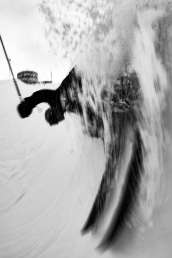
Getting creative
“I wasn’t sporty at all until I was 18. I was a nerd. I did informatics, IT. I played a lot of video games, like Doom and other things. And I wouldn’t have considered myself creative back then. I think sport helped me get this vision and somehow shaped me into the creative space. But some things remain. I loved things that were a bit darker—rougher. I love to play with a kind of “horror” scenario. More dark tones, more mysterious. That still remains. I loved black metal, heavy metal. I don’t listen to it anymore, but that imagery remains in my photography.
Now I feel like darker tones are present in sports photography—through the mood, the shifted colorways. Personally it’s really important that passions are mergeable—that you can combine them. Because different visions, different instincts can produce something good. I think it helps a lot. Over the last three or four years we could see low-shutter shots, more glow and other things that became more popular, because there was a sense that photography was getting boring. You can merge visions—it’s always a compromise—but it can work. And the more passion there is, the easier it is to merge.”


Half athlete half image-maker
“When I started out—freestyle skiing on one side, photography on the other—my thinking was pretty simple: ‘That trick looks sick. This light looks sick. Let’s get a sunrise shot. Let’s get something good’. When you’re young, you’re often driven by that idea of being seen—being sponsored, being validated. Honestly, looking back, I find some of it wrong. But then you grow, you evolve.
For me, injuries changed me a lot. They forced me to slow down and reframe what I was doing. And in a strange way, doing both—skiing and shooting—became my biggest advantage. I can understand how something will look almost instantly. I don’t need the back-and-forth you sometimes get between a photographer and an athlete. I can see the trick and the frame at the same time. I can tell you right away if it’s good or not. Eventually, it all merged. I don’t separate it into “me as a skier” versus “me as a photographer” anymore. It starts as an idea—an image in my head. Then I decide what the best way is to bring it to life: Do I shoot it myself? Do I bring in another athlete? A writer? A photographer? An art director?. It’s the same logic as building anything creative, even a product. First comes the idea and after the vision. Then you figure out who’s best to execute it. That’s how it’s been for me, too. I kept notes, kept pushing it forward, and then the collaborations found their place.
Even with skiing, it’s similar. Snowboarding has this beautiful way of carving—playful, expressive. Skiing can be so alpine-driven, so performance-driven. Not always fun-driven. My turns aren’t the most efficient or technically perfect. But they feel incredible. The head is close to the ground. You feel the snow. And it also looks good. For me, it’s almost never ‘athlete first’ or ‘brand first.’ It’s the idea first—how it could look, how it could feel.”


Behind the lens and in the frame
“If I have to be honest there’s a self-centered element to my photography. I want to be proud of what I’m doing. My skiing isn’t the highest level in the world, but I have a huge drive. And let’s be real—any skier or snowboarder who ends up on a cover and says they don’t care about the exposure… that’s not true. Most humans like recognition. It’s natural. The important part is knowing where the limit is.
If I want the most insane backcountry kicker shot with the cleanest method it’s not gonna be me first person doing it. In those cases, I’ll bring in a bigger athlete, if time allows. For example, I’m working on a project with Nico Porteous, an Olympic gold medalist. He can do things I will never be able to do. No question.
A lot of the time, in my photography the process is more communal. I have a strong relationship with my friends, and many of them have become genuinely creative over the years. Some of them even started shooting themselves and enjoying it, which makes me happy, because they’re discovering a passion I already live with. When it’s a high-stakes job—brand work, limited time, one day to deliver— I have two or three people I trust completely. And then a wider circle of friends who can help.
Plus there’s another layer people don’t always understand: authorship. Sometimes a friend takes the photo—the shutter click—but the framing, the concept, the grading, the decision-making is mine. We still credit the person who shot it, because without them it wouldn’t exist. But I think of myself more as the director than the photographer in those moments. That’s not unusual if you look at other industries. Big fashion photographers often work with teams—assistants, retouchers, stylists—everyone contributes. The image is still a vision executed collectively. For me, there’s also the reality of time: I’m getting older. I got injured. So I’m always trying to pivot further into photography—do more, build more—without losing that part of me that still wants to ski, still wants to be capable, still wants to feel proud of the movement itself.”
A place that raises the bar
“In skiing and in photography, LAAX shaped me massively. I didn’t grow up as a freestyle kid. I started around 18 or 19. Before that I skied with my parents on holidays, and I was in a ski club, but I wasn’t doing freestyle. LAAX is a high-level environment. And honestly, I haven’t skied that many other resorts—at least not in the same way. I’ll travel for powder, but not internationally. I’ve never even skied in the US But in LAAX, every year I find new lines, new zones, new angles. And the level is high in multiple ways: visually—architecture, layout, design—but also in the riding culture. If you’re not good, you don’t progress there. You don’t “accidentally” become great in a place like that. Being around riders who grew up in that scene changes your standards. And that pressure is productive. I look at my work and still think that could be better. I look at what other people do and feel pushed. If you’re connected to the community in a healthy way—without bitterness—everyone grows. That environment made a huge impact on how I see, how I ski, how I shoot. I’m endlessly grateful I got pulled into it over the years.”


Feels like memory
“I’m not sure I’ve ever fully put it into words. But if I had to describe it, I’d start here: a single action shot can be boring. Action shots are important—covers, hero images, key visuals—of course. But the work becomes meaningful when there’s storytelling around it, when it has personality. I’m drawn to images that feel like a dream you half-remember. Not everything is sharp. Not everything is literal. It can feel surreal—like you can’t quite place yourself inside it, but you still feel something. Halo effects, rare light, details that you might not notice while you’re skiing, but that can be revealed through the camera.
I want people to experience the moment—not just see one frame and move on. I don’t love posting a single image without context. I want a series. I want you to feel the turns, the texture, the joy. And I also want it to be accessible. My skiing is “reasonable”. Maybe not with the exact same body language, but the door feels open. A triple cork 1620 on the pro line in LAAX—that’s not something you just attempt. But if art becomes only about the unreachable, the culture stops growing. I think photography—and creativity in general—should be understandable. When people understand, they connect. When they connect, the community evolves.”
When fashion meets the mountain
“My photography is about framing—angles, composition, the willingness to break the “classic” rules of action sports.
When I started, a photographer told me the goal was to put the rider in the sky. Make it look huge. Show the takeoff and landing so the viewer understands. At the time, I thought it was a rule. Now, after years, I partly disagree. Some of it is still true: you do want the viewer to understand what they’re seeing, but that’s why series matter. The athlete’s experience is fragmented: they see the kicker, then the landing, then the spray of snow. Fashion photography teaches you how to build a narrative from fragments. It uses more angles, more experimentation, more risk, because the competition is intense and the industry is massive.
Action sports imagery has often been closer to documentation. But it can go much further: detail shots, off-angle perspectives, moments that are provocative or uncomfortable. In a way that tells the truth of the sport. A crash. A consequence. A strange detail. Fashion has always used provocation as a storytelling tool, and action sports still has so much room to explore that visually. And you can see it changing: grain, blur, dreamy frames—those aesthetics are everywhere in the last five years. The audience likes it because it offers a new way to feel the sport.
I also learned a lot being on the other side—as a talent on commercial shoots. In fashion, photographers often don’t care about your “perfect” body position in the air the way a ski photographer would. They see something else—shape, silhouette, mood. That’s interesting, because it shows how different visual worlds prioritize different truths. At the same time, if you come from fashion without understanding the sport, you miss key things. A brand team might not know what trick reads well, what body position matters, what makes something look clean. Sometimes that knowledge can disappear. That’s where the merge becomes powerful: you can borrow fashion’s eye—its narrative, its angles, its bravery—without losing the integrity of the sport. You can make it feel elevated, but still real.”


All 4 One - Finish Line
The wide collective of the Cisalfa Run Crew has reached its finish line, following legs, breath, mind, and heart across the 42 kilometers of Rome: this is the story told by some of the Crew’s own members, protagonists of the All 4 One project
If the old saying that all roads lead to Rome still holds true, it is just as true that a multitude of individual paths can converge into a single, shared experience: one that is as diverse as it is united. All 4 One. The slogan itself, which accompanied the Cisalfa Run Crew across Rome’s cobblestones, says it all. A journey that began a long time ago, grounded in the essential pillars of legs, breath, mind, and heart: markers of athletic evolution, certainly, but also of the human connection, as highlighted by the relationship between Lorenzo Lotti, the group’s coach, Sofia Montagna, Giovanni Maione, and Lara Alborghetti.
It is no coincidence that, at the end of the 42 kilometres, where the beauty of the Eternal City seemed to radiate through the euphoria of the finish line, the members of the Cisalfa Run Crew, a group of people that has found, and continues to find, in running a powerful companion in both personal and collective growth, revealed emotions far deeper than simple fulfilment. At the end of this shared journey, experienced by Lorenzo, Sofia, Giovanni, Lara, and many other Cisalfa Run Crew teammates alongside them, what remains are memorable times and personal progress, of course, but also the sense of having shaped something far greater. Something born of new awareness, new human connections, newly acquired technical knowledge, and strengthened mental resilience. And, ultimately, new emotions.
Emotions we revisit in a dedicated documentary, and through the voices of the Cisalfa Run Crew members mentioned above: those we have followed since the very beginning of this journey.


Lorenzo Lotti | Mind
“Rome is always a stunning city, and it’s always an emotion to experience both the place and the marathon within it. You breathe history here, and it’s truly beautiful to run through it. This year, I had the privilege of running alongside Sofia, which made it even more special. We met about a year and a half ago through Cisalfa, and since then we’ve run four marathons together: me as her coach, her as the athlete. This was the first one we ran side by side. It’s an experience that strengthens you, helps you grow, teaches you so much about race management: about the mind, the body, the mental game. Over this past year and a half, we’ve built something meaningful. Each race has been a step forward: in time, in condition, in mindset and, as this marathon showed, in our bond.
We had a moment of crisis around the 34th kilometer: more mental than physical. We told ourselves that as long as the legs weren’t hurting, it was all in the head. One kilometer at a time, step by step. We moved through it, and right after that, we found another gear. That’s what the mind means: what it can do, if you learn how to handle those moments. For years, the mind was my weak point. I had to work on it, learn how to arrive at those difficult moments in a more relaxed state. We are built to run: our bodies are made to endure. When we struggle, it’s almost always a matter of the mind.
But it wasn’t just about Sofia. With the entire Cisalfa Run Crew, this has been a real journey. We found a kind of harmony: everyone knew their goal, everyone was chasing their own finish line, their own emotion. And everyone managed both training and race execution perfectly. I love coaching, I love sharing. And helping three very different personalities reach their goals, through both individual effort and collective balance, was something special. From the beginning, we said we had to work on everything: legs, mind, heart, breath. Because without that balance, you don’t just lose performance, you lose the joy, the essence of what a marathon can give.”


Sofia Montagna | Heart
“The day was incredible: one of the most beautiful and emotional marathons I’ve ever run. I had such a strong desire to run, it was the only thing on my mind. I wanted to feel light again, to reconnect with that sense of well-being I feel in training. Everyone kept asking if I was ready, if I felt charged. I said yes, but I was calm. Completely calm. I had done the work, and I had done it well. Now it was just about gathering everything I had sown in training: every emotion, every sensation. And that’s exactly what happened. Every kilometer felt like a dream. I reached the finish line almost in disbelief.
I tried to listen to my heart: to reconnect with that passion that makes me run every day. To live every kilometer with my heart, to put my heart into every step. I wanted to enjoy it fully, without regret at the end. Even physically, the course helped me: with the constant ups and downs, I focused on the descents, knowing my heart rate would settle and I could recover before pushing again. Running in Rome is magical: for what surrounds you, for the monuments, for the energy in the air. I had beautiful memories from last year, but this time it was even more powerful. We were part of this river of people flowing through the city… it was something extraordinary.
The All 4 One project added another layer to this marathon: four people, four different elements, a shared path that brought us here with awareness. And we all gave our 100%. At one point in the race, I hit a small crisis: I told Lorenzo I felt short of breath. He told me to think of Lara, of her strength, of her element: breath. That’s what made it special: supporting each other, taking something from one another, drawing inspiration. The marathon is an individual race, but sharing both the journey and the race with people you admire gives it a completely different meaning. It deepens the finish line, makes the emotion richer. They’re part of the memory.”


Giovanni Maione | Legs
“The marathon is everything: strategy, staying calm, remaining clear-headed when you feel like you might not make it. More than ever, in this race, my legs carried me. In the moments when I was about to break, I just trusted them: kept the rhythm, stayed confident I could get to the end. And I did. At the finish, I broke down. In a second, it all hit me, I had made it. I was proud of myself. I didn’t expect to feel that way. I’m rarely proud of myself, I always want more, but this race taught me something: in the end, what matters is giving everything you have. I gave my 100%, and that’s the only thing I can control.
It was a constant flow of emotions from start to finish. Every marathon is a journey, and Rome was a beautiful one, even if the course was incredibly demanding: cobblestones, turns, climbs, descents. Around the 13th kilometer, my heart rate started to rise, and once it does, it’s hard to bring it back down. I tried to manage it through my breathing. I suffered, especially around the 34th. I had been following the 3:15 pacers, tried to push ahead, but realized I didn’t have it. So I tucked back in, stayed steady, and held that pace to the end.
Legs matter, but they’re not enough. You need mind, heart, breath. And for me, those elements have faces: Lorenzo, Sofia, Lara. Before the race, we built something real. I felt those elements working together inside me, and I felt in harmony with them, too. Yes, you run alone, but knowing someone else is out there, running with you, gives you strength. And then the finish. The most beautiful moment. They were there waiting for me, welcoming me. It was something truly priceless.”


Lara Alborghetti | Breath
“I felt like my heart was about to burst with joy. With every step, I thought about the journey and what I was doing: it all felt surreal. A couple of years ago, I put on a pair of running shoes for the first time. I never imagined I would get here. These 42 kilometers were pure energy: positive energy, gratitude toward myself, toward the journey, a deep sense of satisfaction in what I’m capable of. I learned to believe in myself a little more.
My breath was there, it carried me through all 42 kilometers. I felt it as something truly mine. I managed it, listened to it, controlled it. Every step felt aligned, carried by my breathing. It was magical. I felt part of something bigger: 36,000 people moving toward the same goal. That gave me strength. From the tenth kilometer on, my legs just went on their own. My mind was there, I never hit the wall. I broke the race into sections, just to trick my mind, and everything flowed better than expected. The heart was the engine of it all. Legs and breath, mind and heart: they became one. At the finish, I felt full. Full of joy. I even thought: I could do it again.
And I wasn’t alone in this journey. Giorgia was there for the most important training run—the long one. Thirty-eight kilometers, perfectly in sync. My family was there too: my dad, every Sunday, on his bike, following me, handing me water and gels. He’s not even a cyclist. And yet, he was there. That kind of support… I found it again in the Cisalfa Run Crew.”


This story forms part of a far broader involvement by Cisalfa Sport in the Run Rome The Marathon 2026. As the event’s Main Sponsor, Cisalfa Sport brought not only the four ambassadors of the All 4 One project, but also ten additional members of the Cisalfa Run Crew to the Eternal City. All of them completed the marathon distance, with seven taking on the 42 kilometres for the very first time, offering a tangible expression of the vision that underpins Cisalfa Sport: a commitment to inspiring ever more people, through stories of miles, emotions, and first experiences, to embrace a challenge that extends far beyond sport itself. At the same time, it reads as an invitation—to step into the arena through sport, to chase goals that may at first seem unattainable, yet, through connection and shared human experience, gradually take shape—culminating in a form of fulfillment that is as rare as it is profound.

A magical and revolutionary ritual: the mountaineering of the Cholitas Escaladoras
The premiere of the documentary Ascensio, supported by the SCARPA®–GORE-TEX® partnership, gave us the chance to explore the essence of a group of Bolivian women who speak with the mountains, and leave powerful messages on their summits
Magic ritual. A prayer to Mother Earth. The mountaineering art of the Cholitas Escaladoras contains cultural codes far more significant than the mere physical act of climbing vertically. Theirs is a contemporary Bolivian fable, made of ancient traditions that, filtered through their courage, become a form of redemption for Andean women: a female challenge that draws on aesthetic languages and traditional knowledge, translating them into the conquest of summits as a way to affirm both individual and collective identity, and into a respectful, almost mystical, approach to this natural element.
On the occasion of the premiere of the documentary ‘Ascensio’, a narrative chapter within a broader support system for the Cholitas shaped by the partnership between SCARPA® and GORE-TEX®, we captured the quiet, yet thunderously powerful, philosophy of these Aymara pioneers. According to them, the conquest of some of Latin America’s most iconic peaks, and their recent ascent of Mont Blanc, are not sporting achievements but manifestos: challenges to gender stereotypes and to the social barriers that many Bolivian women still face today.
We gathered the reflections of Lita and Dora, stepping into the world of the Cholitas Escaladoras and discovering the intentions that guide their work: intentions also reflected in the special documentary we present here.
“We come from a community called Cañavirizongo, a humid valley hidden behind one of the best-known mountains of the Cordillera, Huayna Potosí. Our community has always been tied to the mountains. Life there revolved, and still revolves, around working the land high up, where the snow can be seen in the distance. Women were not allowed to climb those mountains; they were expected to stay at home. And yet, for reasons we can’t fully explain, those peaks kept calling to us. For a long time we didn’t have the equipment to climb them. We didn’t even have high-mountain boots that fit our feet. Still, a question kept growing inside us: what does it really feel like to reach the summit?
The turning point came in 2015, when a photographer made an open call for girls who wanted to try climbing a peak. That was the moment we decided to go. We set out together with other local women. When we reached the summit, we realized something simple and powerful: we could do it. That was the beginning. We kept climbing peaks: first in Bolivia, then in other parts of South America… mountains rising above six thousand meters. What had started as a dream slowly turned into a small revolution.
We climb wearing our traditional clothes: the pollera (the colorful traditional skirt), the manta, and the hat. It isn’t an aesthetic choice; it’s a choice of identity. For a long time Aymara women were seen only inside the home, in the kitchen, beside their families. But those clothes tell the story of our roots. The pollera reminds us who we are; it keeps us connected to the earth, to Pachamama – Mother Earth. For us, mountains are not just mountains: they are living beings. When we climb, it is not only an ascent; it is also a way of greeting them.
Over time we realized that our role could not simply be to climb higher and higher. We also needed to tell our story. We wanted other women to see and feel what we had seen and felt: that fear can be faced and overcome. For many years, mountaineering in our region was an exclusively male world. Today we feel we have opened a path. And when a path opens, someone has to keep walking it.
Every mountain speaks to us in a different way. When we arrived at Mont Blanc, we felt it immediately. Everything here is different: the glaciers melt faster, the mountain is different, the terrain as well. But the feeling is the same. From the kitchen to the summit. That is the story we want to tell.
Now our dreams have grown larger. We want to keep climbing, preparing for new mountains: Everest Base Camp, Kilimanjaro, and one day peaks above eight thousand meters. But more than anything, we want to leave a message: dreams must be nourished. And the path we have opened does not belong only to us. It must become a road for many other girls and women who, looking at a mountain, feel that same call.”


