


Sam William Andrews, the hybrid story of a rider-creator
From wheels to lens, interview with the multidimensional rider and photographer from Bristol
Cycling can inspire parallel paths, such as visual communication and content production. Sam William Andrews succeeds in connecting these dots. Born and raised in Bristol, this British rider-creator over time has touched different athletic universes, shaping both his sporting and artistic identities. After years of skate, BMX, and road cycling, today Andrews is both exploring gravel, participating in the world’s most renowned competitions, and evolving his own aesthetic, composed of visions that convey deep knowledge and sense of the present.
His words show a life marked by sport and its imagery, and describe a new generation of athlete-artists-human beings capable of rhyming physical effort with lenses and perspectives. The testimony of this contemporary storyteller is a focus on those who in sport see not just a realm of performances and PBs, but a unique, constant muse.


Can you tell us something about your sporting and photographic journey?
“As a kid I started with BMX, I was outside every day, all day. After some injuries, I transited into skateboarding. Skate culture is a fusion of arts and lifestyle, so in the skate period it was natural to create some content of our progression. Then I switched to fixed gear bikes, and I competed all over Europe, even participated in a Red Hook Criterium. Then, when I felt the need to take things a little more seriously, I got into cyclocross and road criteriums. I quickly realized that content creation and community in cycling was still very traditional and very different from the skate or fixie culture. The aesthetic perspectives that I’ve gained in the various steps of my sports journey have helped me become a content creator for these cycling universes. It’s great to show cycling through the lens and capture different emotions and adventures…. I studied photography in college, but I never thought I would find myself collaborating with brands and racing in lycra.”


You are simultaneously an athlete, photographer and content creator, how would you define yourself?
“I don’t know, it’s definitely a pretty hard balance. I work full time alongside all of this, so it’s difficult to prepare 100% for a race. I think the most important thing has been and continues to be discipline, because you have to sacrifice a lot of things to have a proper structure…. I’ve experienced times when I’ve asked myself ‘what are you doing?’, but when you feel you’ve built something or achieved something, you realize everything was really worth it. Of course there is pressure in both ways. I have the pressure of work on one side and the result of the races on the other. I can control more the creative and storytelling part, but the performance part one has too many unknowns: you can train great and feel well, but if during a race your legs don’t work, you can’t do anything about it…. Despite this, cycling is helping me and giving me so much time in the nature. It makes me feel free. It allows me to be constantly inspired by my surroundings, especially during the big races. Last year I participated in BADLANDS, 40 hours of non-stop gravel, no rest or sleep. Races like this give me a lot of time to think and observe. Dramatic views and emotions are two cornerstones of my photographic research.”


How would you define your relationship with gravel and the many brands you work with, such as Alba Optics and MAAP?
“It is crucial to work with brands that you believe in and trust. I always told myself that I would not collaborate with brands that I don’t like, or believe in the same vision as me. So I simply tried to build a network of products that I love to use. I’m very happy with the long relationships I’ve been able to build. Speaking of gravel, right now this world is taking a new direction-it’s much more professional than it was a few years ago. It used to be all about self-sufficiency and being out there alone for a long time with little support. Now at most races, you need a full support crew, and it’s all about marginal gains. I don’t know if I like this aspect of it, but at the same time it’s what’s growing the sport, giving us opportunity to race professionally, and making it exciting for people to follow the action. I see myself steering more and more towards long distances, where I’m really alone and vulnerable. No one is looking for you. Results don’t matter. You are with yourself for days and nights, experiencing all conditions and emotions. Long distances push you beyond your limits. Of course, the pointy end of gravel continues to fascinate and shape me as an athlete, but I don’t know how much longer I will be able to compete at such a high level…. In the end, I think my only passion is to be out there and enjoy every adventure.”


What are your plans for the future?
“In the short term I have The Rift in Iceland, a series of UCI gravel races, and some road criteriums in the UK. I will also look to go for some FKTs. In the long term, as I said before, I would like to focus more on ultra adventure races. I think I would find so much for myself there. On a photographic level I will push to work with more brands and expand my portfolio outside the cycling universe. Lastly, I would also like to try to focus on video and film production. We’ll see how far I can take all these things.”


BREAKING THE CODE, WIMBLEDON
Everything is different at Wimbledon, not only because of the sporting event itself, but also because of everything surrounding it.
Tennis fans are cyclically drawn to the evocative London grass: a perfectly manicured work of art cut to an exact 8 millimeter height. Racquet stars complete a unique scenario, wearing white uniforms from head to toe, according to the singular rules that have always distinguished this unique tournament.
In the various editions of the British slam, however, several athletes have defied this legendary rule with controversial outfits that, of course, have entered tennis history.

THE WHITE RULE
The all-white outfits of the tennis men and women are Wimbledon’s calling card-the symbol that, along with the green coats, is most etched in the collective imaginary. This rule dates back to the tournament’s origins. The decision to dress everyone strictly in white dates back to 1877, the year members of the All England Lawn Tennis and Croquet Club decided to organize the first edition of this event.
White is the color of aristocracies, of light, it evokes purity, order, softness, etc. All qualities that fit with the elegant air of Wimbledon’s luxury. That somewhat aristocratic atmosphere matched poorly with the players’ sweat, which was more visible on colorful shirts and shorts. This led to the idea of white: the color that best masks sweat stains. Over time this rule became a ten-detailed dress code, which today can be found on the official Wimbledon tournament website. Limits that someone, over time, decided to break.


JOHN McENROE: THE RED HEADBAND
On July 5, 1980, Bjorn Borg and John McEnroe step onto the center court at Wimbledon to rewrite tennis history, and turn a sport that until then was synonymous with classicism into pop music. Borg is quiet, calm, with long blond hair. McEnroe is irreverent, curly and always ready to explode. The outfit in that final, perhaps the most famous in Wimbledon history, violated the law that was in effect until then on the London grass. ‘The ‘Enfant Terrible’ of tennis, who never liked to submit to the rules, defied the code when he made his entrance on center court with a red headband encircling his hair. An iconic detail for a tennis icon.


ANNIE WHITE: THE FIRST VIOLATION
To find the first controversial women’s outfit in the history of the All England Lawn Tennis and Croquet Club, we have to go back to 1985. Anne White, in her match against Pam Shriver, wears white but is forced to change her outfit for another reason: she wears a very white but also very tight-fitting jumpsuit. She manages to play only a few minutes in it. At the first change of the court, the referee calls her back and invites her to change. That outfit is considered inappropriate and not congruent with the Wimbledon stage. Despite the defeat, her outfit goes down in history.

ANDRE AGASSI: THE REJECTION
If we opened a tennis almanac and looked up Andre Agassi’s tournament appearances, we would find nothing until 1991. The thick long hair, Mondrian-style T-shirts and unforgettable denim shorts could not exist on London’s grass. So the Las Vegas rebel decide to boycott Wimbledon multiple times. He doesn’t want to conform to the Slam’s dress code, he doesn’t want to be forced to wear what he doesn’t feel is his own. Eventually, Agassi, as well, has to obey the restrictive rule, and in 1992 he not only participates, but wins the tournament, in a watershed final of a career that, despite still being young, was already getting weighed down with a few too many curses.


VENUS WILLIAMS: “WHAT PINK BRA?”
Lingerie is featured in another episode that has become famous. In 2017 Venus Williams, who has triumphed five times at the tournament, was forced to change her bra during a match against Elise Mertens. The reason? The pink straps that were peeking out under her outfit. The immediate request for an outfit change comes during a rain suspension during the second set. After the match, Venus expressed disappointment, “What pink bra? I don’t like to talk about bras or my underwear in press conferences, it’s embarrassing.”

NICK KYRGIOS: JORDAN’S ON THE GRASS
In school they would have said, he’s good but he doesn’t apply himself. Australian tennis player Nick Kyrgios is considered by many to be one of the greatest talents of his generation. However, his career has been filled with broken rackets, hefty fines and irreverent gestures. In 2022, his fourth-round victory over Brandon Nakashima at Wimbledon is about to end without controversy, until the Australian player decides to break the dress code by wearing a cap and a pair of red Air Jordans to leave the court. Soon after, a reporter asked him why he had chosen to break the rules: “Because I do what I want. I’m not above the rules. I just want to wear my Jordans.”


JANNIK SINNER: THE GUCCI DUFFLE BAG
The new world No. 1 is known for his composure and class…. That’s why he caused a stir when he walked onto Centre Court in 2023 with a luxurious Gucci duffle bag, attracting the attention of spectators and press alike. The South Tyrolean champion had become a brand ambassador for the Florentine fashion house a few weeks earlier and decided to let the world know about it during his first match on the London grass, which he won against Juan Manuel Cerundolo.

Wimbledon’s strict dress code has always been a point of contention, and from the 1980s to the present, players have repeatedly challenged the limits of the total white rule. With the tournament just days away, we can’t wait to find out who will elude the rule this year.
Credits
IMAGO / Sven Simon / Claus Bergmann / glasshouseimages / United Archives / Adam Stoltman / Bridgeman Images / Colorsport / Oliver Hardt / Belga / Action Plus /
Filippo Libenzi

J. Michael Prince, of polo, authenticity and culture
Riders and calcianti, we heard the evocative story of USPA Global President & Chief Executive Officer J. Michael Prince
Riders and calcianti. Polo and Calcio Storico Fiorentino. Rarely has the modern sports imagination witnessed such an evocative ‘match made in heaven’: a connection that unites activities steeped in history, tradition but also uniquely modern. On the iconic stage of Piazza Santa Croce, US POLO Assn. has once again elevated the image of its sport and brand by forming a unique synergy with the most identifiable game in the city-cradle of the Italian Renaissance. It all took place during a one-of-a-kind week inspired by Pitti Uomo.
We met with USPA Global President & Chief Executive Officer J. Michael Prince on this momentous occasion. His story underscores that age-old fascination we humans have for sports that become both cultural heritage and a breeding ground for style and fashion. The words and career of this American professional perfectly tell the tale of a symbiosis between athletics and fashion culture. His story lets us discover the legacy and timeless philosophy of US POLO Assn. and dive into a life that has always gravitated around a passion for sports.

Price starts by saying that US POLO Assn.is more than just a brand; it is the engine behind global polo itself. It is a virtuous blend of philanthropy, sensitivity and unconditional support for a compelling sport that sees athletes and horses perform in unison, reflecting the atavistic relationship between human and animal in modern times. US POLO Assn., above all, represents the desire to continue a legend that began more than 2,000 years ago, sharing and expanding it throughout the world. It is a brand that nurtures a sport and the sport that nurtures the brand.
Your professional career is deeply rooted in sports culture. Can you tell us something about your relationship with it?
“Ever since I was a child, sports have always been important. Thanks to it, I learned the meaning of teamwork and dedication in high school, along with winning and losing gracefully. These concepts have carried over into my professional career. I worked for Converse, a sports-inspired brand, where I had the opportunity to connect with many elite athletes, especially from basketball. Then I moved on to Nike, and then I had the opportunity to supervise other iconic brands like Umbro, which has always been a part of football culture. These experiences allowed me to cut my teeth and learn from some of the best brands in the world, not just in sports. When the opportunity to work with US POLO Assn. came along, I didn’t see it just as a fashion brand but as organically connected to the soul of a sport. And polo isn’t just any sport. Not many people know it, but polo has been played for over 2,000 years; its origins can be traced back to about 600 B.C. And the USPA – United States Polo Association, our governing body, was founded in 1890. That’s why our brand loves to talk about sports history and our deep connection with it. What I also loved about working with Converse, for example, was that it is accessible to everyone, and I found the same thing in US POLO Assn. I’m aware that I’m part of a sport-inspired brand that needs to communicate with working families worldwide. In my vision, it’s essential to be part of a brand that is accessible to everyone, and the same reasoning applies to polo.”


What does it mean to represent a brand that’s so rooted in history? Is it more a sense of pride or responsibility?
“I feel both. In an increasingly noisy world, sports continue to be so authentic, so real…. Everyone can relate to sports by playing or watching them. The most valuable feature of US POLO Assn. lies in being the authentic brand of the sport in the States and around the world. Applying this kind of sports inspiration to our brand lets us sell our clothes in 190 countries, and I think that’s really special. In the last five years, we’ve grown tremendously, over a billion dollars in sales, and I’m convinced this is connected to what we stand for. Consumers relate to more than just a brand. Our real, tangible connection to a sport and our timeless designs are essential in our relationship with them.”
You have stated in various interviews that you’ve fallen in love with polo. What are the unique qualities of the sport?
“I attended my first polo match when I joined US POLO Assn. I was blown away by the performances of the elite athletes, and I’m not just talking about the riders but their horses, their partners. The way they moved in unison, on the field, made me think of it as an art form. It is great that two ‘players’ work together as one…. Then I looked around, there were so many families in the stands together, people who were connecting through this wonderful sport. I realizez then that I was part of one of the most beautiful sports in the world. That’s also why I’m proud of our global events – they let us introduce polo to so many people who don’t know about it.”


The partnership with Calcio Storico Fiorentino is a match made in heaven. It’s two sports that have incredible sports legacies. How are these legendary disciplines spread worldwide and, in the case of US POLO Assn., in today’s market?
“What we see here is respect for tradition. And that is always very, very important. You have to respect the past to embrace the future. I think of the many fans of Calcio Storico Fiorentino, who are passionate about a sport that’s been around for hundreds of years; it started way back in 1200 A.D. And then think of them discovering a sport like polo, which has been around for 2,600 years…it’s incredible. Then, we put them all in the wonderful city of Florence – I can’t imagine a more beautiful combination of sports and places than this. I’m also really excited about what will happen in Paris, where we’ll combine our 135th anniversary with the 100th anniversary of the Olympics in the French capital. There will be a match between the U.S. and French national teams… These events give polo a chance to show itself to the whole world, and that really excites me.”
The present and future of US POLO Assn. and the sport it represents are closely connected to sustainability and the well-being of animals. How do these two issues impact the directions you are taking as a brand and as a sport?
“In sports, we put that deep relationship between human and equine athlete first. You need to be aware and protective of the health of your horsers. When you see a polo match, the mutual love between rider and horse is immediately evident…. And every possible precaution is taken to safeguard both and keep them healthy. As a brand, we’re always thinking about these issues. We have a clear philanthropic vocation; we are at the forefront in donating funds to support the polo community. We invest in the welfare of the horses, support the players, but also spread this culture through the creation, for example, of a museum. It is crucial for us to have this philanthropic ecosystem that allows us to give something back to the sport, but also to the many foundations that help it.”


THE COPA AMÉRICA SYMPHONY
A gallery of colors, fans and passion celebrates the football event that unites the Americas
“Football resembles music,” claimed Carmelo Bene’s pen. “Can music perhaps be explained by music? No. The same goes for football.” The Copa América turns these words into images. The football competition that almost entirely unites the New World is a score of colorful notes. It is a stream of flamboyant costumes, religious echoes and mystical passion that, since 1993, has involved not only CONMEBOL affiliates, but also countries in Central and North America. We celebrate this mix of cultures, and their connection to polyglot football-fútbol-soccer-futebol, through a special gallery inspired by the very typical, yet different aesthetic vibes of this part of the world.


Credits
IMAGO / Icon Sportwise / Matthias Koch / Propaganda Photo / NurPhoto / Photosport / Sports Press Photo / PanoramiC / Russian Look / Pius Koller / Xinhua / Bildbyran

WATCHLIST - THE TOUR DE FRANCE IN 5 DOCUMENTARIES
The 5 best documentaries to discover and understand the Grand Boucle's magic
Few events in the world have the epic and mystique of the Tour de France. The yellow race has been since as far back as 1903 a novel built on tears and hard work, it is a mad cycling marathon conceived by the brilliant ‘tyrant’ Henri Desgrange and embraced by legendary athletes. Anecdotes, exploits and failures have made the Tour a timeless celebration of both a sport and a country, painting, generation after generation, a work of art as tragic as it is romantic. With the 2024 edition just days away, we have selected the best documentaries to understand the beauty of this event. Enjoy.

Tour de France: Unchained
This Netflix production recently launched its second chapter. Clearly inspired by ‘Drive to Survive,’ the F1 series that changed sports storytelling, ‘Tour de France: Unchained’ is a journey into the as legendary as it is contemporary hell of the world’s most famous cycling race. Each episode is a stage in the stage, where biographies, emotions, exploits and meltdowns follow one another like breakaways and help us understand the dynamics of this cycling heaven.
Slaying the Badger
Before the rise and fall of Lance Armstrong, America revered another cyclist, Greg LeMond. The man who said, “It doesn’t get easier, you just go faster,” was the first non-European to win the Tour de France, in 1986. After recovering from a dramatic hunting accident, the Californian also became one of only eight cyclists in history to win three consecutive Tours (1986, ’88, ’89). This ESPN documentary focuses on the story of ‘LeMonster’ and, at the same time, allows us to discover his timeless rivalry with Bernard Hinault, the invincible ‘Badger,’ the 5-time Grand Boucle winner. ‘Salying the Badger’ is a description of a generational change and the clash as visceral as it is romantic between two cycling legends.

Geraint Thomas: The road will Decide
From Welsh rurality and humor to the elegance of the Avenue des Champs-Élysées. Geraint Thomas’ journey is a story to be discovered, and was told by the BBC in a documentary that is also available on YouTube. This production follows Thomas in 2019, the season after his first and only Tour de France victory. His testimony and a special behind-the-scenes access show us the pressures, desires, and feelings of a king who desperately wants to keep his crown.

Mark Cavendish: Never Enough
The Tour de France teaches how to climb and descend. It also teaches how to triumph and collapse. The life of ‘Cannonball’ Mark Cavendish is a metaphor for all this. In this Netflix production, Cavendish is shown not as one of the greatest sprinters in history, but as a human being. Failure and depression become synonymous with resilience and desire. The Briton is portrayed after a long layoff as he tries to reach and break a unique record in Tour history. Cavendish manages to match the 34 stages won by ‘Cannibal’ Eddy Mercx, but the significance of this docu does not lie in the statistics, it lies in the feats of an exceptional athlete, and a fragile man.

The least expected day
We discover a collective history by experiencing a season with the Movistar team. Thanks to Netflix, we can take a look at the dynamics of one of the longest-running formations in the cycling universe. Founded in 1980, the Movistar Team is portrayed in an extremely difficult season, allowing us not only to analyze hierarchies and internal relationships, but also to travel on the team bus during legendary events such as the Giro d’Italia and, of course, the Tour de France.


Behind the Lights - Chris Caporaso
We discover the evocative, minimalist lens of the Australian photographer
Lines can communicate, geometry can inspire, and in minimalism we can find the purest aesthetic-this explains Australian photographer Chris Caporaso’s lens. In an increasingly confusing and contrived world, his visions elevate the beauty of sporting simplicity, as well as its protagonists and tools. Yet the 37-year-old Melbourne based creative is an active part of athletic complexity. In fact, he divides his time between the day-to-day job as an Australian football match analyst with his photographic production-a crossroads as atypical as it’s fruitful.


“I grew up in Adelaide, and so my earliest sports memories are related to the Formula 1 GPs I watched with my father. I was obsessed with cars; I kept drawing them as a kid. I still have stuck in my mind the names and aesthetics of teams like Benetton and Rothman Williams…. Time led me to become a match analyst for an Australian professional football team. During the pandemic, when we had to isolate ourselves from everyone in order to continue the season, I basically lived with my entire workplace on the Gold Coast for a hundred days. The situation was draining me. So I took the camera with me and started capturing things. I discovered photography as a teenager, and I always took cameras with me on family trips. It wasn’t until 2020 that I realized how much I really needed this outlet: photography is giving me balance in my everyday life and, at the same time, allowing me to develop freelance projects parallel to my ordinary job. Thanks to the lens I can leave football and its chaotic dynamics aside for a few hours, clearing my mind.”


Chris’s visions are the product of an academic and human journey committed to aesthetic taste. Inspired by Frank Lloyd Wright’s architecture and a path in design, Chris’s photographic style is at the intersection of contemporary documentary, social coolness, and fashion vibes connected to the streetwear universe.
“I think my photographic style is always evolving, but it has a consistency. My early studies in design and my interest in architecture are foundations for my visual production. I do love minimal and monochromatic aesthetics. And I also love diving into cultures, representing their uniqueness. I’ve been to New York many times, so there’s a heavy influence there…it’s always been a great source of creative inspiration for me walking around with headphones on, and capture what’s happening on the streets and the down in the subway. My sports photography focuses mostly on Formula 1, tennis and sneakers. I’ve been incredibly lucky to visit the F1 paddock on a few occasions, I kind of just appreciate the cars as art themselves, the aerodynamics and innovation behind them that form aggressive lines and nice curves making them quite photogenic…. The same happens when I watch a tennis match. During a tournament like the Australian Open, the colors and the perfect lines are so aesthetically pleasing, lending itself to interesting compositions. It’s almost poetic to me how that perfect series of lines then forms a shape that a sport with such history is then won and lost between. Sneakers are a lifelong interest of mine and are part of my identity. I’ve spent a lot of time shooting sneakers both for the culture and also some commercially. My all-time favorite pair is the Nike Air Max 1 Atmos Elephants but the sneaker that got me into the culture is the Nike Air Max 90 Infrareds. Right now I’m probably just wearing some New Balance 990s.V6’s in grey. In my photography I want people to feel something through my images. I can be a bit of a minimalist, I like my images to be clean and use depth in a way to direct your eye. I want everything to be aligned, and the colors to compliment each other…. Like most creatives I can be my own greatest critic sometimes”


Now divided between the tactical studies of a unique sport such as Australian football and the development of a creative career, Chris continues in his pursuit of elegant details and essential spaces. “In the last period I have planted a seed both in my head and subconscious,” says the Melbourne based photographer, “I would like to make a definitive transition into the creative world. The football environment is exciting. Helping the team and providing support for players and coaches fulfills me, but I have a dream, or rather a hope, that I can devote myself completely to creativity. Maybe one day it will happen.”


WATCHLIST - EUROPEAN FOOTBALL CULTURE
5 films and series introduce us to the European Championship and the relationship between the Beautiful Game and its homeland
The European Championship is just around the corner and an entire continent is waiting to experience the football religion. Where it all began. Where it all continues. If England is the home of football, Europe is its cradle: an ancient civilization that has never stopped colonizing the entire world with one of its most precious and universal assets. The Beautiful Game is the irrational soul of Europe, and Euro ’24 is yet another celebration of this symbiotic relationship. We have selected some visual productions that portray this special bond: documentaries, series and films that will show you the essence, extravagance and radicalism of European football. Enjoy.

The English Game
If we want to understand a sport, or rather, a culture, it is necessary to start from its origins. This Netflix series is a journey into the pioneering years of English football. The nineteenth-century genesis of football is told through historical figures and true events. ‘The English Game’ is not a documentary, but an elegant series that explains to everyone the rise of football in the English and European society.


Gascoigne / Beckham
Football is synonymous with England, and England is synonymous with football storytelling. ‘Gascoigne’ is the Prime Video focus on one of the most controversial and beloved footballers ever. ‘Gazza’ is English DNA applied to football, it is the genius of the number 10 and the irrationality of the terraces. This documentary chronicles his life, as well as his dramatic relationship with alcohol and visceral bond with the ‘Three Lions’ national team-a tricky combination that shaped the iconic Euro ’96 celebration. From generation to generation. ‘Beckham’ is the Netflix production inspired by the life of the ‘Spice Boy,’ David Beckham, the wonderful number 23 who managed to change the image of football forever. Beckham’s mind and emotions are the central themes of this documentary which, inevitably, portrays the former Galacticos participations in the European Championships.
The Final: Attack on Wembley
‘Attack on Wembley’ takes us into the illogicalities of English passion, showing us the dark side of the “It’s Coming Home” philosophy and analyzing the desecration of the Wembley sanctuary at the 2020 European Championship final, when all of England mourned the end of a dream, and thousands of fans destabilized public safety before what was supposed to be a legendary match. This special focus is available on Netflix.

Looking for Eric
Éric Cantona is an image that can both unite and divide the English and French football universes. He still is the United mystical number 7, and one of the most brilliant icons in European football history. ‘Looking for Eric’ is an indie movie about the relationship between Europe and football, but it doesn’t talk about football. The former footballer is a supernatural entity that affects the life of an anonymous letter carrier, showing how football can deeply affects the mind and life of every inhabitant of the continent.

Diamantino
This Cannes-acclaimed film is an extravagant work, capable of interweaving the stereotypes of the European football starsystem with deep social and political topics. Portuguese star Diamantino lives a football fable and a crazy adventure in real-world awareness, where pain and hatred leave no room for the simple football magic. ‘Diamantino’ portrays in a surreal way the instrumentalization of sport in the European national and political system. It’s a fairytale that uses football, and its kaleidoscopic ramifications, to talk about something more – life.

EXTRA - Fever Pitch
We have to mention the greatest cinematic work inspired by football passion. ‘Fever Pitch’ is not strictly related to the European Championship, but it is a cult film that anyone must enjoy to discover what does it mean to be a football fanatic on the continent. Colin Firth is a professor of Humanities, and he lives just for Arsenal. The film adaptation of Nick Hornby’s literary masterpiece does not criticize the illogical behaviors of this middle-aged man, but understands his reasons, describing the biography-typical of many, many European fans. “We’ll never get over this,” is the most iconic line in a movie that everyone should watch before criticizing any football fan.


On your marks - Visions of European athletics
Thanks to KARHU, we felt the vibrations and captured the essence of the European Athletics Championships
“Ai posti di blocco,” people say around here in Rome, where chaos and wonder coexist without ever, really, separating. “On your marks,” chime the cool megaphones of a stadium born for heat, the Olimpico. In the Eternal City, idiosyncrasies take on connotations of forced, or perhaps intended, coexistence. They paint scenes and moments that manage to be both sublime and dramatic at the same time, serving as amplifiers for the sensory patterns of the European Athletics Championships.


Thanks to KARHU, official technical supplier of the event, we spent a few days in the capital of Italy at that momentary Eden of European athletics. Our cameras captured that multisensory whirlwind of languages and movements united by a single emotional continuum: Athletics. Check out our gallery.


The Eleganza of the number 10, collectable edition
Calcetto Eleganza turns 10, and a unique collection of cards celebrates the history of the Milan community and its new jerseys
It’s the early 1960s, Modena. Giuseppe Panini looked over at his brother Franco. “I want to make collectable cards,” he said. It was the beginning of a simple yet enlightened sport, social, even artistic rebellion. 2014, Milan. “Non per sport ma per moda” – “Not for sport but for fashion”. This sarcastic claim kicked off a different kind of revolution with a common denominator, Calcetto Eleganza.
Football as the muse, creativity the matrix, and community as the outcome. At its prestigious 10th anniversary, the Eleganza project continues to evolve and expand, say co-founders Davide Di Martino, Nicolò Riggio, Marco Gardenale and Aldo Giordano, without compromising its essence. An essence made of everything Milanese and cosmopolitan, where football fetishes like Pato, Francescoli and Busquets go hand in hand with the eclecticism of Satisfy, Daft Punk and Achille Castiglioni. Where the Beautiful Game sits center stage without really being the main character, instead becoming the summit of a constantly renewing pyramid of sports.
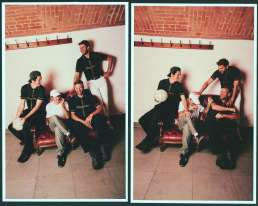


Decked out in its new jerseys, entirely self-produced for the first time in the project’s history, Eleganza reveals itself as a universe of different nationalities, careers, visions, trends and personalities. Like an album of collectable cards to leaf through. Like the number 10, the most timeless and elegant number there is.


Luca Di Marco
Favorite team and player.
Catania and Inter, my city’s team and my family’s team. Inter took me in when I moved to Milan. Mariano Izco and Ivan Zamorano. Despite the criticism, the former was the soul of Catania. The latter because I love killer wingmen – the ones who can do it all but stay out of the spotlight– and the mystique of 1+8.
Favorite brand and creative person.
Nike, because of all it’s represented over the years, and Umbro, because it raised the bar for football aesthetics. Domenico Romeo, because he was the first designer of the Calcetto Eleganza logo. I still have our first emails….
Eleganza.
Eleganza is as much about how you perform on the field as in the locker room. It is a way of being together, a passion that combines football, community, style and fashion. In the beginning, Elegance stood for irony and brotherhood, then it progressed and took on other meanings.
Why Calcetto Eleganza.
It was necessary. We were all following streetwear trends, as well as those related to sports and urban culture. There was a lot going on around us. We took advantage of the historical moment and the city of Milan, and we were able to create a platform that could bring together a group of creative people in love with football.
The number 10.
It makes me think of times past. I’m talking about footballers with flair and creativity, who put their characteristics before everything else. So, I’m not talking about me. It’s those players who could no longer exist today. And then I think about our milestone. The longevity of Calcetto Eleganza surprises me: years have passed, and generations have changed, but Eleganza continues to generate interest.
In your life, on the pitch.
I’m creative. I founded and work in a media agency. Instinct is something I look for and follow both in my profession and on the field. Let’s just say I stick to projects and opponents.
The locker room.
I am the old ‘Patrón’ rooting on the young people. I’ve been doing that from the beginning of the project.
The Eleganza jerseys.
The vertical gold stripes are the new, and definitely Elegante, element that distinguishes both colorways.


Alice Marta Azzolini
Favorite team and player.
I don’t really follow football; I’m part of Eleganza Cycling, the cycling branch of Eleganza. So, I would say Alfonsina Strada.
Favorite brand and creative person.
Italian ‘market’ brands and Antonio Gramsci, or maybe Silvia Federici.
Eleganza.
It is a welcoming group of people who can transform macho sports like football or cycling and make them inclusive. Before Eleganza, I had a lot of fear connected with cycling, descents, etc. Without them, I wouldn’t be a cyclist.
Why Eleganza Cycling.
When they opened this new branch, I joined right away. I had just recently started cycling and always disliked sports settings that were really only interested in performance; Eleganza was the only platform that gave me the opportunity to have collective experiences and not just workouts.
The number 10.
In Milan, 10 years is an eternity. Now there are crews and communities in any sport, but the environment was very different in 2014. I think the important thing is to really do things. In these 10 years, Eleganza has done so much, and the project has evolved a great deal. It’s beautiful, then, that there are increasingly more sports outside of football.
In your life, on the road.
I’m a content designer. In this group, I’m the one who shows up on time, always stays up-to-date.
The locker room.
I play the role of feminist, though everyone is sensitive to the issue. I’m the one focused most on the small battles for inclusivity in sports.
The Eleganza jerseys.
Black is always elegant. Then, it makes them Elegante that we’re the ones wearing them.

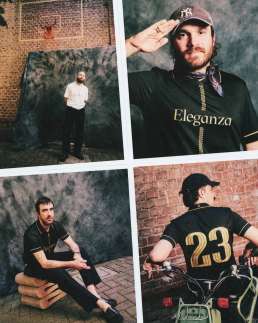
Alberto Panocchi
Favorite team and player.
Milan and ‘Sheva’, the second Milan shirt of my life: it was counterfeit and had the number 32. It was given to me before they confirmed number 7.
Favorite brand and creative person.
Levi’s. I like iconic brands with real stories behind them. Virgil Abloh, who influenced me a lot and, for a while, I followed him like a groupie. I could also add Luca Benini, the founder of Slam Jam, who really inspired me.
Eleganza.
Harmony. Things that don’t clash, with consistency. Calcetto Eleganza fits this definition: it’s made up of harmonious, balanced people. Maybe I’m the only one who’s not.
Why Calcetto Eleganza.
Because I wanted to play football with people where we can talk about everything but football. When the project started, we were almost all creative people who had recently got to Milan. We had different stories and backgrounds and so much to share. Today, I’m proud to see the personal paths we’ve taken during these years. And I’m equally proud to see how much the community has grown.
The number 10.
There are different interpretations of this number. I feel like a 10 off the field: the 10 that turns the night around, that gets things going. 10 also makes me think of aging, or better, maturing. Over the years, we’ve accomplished a lot but I’ve also got some obvious regrets. We could have seized on more opportunities, but I’m aware that, for better or worse, all of us get caught up in the work and dynamics of Milan. That said, I’m proud that we’re there, and we’re recognized. My wish, for the future, is that Calcetto Eleganza does get taken for granted.
In your life, on the pitch.
My job description says Experience Manager, but I don’t really know how well that explains my role. Let’s just say I put things together. On the field, however, I enjoy making a save more than scoring a goal. I feel like I’m responsible for my actions between the posts.
The locker room.
First there’s the locker room, then the field and the results. Victory is a consequence of collaboration, the camaraderie you build with your teammates. Let me give an example that means a lot to me: the regional junior championship I won with Montecosaro, a small team from the Marche region. We weren’t the strongest, but we went out every day together, there was this magical chemistry. I saw the same thing in Pioli’s Milan, in a different proportion, obviously.
The Eleganza jerseys.
I imagine them all together in a team photo. The work in gold and black definitely creates that Eleganza effect. And then there’s the satisfaction of making it by ourselves. Of making our second skin.


Chuck George
Favorite team and player.
New York Red Bulls. No favorite player.
Favorite brand and creative person.
Studio Nicholson or Supreme, but I prefer vintage. Songwriter Sturgill Simpson.
Eleganza.
I can only say one word, Eleganza. Molta Eleganza. Bellissima Eleganza (with American pronunciation ed).
Why Calcetto Eleganza.
We met through a collaboration. We showed World Cup matches in my restaurant and created a special T-shirt. The concept behind that design was the power of the Beautiful Game and the fact that it is an eternal ‘childhood’ love. I have always played baseball, and on a sociocultural level, football plays the same role here. That’s why I’m fascinated by it.
The number 10.
It’s still youth. Only the beginning.
In your life, on the pitch.
I own Chuck’s restaurant; we’re in Milan, Rome, Paris, and soon in London. My role in Calcetto Eleganza is community builder and foreign friend.
The locker room.
I play the fool; I love to prank everyone and rile them up.
The Eleganza jerseys.
One more word, Eleganza (again with US pronunciation ed). The white, the black, the gold, the pinstripes. They remind me of Yankees jerseys.

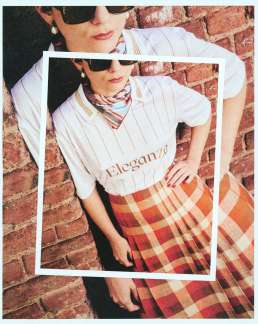
Elisa Carassai
Favorite team and player.
When I was growing up, my mother would do the blood tests for Juve, so I’m a fan of the Del Piero golden era.
Favorite brand and creative person.
Simon Rocha. Donna Tartt or Ann Carson.
Eleganza.
Creating a community through friendship and shared passions.
Why Calcetto Eleganza.
They ended up in my life by accident during the lockdown. Then we started hanging out together. So, it started as a friendship, and only later we came up with different ways to collaborate, both editorially and musically.
The number 10.
It makes me think of a milestone, of building an important community that can reach across different areas. It’s 10 years of international connections, of building a network of creative people around the world. From Milan, Athens, London, Paris and Stockholm…. It’s really great that, through sports, we can also celebrate so much more.
In your life, on the pitch.
I run an independent magazine called Sali e Tabacchi Journal. I founded it a few years ago in London while studying. This project brought me back home, to Milan, where I’m also doing editorial and strategy consulting for fashion brands. Eleganza allows me to develop creative endeavors, like music projects for Radio Raheem and Radio Bandalarga, and create cultural and community activities. The idea is to maneuver around sports and creativity in a common field.
The locker room.
I feel like I’m the connector. I really enjoy connecting people and making real connections.
The Eleganza jerseys.
Eleganza is in the colors and, of course, the way you wear them, as well as personal styling.


Davide Coppo
Favorite team and player.
Milan and Andriy Shevchenko.
Favorite brand and creative person.
Everything Massimo Osti has done. Winfried Sebald.
Eleganza.
Attention to detail.
Why Football Eleganza.
When I first met the guys, I liked the idea of using football as a vehicle to create community, to bring people together around a field, a table, or a screen,. Over the years, I’ve really met so many people.
The number 10.
It’s creativity, of course. And it’s a long time, 10 years. Years where we’ve remained friends. Years where everything has moved faster and faster, but the Eleganza project continues on its path. It makes me think of slowness in a good way.
In your life, on the pitch.
I’m a writer, and I reflect on the pitch; I’m always thinking. And the goalkeeper also has too much time to think….
The locker room.
I like it a lot. It has always allowed me to see the positive sides of people, and even the positive sides of negative aspects.
The Eleganza jerseys.
They follow a typical Eleganza feature: the desire to bring non-football patterns and designs into football. In this case, there is also the courage of making them black and white, and the responsibility of having self-produced them.


Xheni Ballin
Favorite team and player.
I play, but I don’t watch football. You guys can choose the coolest female soccer player and team for me.
Favorite brand and creative person.
Maison Margela and Emilia Nardi, a friend of mine. Egon Schiele.
Eleganza.
In football, it’s verbal and non-verbal communication. Here, it lies simply in the phrase ‘cool as fuck.’
Why Calcetto Eleganza.
I discovered it through a friend. I’m not from Milan and I used to play soccer in America, so it was nice to meet such a community. Even though I only knew one person, I immediately felt part of the team.
The number 10.
When something is around for 10 years, it is here to stay. If you survive that long, nothing can stop you.
In your life, on the pitch.
I’m a photographer and writer and about to publish my Intense Magazine project. I also work in digital marketing. I think all our professions and passions are reflected on the field; it’s like everyone here has an artistic streak.
The locker room.
I’m the DJ, I put on the music.
The Eleganza jerseys.
Eleganza is in the gold details and lettering; they are perfect for a 10th anniversary.


Maximiliano Nicolas Ruiz
Favorite team and player.
Fc Internazionale. Since I was born in Buenos Aires, it would be obvious to say Diego Armando Maradona, so I’ll say Enzo Francescoli.
Favorite brand and creative person.
Acne Studios. Donald Judd.
Eleganza.
It lies in the phrase ‘power is nothing without control’ (laughs ed.).
Why Calcetto Eleganza.
As friends we played together. We just happened to all be a part of the creative universe. Creative people often say football is uninteresting; for us it was different. On Sundays we watched the games. It’s been a shared passion that brought about everything else.
The number 10.
I played professional football until I was 23. So, the 10 has been part of my imagination since childhood. I would go to bed at night hoping to wear that number, and score. It is symbolic; it expresses so much. The other feeling is that we’re getting older, but I’m glad that so many friends are carrying on and passing on that vision of football: of playing on Saturday mornings, of being 60 years old and still kicking around a football… sheer beauty.
In your life, on the court.
I am founder of A Wolves Agency, a production and communications agency that also works in football. On the field, I’m commanding, always looking for the ball and to be right, but in an honest way.
The locker room.
When I was young, I was always on the sidelines, I needed my own space. Growing up, it became the same when I’m with a group.
The Eleganza jerseys.
The black and gold are classic, timeless Eleganza. The collar makes me think of football that’s a bit more intellectual.


Tommaso Naccari
Favorite team and player.
Inter, though my dad’s a Milanista and my mother’s a Genoan, or better, anti-Sampdorian. Ronaldo ‘the Phenomeno’, my first sticker. A name from today, Denzel Dumfries.
Favorite brand and creative person.
Stüssy. Eric André.
Eleganza.
It is what gravitates around football, from the idea of community to style to all the talismans that populate this sporting universe. Eleganza means erasing football objectivity.
Why Calcetto Eleganza.
I’m a pretty bad footballer, so I’m the one who should be asking the others…. Jokes aside, Eleganza is developed on the pitch, but there’s a lot more going on besides that. All kinds of approaches to football are interesting to me.
The number 10.
Although I hate to be nostalgic, I think of Baggio. Then, I get envious because 10 is the apotheosis of being able to play football: something I can’t do very well. Finally, it’s the goal of a project I have been part of for more than half its life. I’ve seen it change, open to other sports and evolve. It is nice that there are things like this that have ‘excuses’ to bring people together.
In your life, on the pitch.
I tend to write, even if it sounds pompous. I hope I’m better at writing than playing on the field. My contact point is in the confusion; it’s working and playing in controlled chaos.
The locker room.
I’m the joker, no doubt. I love to laugh at and with myself.
The Eleganza jerseys.
The idea that a football jersey can be primarily a garment is what defines Calcetto Eleganza. The 10th anniversary jerseys are the perfect example of this concept. I also like that the word Eleganza takes the main sponsor’s position.

It's a European story, it's an athletics story
Thanks to KARHU we have traveled through the history of the European Athletics Championships, and we’ll keep doing it in Rome
The European Athletics Championships are just around the corner. Thanks to the event’s official supplier for technical equipment KARHU, we’ve portrayed the history of the continent’s most important athletic stage.
From the ‘Flying Finns’ to Emil Zátopek. The JOIN THE CHAMPS series allowed us to relive apex moments and endless legends. Because the European tartan has never stopped celebrating some of the brightest personalities of world athletics. And it continues to do so. As we await the first “on your marks” of the upcoming Roman edition, we tell you about the nuances of an athlete, or rather a symbol: Emil Zátopek. The Czechoslovakian middle-distance runner and marathoner nicknamed ‘Locomotive,’ the man who could overcome the limits of his own body and the parameters of athletics itself. The runner who, quite simply, is still one of the most revered icons in sports history. His achievements and words lead us to Rome 2024.
You can find more articles from the JOIN THE CHAMPS series here, and in the coming days you can follow our day-by-day digital updates from the Stadio Olimpico, where we’ll once again partner with KARHU.


EMIL ZÀTOPEK, THE LOCOMOTIVE WITH NO SMILE
“I’m not talented enough to run and smile at the same time.” One sentence defines the humble greatness of a unique athlete. Emil Zátopek was more than a middle-distance runner; he represented the epitome of a human being overcoming his limits and the limits of his species. They called him ‘ the Locomotive’ for his rhythmic stride, accompanied by colorful grunts and grimaces.
Born in Kopřivnice, a small town in Moravia, he discovered running by pure chance at 16 while working for a shoe company. Inspired by legends of the most light-footed Finn, the immortal Paavo Nurmi, he set out to perfect his ungainly stride, making it the most effective in the world. The irrational ascending climax of his performances were the contours of a symphony replete with fatigue and victory, culminating in an impossible treble, never to be repeated or bested. “An athlete cannot run with money in his pockets,” Zátopek stated, “He must run with hope in his heart and dreams in his head.”
And in the Finnish summer of 1952, hope, heart, dreams and head came together to shape one of the most remarkable sporting feats in history. Wearing KARHU, Emil ‘the Terrible’ dominated the Helsinki Games, winning the 5,000 and 10,000 meters, setting new Olympic records in both. But Zátopek didn’t stop there, participating last minute in the most iconic race of the five-ring event, the marathon. The representative of Czechoslovakia had never run – at least during an official race – the 42 kilometers inspired by the ancient exploits of Pheidippides.
Step by step, car by car, ‘the Locomotive’ first hooked onto the world record holder Jim Peters, holding the same pace. After a quick exchange of banter, Zátopek sped off toward his third, unexpected gold medal and his third (even more shocking) Olympic record. Peters would later recount that, passing their first 15 kilometers together, Zátopek asked how their pace was going. “Too slow,” the Briton answered in jest. So Zátopek simply sped up and never looked back.
“If you want to win something, you can run the 100 meters. If you want to enjoy a true experience, run a marathon.” Zátopek would later be elected Greatest Runner of All Time by popular vote. Those days of sports glory will likely remain unmatched, a legacy of extraordinary physical, mental and character might. A legacy for athletics worldwide.


ZÁTOPEK AND THE EUROPEAN ATHLETICS CHAMPIONSHIPS
The 1950 European Championships were the prelude to the most remarkable feat achieved by a runner in the history of sports. In Brussels, Emil Zátopek won the 5,000 and 10,000 meters. Only two years later, in the Helsinki Olympics, the same man won gold and broke world records in the 5,000, 10,000 meters and Marathon. He also boasts another continental success in the 10,000 meters in Bern 1954.


